Random Thoughts from a Nonlinear Mind: Volume 2: The Athena Chapters,
Chapter Fourteen:
The Mall Walker! or Six Years Gone…(working title) or Just Do It!: Reflections on my Last Concert or Notes for a TED Talk I Will Never be Invited to Give
It was like somebody laid hands on me.
Bob Dylan, Nobel Lecture 6/4/17
It’s been six years since I attended a concert. For those of you mathematically inclined, that is 72 months, 2191 days, 52,560 hours, 3,155,692 minutes, or 189,341,556 seconds, depending on how you want to express (or feel) the passage of time. Good news, though, I am finally done. This is the last essay in this volume.
I am sure that anyone who has bothered to read this far has some questions for me. I imagine some would want to know if I have reached any conclusions about this ordeal. Others might wonder if I wake up with a more enlightened view of the world and my place in it. Sigh…no, my best response would be that going to that show, and all the aftermath seem to be nothing more than a series of random events. I sense no deep meaning in any of it. I don’t feel smarter or wiser, nor do I feel defeated or disappointed. I am in my mid-50s now, and, honestly, I don’t feel much of anything.
*****
The high pitched shrill of the phone startled The Old Man. The damn thing never rang anymore. He kept paying the bill out of habit; it seemed like it would be a major hassle to shut it off. He would probably have to go someplace and stand in a long line with a bunch of other people who would rather be any place other than where they were. He didn’t need it.
The ringing finally stopped. After a decent struggle, he got up out of his chair and looked at the Caller ID. He squinted hard to bring the tiny screen into focus. As he turned his head slightly to the left, he realized it was not a number he recognized.
“Alexa, it appears we have a mystery.”
“Sorry I don’t know that.”
“Of course, you don’t.”
His keyboard reacted sluggishly as he punched the unknown number into the search bar. These batteries are about to go. He reached into the top drawer of his desk. He pulled out two new AAA batteries, turned the keyboard over, and replaced the old cells. He moved the mouse around the screen; the tracking seemed fine. Those batteries could wait.
The results quickly populated the screen. It looked like he would have to pay to find out who owned the number that just called him. He was about to try a deeper search, the kind that a proper and true computer guy would know about when he noticed that his phone console was blinking. Whoever called had left him a message.
“Alexa, play Mozart.”
He immediately recognized The Dissonance Quartet. He leaned back and closed his eyes, his index fingers conducting the fictional orchestra. A popular thought crept in: Biggest cosmic ripoff in the history of bipeds. I will never understand why we had to lose him so young. It doesn’t make any sense, no reason at all that needed to happen.
“Alexa, turn it down.”
He was ready; at least he thought he was—deep breath, nice and slow. You control your breathing; it does not control you. In his experience, it was rarely good news when a mysterious number left a message. He leaned forward, hit the PLAY button, and hoped for the best.
“Buford Lister. My gosh! I can’t believe it, I have finally found you. My name is Jesus Masterson. You knew my father, Ken. I am calling because I have been charged with trying to convince you to give a TED Talk. I just wanted to gauge your interest. Call me back if you like. We would really enjoy having you.”
Well, now, that was unexpected. He took a long swig of his warm beer as his thoughts roamed. Ken Masterson, that name brings back some long-buried memories. Buford Lister ejected a small black jump drive from his home-built desktop computer and twirled it around his fingers as kids do now with their fidget spinners. He sat in silence as Mozart softly filled the room.
“Alexa, turn it up.”
AUTHOR’S NOTE: Mozart is the correct choice for most any old man in a contemplative mood, especially one faced with an interesting and unexpected decision. The problem here is that the last time Buford Lister gave a big talk, an important talk, it radically changed his life’s trajectory, taking him in an unexpected and unwelcome direction.
Man, I did not see this coming. Do I really need this? I need to put on my thinking shoes. C’mon, let’s go. C’mon now. A combination of rocking and elbow pressure got him to his feet.
He always tried to count the number of pops and cracks he would get from his ravaged knees as he stood up. This count was four, three from the right knee, and a single pop from the left. He unsuccessfully tried to straighten his back as he walked to one of his bookcases, his left knee clicking with each step.
“Ken Masterson,” he said aloud to no one. “I have not heard that name for a very, very long time. That is about the last thing I expected…”
He reached the wall and ran his hand across the second shelf of the fourth bookcase from his library window. He pulled out a worn copy of The Structure of Scientific Revolutions by Thomas Kuhn. The pages were severely battered, barely holding on to the overworked binding. He placed the book down on the edge of the shelf. It was the Calculus book next to Kuhn that had his interest. He opened the large book to the back, to the hollowed-out hole where he kept his life’s work. He placed the jump drive in the book and pushed it back into its space. He looked over the Kuhn book and decided it was not going to fall apart if he put it back. As he gave the binding one last look, the thought occurred to him that he should keep that drive in something fireproof. Well-hidden means nothing in case of a fire.
*****
My dentist’s office is an interesting place, not that I am overly fond of my time spent there. For reasons unclear to me, the older I get, the more I dislike sitting in that chair. Fortunately, the last few visits have been quick ones.
Once your appointment is over, all patients are escorted to the front desk. After they walked me out a couple of times, it dawned on me that they were doing this not because they thought I was too stupid to find my way; they were doing it so that I wouldn’t run out the front door without paying. I asked them if people had, in the past, sprinted to the doors instead of going to the front desk. They said they escort everyone for a reason. It is not a daily occurrence, but it does happen with some regularity.
After mentioning to my dentist that I was writing about my experience at his office, he told me that he had one guy pull his own tooth and then run out the front door. He got the guy numbed up and told him he would be back as soon as the anesthetic did its job. When the dentist returned, he realized that the guy had taken one of the dental instruments and yanked it himself. Of course, he was nowhere to be found. I guess this guy was too worldly for whiskey and pliers. Somewhere, anonymously walking the streets of my town, is a true sophisticate.
A couple of years ago, after being escorted to the register, I nabbed an oversized novelty tooth from that same front desk. I doubt I did anything criminal; they were sitting out in a big basket, next to the ink pens and calendars. The implication was that as long as I paid my bill, I was welcome to them. When I picked one up, I realized it was foam. It was a stress tooth, closely related to its cousin, the ubiquitous stress ball. As I examined it, I had no idea that I was eventually going to wear it down to the nub. That is why I took a second one on my next visit. That one is also showing some unusual wear patterns.
*****
“Alexa, should I give a TED talk?”
“I do not understand the question.”
“Of course, you don’t understand the question. Neither do I. Alexa, add this to the long list of things I do not understand.”
“Sorry, I do not know that.”
Buford Lister sat back down in front of his computer. He took a deep, dramatic breath and then typed “Ken Masterson Mathematician” into Google’s search bar. He leaned back and took a long draw from his beer as he looked over the results. Don’t do it. I’m serious, don’t do it. Why are you doing this? I am telling you one last time not to do this. Put the damn blinders on and look forward; there is nothing worth remembering back there. Let the past remain dead; dig it up at your own expense. He struggled with himself, his brain thinking one thing and his hand doing another as his mouse moved to the top of the screen. That annoying little internal voice (the one he simultaneously hated and owed a lot to) kept telling him not to click the IMAGES tab. He clicked the IMAGES tab.
He immediately saw two pictures of large groups of mathematicians and physicists, the photos being decades on top of decades old. He tried not to smile as the memories overcame him. There it is, my God…we were so young. There I am, long before the universe saddled up and did its worst to me. He brought his forearm to his eyes and rubbed.
“Alexa, what would I tell him if I could go back in time and say just one thing?”
“I do not understand the question.”
“Yeah, I know.”
He clicked on the “ALL” tab and looked for Ken’s Wiki page. It can’t be that long ago, can it? He has been dead for over 15 years. How is that possible? I don’t know where that time went.
Buford Lister grabbed another beer from the cooler he had stashed by his computer desk. He placed it on a coaster that read “BEER” and pulled himself up. He walked down the hall to the 16 stairs that lead to his laundry room, counting each step quietly as he descended. There he would find the delivery he had received weeks ago from Amazon. Curiosity, his reckless emotion, that attribute of his personality that had fueled his young ambition, had finally gotten the best of him. He ripped open the package, quickly examined its contents, and then took the thick, hardcover book back upstairs.
*****
I mentioned in a previous essay that the struggles I have with running have all been about how far to run, not whether or not to run. As the Nike slogan goes, I just do it. I put on my clothes and go. It’s what happens once I get out there; that’s an issue.
I am sure most everyone reading this essay will have no idea who Alberto Salazar is. In the 70s and 80s, he was one of the best distance runners in the world. I am mentioning Salazar because he and I have one thing in common, our running gaits. We all naturally have an identifiable way we walk and run. Do you have people you can identify just by the way they walk or run? I certainly do. Gaits are distinctive, both when walking and when running.
Salazar’s gait became famous. It was known as The Salazar Shuffle. He did not have a lot of leg kick, and his feet were never very far off the ground. It was, not surprisingly, more of a shuffle (well…duh!) than a world-class running gait. Why is this important? When I was a college runner in the 80s, some people thought of Salazar when they saw me run. Was it because of my blazing speed? No, it was because my natural running gait is also a shuffle. The next logical question to ask is: OK, so why is that important? What could my running gait have to do with anything? Sigh…
Many months ago, I went for my daily run. I was tired as I put my stuff on. It never occurred to me that I was too tired to run. Just do it! Don’t think about it or philosophize about it. Don’t rationalize or make excuses; just lace up the shoes and go. As always, that was my thought process.
I am always cautious when I run. I don’t run on ice, and I am always sure that my shoes have good soles. I spend lots of money on shoes. Worn running shoes are opportunistic, always peaking ahead for any chance to induce a disaster. I was as careful as usual on a Friday in late October. Unfortunately, I face planted on the asphalt. I don’t know how it happened; one moment I was upright, and the next I was on the ground. I am pretty sure the fact that I don’t lift my feet very high had a lot to do with the fall.
As soon as I fell, I knew I was in trouble. I was the only person at the cemetery, so I wasn’t going to get any help. After sitting on the road and contemplating my fate for a minute or two, I managed to get myself back to my truck and to the hospital. What I didn’t know was that the fall started a Rube Goldberg series of events that could have easily killed me.
*****
Buford Lister sat straight and tall in his chair as he looked over the cover of The Lister Affair, the book that had been in his laundry room for a week or two.
“Maybe this wasn’t such a good idea. Maybe I should stop talking to myself. Maybe, maybe, maybe. Lots of maybes…”
Buford Lister unlocked the handle on the side of his chair, the one that kept him in the upright position. He leaned way back and started looking for patterns on the ceiling. All the little bumps of paint seemed random enough, nothing noteworthy up there. As he looked closer, he imagined a series of light and dark squares populating the section of the ceiling that had caught his interest. “Galileo, now that dude was a stone-cold genius,” he said as he examined the phantom checkerboard. “All right, enough. The ratios of Galileo can wait.” Even though he told himself to stop, his thoughts roamed back to a time, long ago, when he was learning about perfect squares and their relationship to odd numbers. As always, he couldn’t keep his memories focused on the numbers; Susan, The Plumber, and other random figures always insisted on showing up. He violently shook his head. “Dammit, Stop it!” he screamed at himself. The long draw of warm beer went down smoothly.
He knew that the most interesting thing, the most important thing, was sitting on his desk in front of him. He finally mustered the courage to open the book to the index. There was only one name he was going to look for. If she is in there, I am going to find Bruno and…
*****
My elbow now has three plates, three screws, and seven pins in it, if I am counting correctly. They were inserted during the seventh game of the World Series. There they will remain. I wish that were the end of the story, but it is not.
As you might imagine, after my surgery, I was given a basket full of medicine. This one for nerve pain, that one for general pain, this one to sleep, and on and on and on. I was also prescribed a coated aspirin, which I took on schedule.
Oddly enough, I never felt much pain from the injury. I was the most uncomfortable when the x-rays were taken at the emergency room. That really hurt. The worst of it was when I was trying to get some sleep. That part did not work out very well for me.
*****
Buford Lister indeed started at the back of the book. He recognized most of the names, almost all of them. Who is this guy? I don’t remember him. Maybe he is just some guy, a so-called expert, commenting on some aspect of this debacle. A scholar versed in the art of second-hand scholarship, that must be it. Some jerk who has never met me thinks it is OK to tell the world what happened all those years ago. Why would anyone care what someone like that has to say about this?
He flipped the pages back one by one, his finger running the length of the print at each turn. He steadied himself, took a long pause, and then turned the page. There appeared to be four or five inches of entries for Lister, Susan. He picked up the book and threw it across the room.
“Alexa, why did I do that? I knew it was the wrong thing to do, and I did it anyway.”
“I do not understand the question.”
“I know.”
*****
A few months after my fall, I was working in a large field about 20 miles south of my home. I started breathing very fast, then faster, and faster. I dropped to my knees. I wasn’t in any pain; I was more confused than anything. Luckily I was not alone; I usually am. I made it to the Emergency Room.
I learned that the nurses in the ER do not hesitate when a man my age tells them he is having trouble breathing. They immediately brought me back to a room and hooked me up to all kinds of equipment. The Doctor in charge came in and told me they were going to take some blood, which they did. After a short period of time, he came back in and told me that if I was a religious man, it was time for me to start praying. He had called a helicopter to get me and bring me to the city. It was easy to tell he was deeply concerned about what was happening to me.
I had tested positive for a heart attack and, in his words, “very positive” for pulmonary embolisms. While I believed that my lungs were full of clots, I did not believe the heart attack part. On my way to the hospital, I had texted a couple of nurses who told me that my symptoms made them think I had a blood clot. As it goes, this is what happened. A clot had formed in my right arm, at the site of my elbow surgery, and traveled to my heart. There it was shredded up into dozens upon dozens of “submassive” clots that filled my lungs—all in all, not a happy experience.
Clearly, a blood clot to the heart is serious business. People die when that happens. I was lucky, being a life long runner helped, but luck also played a major role. I ended up spending five days in the cardiac unit of a major hospital. There my transformation (my Kafkaesque metamorphosis) took place; I was wheeled in on a gurney, and I left as The Mall Walker!
*****
“Alright Alexa, I am going to call Jesus and work out all the details. I think I might have to do it. It might be a good idea to give a TED Talk. Alexa, what do you think about that?”
“Sorry, I do not understand the question.”
Buford Lister called Jesus Masterson and had a quick conversation. He told Masterson to email him the details. He would email back any questions.
“What to talk about, except for the obvious? What would I want to tell the world if I had one chance to do it?” He had been living alone for so long that he let the pregnant pause linger an unnaturally long time. “I don’t know; maybe I shouldn’t do this. That would be the safe thing and most probably the right thing.”
*****
I am a Mall Walker…a stone-cold striding hunk of man. If I don’t already, I will soon own the mall. People are getting to know me; they wave and smile. I am in the club; it is just a matter of time until I run the meetings.
If you happen to be in the mall and you see a guy walking for two hours every day, that is me. If there are multiple such people (not likely), I will be the guy squeezing the large foam tooth with his right hand. Oh yeah, I am right-handed, so I have not been able to shave, I am still having trouble bending my arm that far. Consequently, I have a large white beard that I am anxious to lose. I look old enough without the beard.
*****
JM,
OK, I’ll do it but only on the condition that there are no restrictions placed on me. I am talking time, content, and anything else I can think of. Let me know.
BL
Five minutes after Buford Lister hit Send, he received the following message.
BL,
It is your show. Do whatever you like. We are your humble servants.
JM
*****
I saw a guy, a fellow Mall Walker, today. He gave me a subtle head gesture. The nod he gave me was the same type that Wayne Gretzky would give Larry Bird if they saw each other from 10 yards away in an airport. The nod says all that needs to be said…
Halfway through my walk, another guy appeared. He took off his winter coat to reveal a fluorescent green windbreaker, the kind of garment that lets the other Mall Walkers know he means business. Without saying a word, the jacket screamed, “C’mon, try your best to catch me. Bring it, give me all you’ve got.” I half expected the back to have stitching, which read, “If you can read this, you are my BITCH.” Even though I was one hour in, one hour tired, I buried him. When we later crossed paths I didn’t bother to nod, I just lowered my head and let my dust do the talking.
*****
“Ladies and gentleman, our next speaker had a book written about his exploits as a young student at Harvard University. I am sure most of you have already read The Lister Affair.” The applause was loud and long. The Master of Ceremonies, a blubbering dean from Reederstock University, had the good sense to table the rest of his introduction. It was clear that the audience was ready. “Here he is, mathematician, scientist, one of the best poker players the world has ever seen… Buford Lister.”
The audience stood as an old man in worn jeans, and a faded black long sleeve t-shirt made his way across the stage.
“Hello, my name is Buford Lister. Why am I here? Why are all of you sitting where you are? Why are there cameras all around this stage?”
“The easy answer is because I really screwed something up when I was a kid. I missed the simple fact that a 1 should have been a -1 in a paper I wrote. Man, did that little oversight cause lots of problems.”
Author’s Note: There was lots of laughter when this happened—more laughter than applause. The audience was composed of brilliant people, academic types mostly. If all of them hadn’t read The Lister Affair, they indeed were familiar with the story the book told. As Buford Lister rubbed his eyes, the audience once again stood.
“I am supposed to give a talk about overcoming magnificent failure, at least that is what I guess all of you are expecting. I bet you all think that I am going to drone on about how we all need to stand up tall after we do something so incredibly stupid that we become famous for it. Well, I have never been one to follow directions, so I am going to talk about what I damn well please.”
Buford Lister grabbed a beer from a small desk in the middle of the stage and took a swig as he waited for the applause to die down. Initially, some suit had told him he couldn’t drink beer while giving his talk. Fine, no talk then. Another suit overruled the first suit. All the suits had to have a long meeting about this topic. They decided it was better to have Buford Lister drinking beer during his talk than to not have him at all.
“I am going to tell you a story about the third-grade version of me. I was at this remote grade school right here in Iroquois County, Ohio. We are not talking about cutting edge education, especially back then. Things were bad, but no one knew any different. At the time, I thought everyone’s teachers knew very little about anything. To me, it seemed that they all went out of their way to stifle creativity. As long as all the kids sat down and shut up, then things were fine.” Buford Lister stroked his white beard. “Obviously, this was some time ago.”
“I want to tell you about what happened one day. I remember very little about that time in my life, but I do remember this. As usual, I was sitting in my seat, minding my own damn business when the teacher told us it was time to tell the rest of the class what we knew about the evaporation cycle. Well, to me, it was all trivial. Rain comes down, the sun’s heat causes some of it to evaporate. What’s the big deal? Buford Lister took his glasses off and started shaking his head. A smile tried to creep through but ran out of momentum. The teacher had the first three students get up and explain the evaporation cycle. The first kid, a girl named Michelle, gave her little talk, and then she did something that stunned me. She stood there and said, “And here is my illustration.” She held up a little picture she had drawn.”
“I was stunned. I had no idea what an illustration was! I was unfamiliar with the word. It was not then part of my now extensive and erudite lexicon. As a little aside, I thought erudite started with an “a” so it took me a long time to find it in the dictionary. Now, that reminds me of another little story. When I was in sixth grade my teacher got very angry with me. I went up to her and asked her how you spell some word. She told me to look it up. In my most serious voice, I asked her how was I supposed to look it up if I didn’t know how to spell it? I was totally serious. She was unimpressed. So, instead of engaging me in a discussion about how I might find the word, she told me to sit down and shut up. That is how they roll in Iroquois County, Ohio.”
“So, back to my third-grade dilemma. I was in deep trouble. My teacher was sending up students in groups of three. I was in the next group. I had just learned what an illustration was, and I needed one in about a minute. I wish I was known for this and not the other thing…”
Buford Lister walked over to his computer that was hooked to a very large screen. He looked out over the audience. So, this is what I did.
“I walked up to the front of the class. I calmly explained what I knew of the evaporation cycle. Then I announced, Here is my illustration. That is the sun with a straw.”
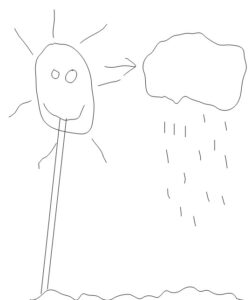
“As I recall, I was the hit of the presentations. Everyone, including my teacher, laughed. A few kids applauded.”
“In conclusion, no matter what happens to you in your life, no matter the bad things that happen, whether they are your fault or not, there is deep within each of us, a third-grader than can conjure up an illustration when we need it most. Those issues do not define you just as they do not define me. I prefer to think back to the third-grade version of the man you are looking at now.”
*****
I had a doctor’s appointment the other day. He told me that the clots are gone and that I can start running again. That is precisely what I am going to do.
Imagine the confusion at the mall. The streaks of charred tiles I have left behind can’t offer up their own explanation. Sure, some people will tell tales of the mysterious man who walked so fast that his feet defied the rules of space and time. Others will add to the legend in their own ways, some subtle, others not.
The truth will stand. A man recovering from a severe fall became the most accomplished mall walker in the tri-state area. He laced up his shoes, turned on his tunes, and walked two hours every day. After months of seeing a blur, a phantom, traverse the length of the structure; he disappeared as fast as he came. Few know that he was never passed, never overtook by a fresher, younger walker, no matter how tired he became.
*****
Buford Lister held his hand up to the audience to stop the applause. His shoulders slumped as he shot-gunned another beer.
“I do intend to make this talk a little longer than two or three minutes. I have to say that I thought about ending my talk after only a couple minutes but…”
It was only the people in the first couple rows who saw the tears, at least at first. They started to stand and applaud. Shortly thereafter, the other people in the auditorium looked at the large video monitors and realized what was happening. Within a short period of time, everyone was standing and clapping.
“I have never talked about this. I am sure just about everyone here knows that. The only reason I am going to talk about it now is because of that damn book, a book I never authorized, a book I would never have written myself, a book I never wanted to exist.”
He took a copy of The Lister Affair out of the desk (the same one with the beer) and dropped it into a big plastic garbage can that had been placed on the stage. The audience remained standing.
“A long time ago, I was on the cusp of doing something special. I was creating new mathematics. I was working very, very hard. My wife, Susan, couldn’t understand why I was always locked away, why I was always working. I tried my best to explain it to her, but she just wouldn’t listen. And then came the baby.”
He walked across the stage, the whole time thinking what an ass Bruno is for writing about this. It was no one else’s business, no one at all.
“Bruno never should have written about any of this. He did, I don’t like it, he dredged up a bunch of memories that I never again wanted to deal with. Suicide…I still don’t have anything to say about it. I don’t understand it; I don’t like it, I wish it weren’t an option for anyone.“
What do I say now? Will this be some kind of catharsis if I keep talking? Bruno already laid it all out, so I guess I keep on going.
“I was away at the conference, you all know the one. Probably the most famous gathering of scholars in the last 100 years, I guess. It was there that The Yeti stood up and changed my life forever. It doesn’t matter how it happened, how the mistake was made. None of that matters. I don’t have a time machine; I tried, I can’t make one, such a thing is beyond my capabilities.”
“I was destroyed when I came back to Cambridge from that conference. Everything I ever wanted was gone for good. You get one chance to lose your reputation. Just one. There are no do-overs. Susan didn’t understand any of this. As soon as I got home, she started fighting with me. She said she needed more help even though her mom had flown out to assist with the baby. Susan was very unhappy, and she didn’t care what had happened to me out west. She wasn’t even willing to listen.”
“Back then, and this was a long time ago, not much was understood about postpartum depression. I certainly didn’t know anything about it. I know a lot more now, but there is still so much that we, as a species, do not understand”.
“I was home for only a few hours when I had to go for a run. The baby was sleeping, and I knew I was going to get some time with her when I got back from my run. I told Susan I would see her in a bit, and I headed out the door. I heard her screaming at me as it shut.”
“I ran for around 90 minutes or so. When I got home, I saw my daughter sleeping in her playpen in the living room. This seemed unusual to me; she was usually in her room. I checked on her and then went to take a shower. That is when I found her. Susan had shot herself in the head while sitting in the bathtub. It was clear that she was gone. There wasn’t a thing I could do for her. I called the police and waited on the couch.”
“We had a gun cabinet. Susan’s father gave it to us. He wanted me to protect his daughter from the evils of the big city. I had taken and hidden the key shortly after my daughter was born, but when the police came, they checked the cabinet, and it was not locked. I told them I had no idea how that could have happened. The police left. Susan left in a body bag. I stayed home that night with my daughter and Susan’s mom. Where was she when Susan decided to shoot herself? She went into town to do a little shopping.”
“Up to that point, that was the darkest time in my life. I had lost a career, what I and everyone else around me thought was going to be a big one, an important one, a groundbreaking one. A couple of days later, my wife killed herself. I went to a very dark place. I immediately knew that my daughter needed to go with her grandma and grandpa, Susan’s parents. They wanted her, and my daughter certainly needed them. I was in no position to take care of her.”
“You may be wondering why I have not said my daughter’s name. I have done a good job of hiding her. She went off with Susan’s parents and lived a fantastic and wonderful life until…”
Buford Lister sat down at the desk in the center of the stage. He pushed his glasses up his nose and started to speak.
“My daughter became famous all on her own. She ended up spending a lot of time in France, where she modeled professionally. And then came the band, the music, the genius pouring out of her in every direction. The fame? She dealt with it well. She understood what was going on. She got it. And then she got married and had a daughter. Everything was great. She was thriving until she had her second daughter. On the day that baby was born, my daughter, my beautiful genius daughter, shot herself in the head.”
The audience audibly gasped in unison. After the gasp, there was nothing but silence.
“I don’t know what to say. I have seen my fair share of tragedy. More than most, I guess. I imagine everyone here is wondering about my relationship with my deceased daughter. We talked, but not a lot. We emailed, but not a lot. I felt so guilty about Susan’s death, and she, of course, blamed me for it. Susan’s parents raised her, and I don’t think they ever had a good thing to say about me. They always blamed me for not making sure the gun cabinet was locked. They couldn’t understand how Susan got it open. I don’t really have very much good to say for myself.”
“I really wish Bruno hadn’t written that damn book. I wouldn’t be up here reliving memories that need to stay buried. He had no business writing what he did. I have no idea what motivated him; I guess he is probably brain dead and can’t do the math anymore. Lots of people in his position write books for the popular market once they have lost their mental powers. I just wish he hadn’t done it at my expense.”
*****
At some point, I stopped writing these essays for one particular person. When I realized there were no magic words that would convince Athena to eat lunch with me, I started writing the essays for my niece and nephews. As I write this, they are far too young to understand what I am talking about (none of them are in high school yet), but it is my hope that in a few decades, some of this may resonate with them. Perhaps it is more likely that they won’t fully appreciate what I have written until I am long gone. That said, I thought it would be fitting to end the volume with a letter to them.
Three Dudes and a Chick,
Almost everything in this book is true, except for the things that obviously aren’t. I really did go to a concert, and while standing against a wall drinking a beer, I saw Athena. I did go up to her after her set and introduce myself. Time did indeed stop between the “I” in I’m and the “a” at the end of Athena. I am chuckling as I type because I can still feel that moment. Those Random Pulses, while increasingly shy, are still capable of inter-dimensional travel.
I have only one thing to tell you guys. It is the best I can come up with when I reflect on that night. It is probably the only thing I learned, the only real insight I have had.
As I have gotten older, I have discovered that the universe is indeed totally indifferent to me. I see no real purpose to my life other than what I make of it; the things I value are all I have to give my life meaning. I have never sensed a guide directing me according to some grand plan. I feel such a proposition is preposterous. As time passes, you will come to your own conclusions about such things.
So, what is that one thing, what is that great insight? I have noticed that many people try to convince themselves that they are in love. They will bend over backward to stay in a relationship simply because it would be too inconvenient to leave. Perhaps there are children involved, or maybe one of the people in the relationship can’t stand to be alone. I have seen lots of this. I think, in many ways, these types of behaviors speak to a central notion of what it means to be human.
My insight, though tangentially related, has nothing to do with love; it is about inspiration. You can easily fool yourself, convince yourself, that you are in love, but you will never be able to persuade yourself that you are inspired. You either are, or you aren’t. Inspiration is a funny and fickle thing. For reasons I do not understand, Athena inspired me like no one else I have ever met. I challenge you to fake something like that. Go ahead, attempt to conjure up some inspiration. Let me know how that works out for you. I’ll be waiting right here.
If you ever find yourself truly inspired, do all that you can while it lasts. I got a bunch of essays and a couple of novels out of it. That is not bad. I will say this, try not to waste the opportunity. The Muses are mercurial. I have found that they, just like the universe, are totally indifferent to me. They do not respond well to pleas. They can not be bribed. They simply do not care.
I am a little sad that this volume has come to an end. I will always wonder what I could have created if things were different. Inspiration is rare, and it appears I will never see the source of mine again. I doubt I will get another glance at The Book. I am not being greedy, but I have thought about how nice it would be if I got to peek in there whenever I wanted. I got glimpses of some astonishing things, sights, and sounds that are certainly worthy of further study.
Fortunately for everyone, I am not a poet. I much prefer longer forms to express ideas. But if, instead of an entire book, I needed a pithy description of what happened when we met, I would have to reference the epigraph of this essay. When I heard what Bob Dylan had to say about listening to Leadbelly’s Cottonfields, it resonated strongly with me. Take a look at (or better yet, a listen) to Dylan’s speech; the paragraph about Leadbelly is one I could have written about Athena. When I heard that part of his recording, I was stunned. I felt that at least one other person (other than Tom of The Plain White Ts) has an idea of what might have happened to me when she introduced herself.
So, it appears Bob Dylan and I are kindred spirits; who would have guessed that? I certainly wouldn’t have. And yes, I was more than a little surprised when he was awarded The Nobel Prize. If you had told me that a writer from the United States was going to receive The Literature Prize, I would have bet my house on Philip Roth. I didn’t see Dylan coming…not even a little.
I guess Dylan and Athena amount to about the same thing, don’t they? I never saw either one coming; I had no idea such things were even possible. In my experience, it has always been the things coming out of left field that make life worth living. I still get the biggest kick out of waking up in the morning. I know there is a chance I could write something pretty good, that I could create something inspired, or maybe, just maybe, I could get a peek in The Book.
You all know you are my favorite human beings, right?
Unky Awesome
POSTSCRIPT
And here we are, the end of this volume. It is not going to end with a great bang, but rather a slight whimper. I imagined different ways that the last chapter would end, and while this version is not the one I hoped for or preferred, it is the one I always knew was most probable.
It has been nearly nine years since I met Athena. As I sit here and type, COVID-19 is wreaking havoc throughout much of the world. My state is in lockdown. I am writing a lot.
There are still three CDs on my special shelf, her band has made more music, but I haven’t bothered to listen to it. I haven’t been to a concert; my guess is the show I have written so much about is the last one I will attend. That is just the way things are.
I have been dealing with complications from my running accident from around three and a half years ago. When I fell, I also injured my right hip. It has been bothering me a lot…until four days ago. For reasons I can not explain, my hip stopped hurting. After a year of severe limping, I can run again. I don’t understand any of this, but I am not complaining; I am going to run every day until the pain comes back. Of course, I am rooting for it to stay away; that would make my life a lot easier.
As for final thoughts on Athena, I have nothing more to say. I think I have done a pretty good job documenting that night. I sincerely hope that meeting her remains the strangest thing that has ever happened to me. I simply don’t have it in me to go through something as bizarre as this again.