The internet, for good reason, creates the illusion of placelessness. We often speak about online spaces as though geography has somehow dissolved into pure abstraction (perhaps because it has). A post is published, indexed, shared, and consumed in a domain that appears detached from physical space (because it is). Yet audiences still necessarily cluster geographically. Attention still has borders and centers.
At the same time, even relatively small blogs (and unread blogs, like mine) can develop surprisingly international footprints. A post written in Ohio may quietly reach readers in Germany, Singapore, South Africa, Peru, or Hong Kong. The resulting distribution is happily uneven but not random.
Recently, I examined the geographic distribution of my own readership data. The results revealed a familiar but fascinating structure: a dominant national core followed by a remarkably long international tail. Nearly seventy percent of my readers came from the United States, but the remaining audience is dispersed across dozens of countries spanning six continents. Astonishing. I never would have believed I could have such reach.
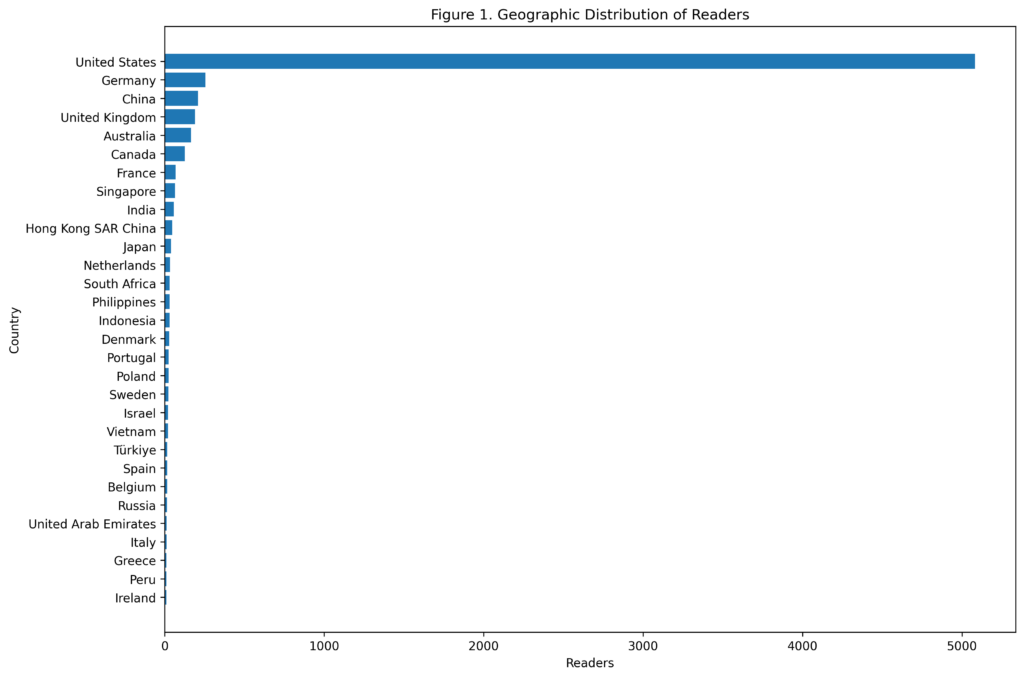
Figure 1. Geographic distribution of readership by country.
Figure 1 presents the raw audience distribution. Unsurprisingly, the United States dominates the dataset with over 5,000 readers. The next tier includes Germany, China, the United Kingdom, Australia, and Canada. Beyond that lies a progressively descending series of countries contributing smaller but still meaningful readership totals.
At first glance, the international component appears minor. This impression, however, is partly a problem of scale. Extremely large values visually compress smaller values. Once one category becomes overwhelmingly dominant, the rest begin to resemble statistical background noise even when they contain important information.
This is a common problem in data analysis. Large systems frequently obscure their own internal structure. There are ways to deal with this.
To better examine the distribution, it is useful to transform the data logarithmically.
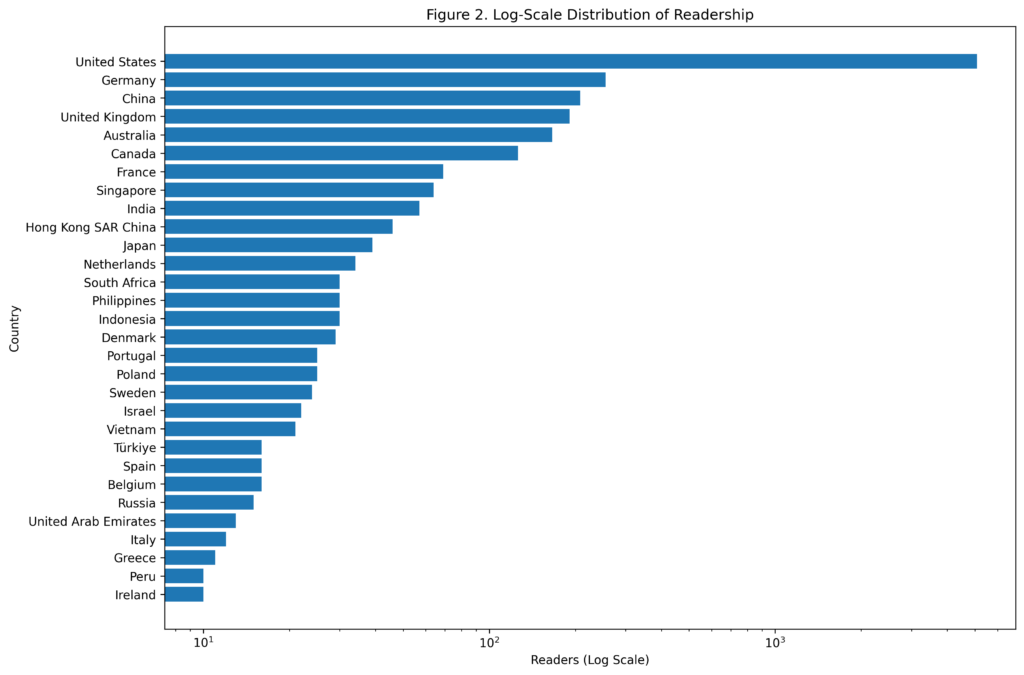
Figure 2. Geographic readership distribution displayed on a logarithmic scale.
The logarithmic transformation substantially changes the interpretation. Germany, China, the United Kingdom, Australia, and Canada now emerge as a distinct secondary layer rather than simply disappearing beneath the gravitational pull of the United States. The international audience becomes easier to conceptualize as a real structure rather than a residual category.
Interestingly, this type of distribution appears repeatedly throughout complex systems. City populations, word frequencies, citation networks, website traffic, and social media engagement patterns often exhibit similar heavy-tailed behavior. A small number of nodes dominate the system while a long sequence of progressively smaller contributors extends outward indefinitely.
The resulting geometry is neither symmetrical nor random. It reflects the cumulative effects of language, search algorithms, network diffusion, cultural proximity, and simple historical contingency.
English-language content naturally concentrates within the United States. Yet once ideas begin moving internationally, the pathways become less predictable. Germany appearing second in the distribution may reflect academic interest, search indexing patterns, algorithmic recommendation behavior, or merely the accidental accumulation of links over time. The same is true for Singapore, South Africa, or Peru. Online diffusion contains both structure and randomness simultaneously.
The cumulative distribution makes this even clearer.
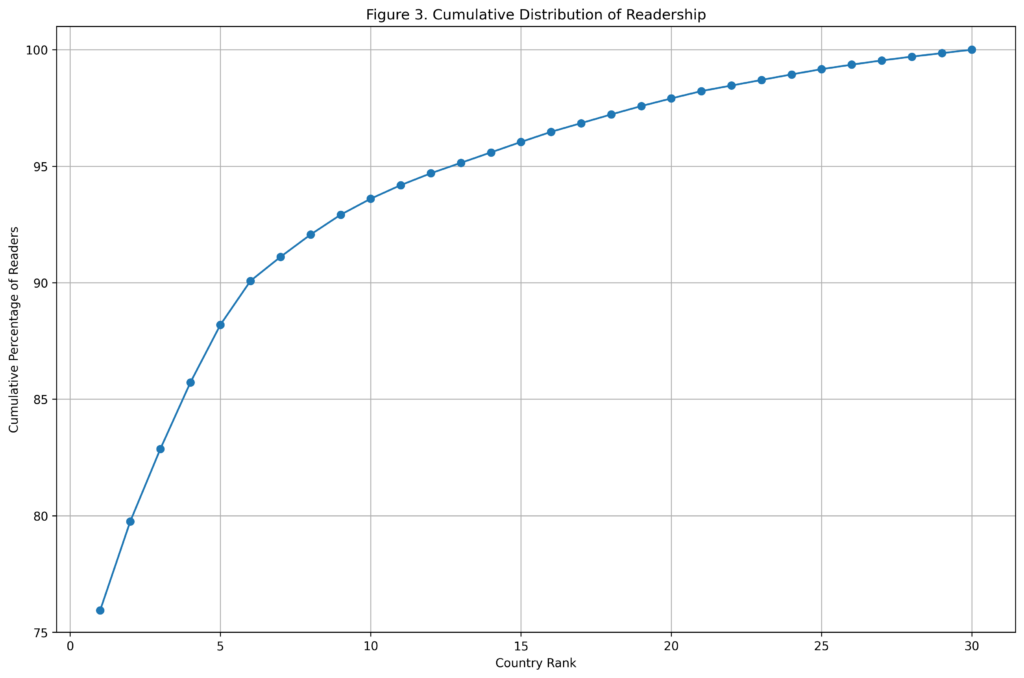
Figure 3. Cumulative readership concentration by ranked country.
Figure 3 demonstrates how quickly the audience accumulates. The United States alone accounts for nearly seventy percent of total readership. After that initial jump, however, accumulation slows dramatically. The remaining percentages require dozens of smaller national audiences contributing incrementally to the overall total.
This is the hallmark of a long-tail distribution.
The phenomenon is philosophically relevant because it reveals the coexistence of centralization and dispersion within modern information systems. Attention is highly concentrated, yet ideas still scatter globally in surprisingly diffuse ways. A relatively small intellectual project can nonetheless establish faint statistical traces across an enormous geographic landscape.
Perhaps most important, the smallest numbers matter the most conceptually. One reader in Tanzania. One in Iceland. One in Yemen.
Individually insignificant from a statistical perspective, collectively they reveal something larger about the architecture of the modern internet. Ideas no longer move outward in neat geographic circles. They scatter unevenly, unpredictably, and sometimes almost at random.
The geography of attention is neither flat nor centralized. It is as fascinating as it is nonlinear.