Catcher is the hardest offensive position to evaluate cleanly.
The physical burden is different. The playing-time patterns are different. The defensive responsibilities are different. Catchers do not simply stand in the field and wait for the next ball in play. They handle pitchers, absorb foul tips, control the running game, frame the strike zone, call pitches, manage fatigue, and carry a level of defensive responsibility that no other position quite matches.
That makes an offense-only catcher study both useful and limited. Useful because it lets us isolate hitting. Limited because it does not measure the full value of the position.
So the question here is narrow: Who was the most dominant offensive catcher of his time?
Not the greatest catcher overall. Not the best defensive catcher. Not the best all-around catcher.
The best offensive catcher.
Methodology
Using the Lahman Database, I identified catcher seasons through Appearances.csv. A player-season qualified if the player had:
At least 50 games at catcher
At least 300 plate appearances
For each qualified catcher-season, I calculated six offensive measures:
OBP
SLG
HR per PA
BB per PA
Runs per PA
RBI per PA
Each category was converted into a z-score within that season’s catcher peer group. The season score was the sum of those six z-scores.
Season Score =
OBP z + SLG z + HR/PA z + BB/PA z + R/PA z + RBI/PA z
Partial seasons were weighted by playing time, with full credit beginning at 600 plate appearances.
The purpose is to measure distance from the catcher norm. A catcher in 1932 is compared to other catchers in 1932. A catcher in 1997 is compared to other catchers in 1997. A catcher in 2025 is compared to other catchers in 2025.
The model asks a simple question: How far above ordinary catcher offense did this player stand?
Figure 1: Career Offensive Dominance
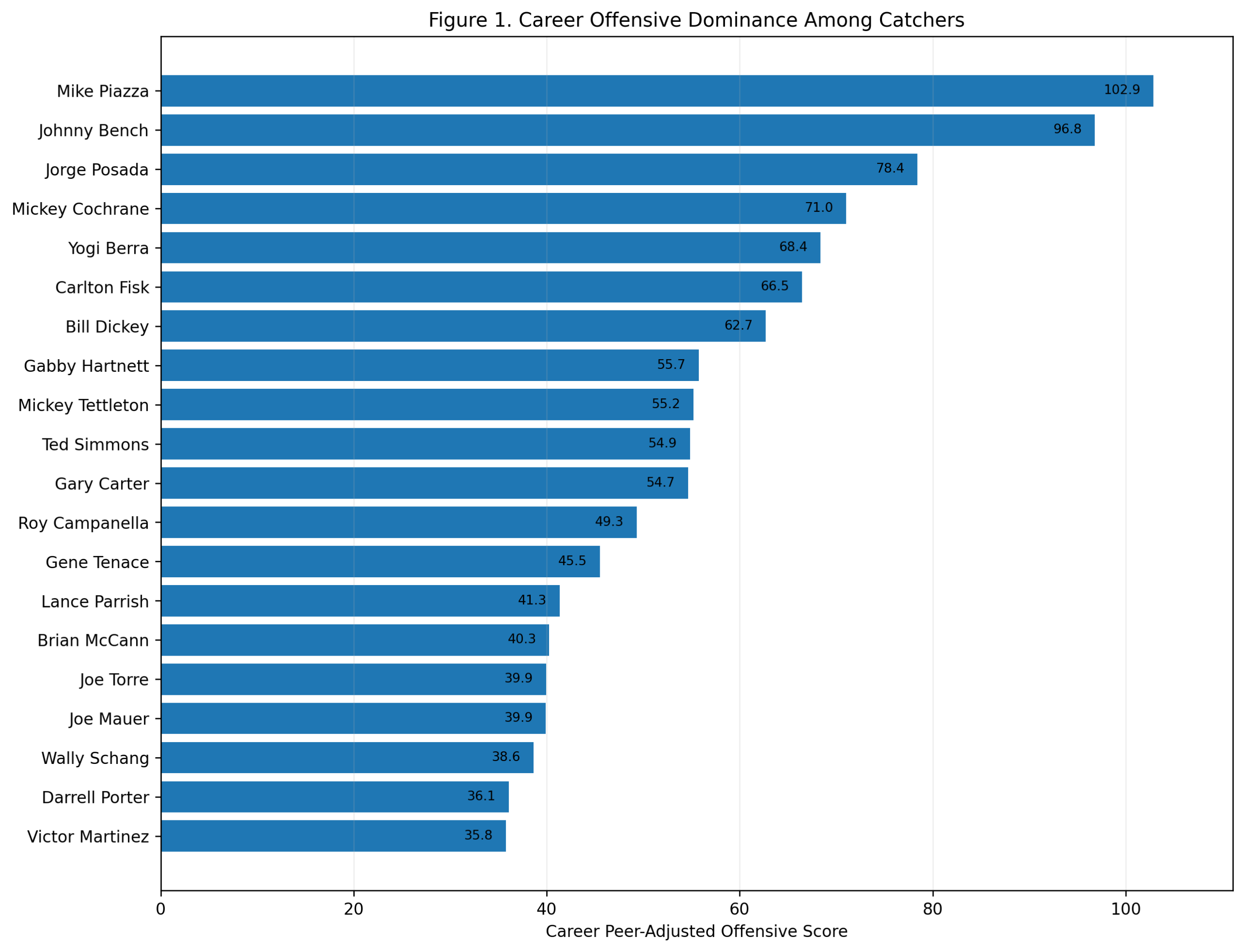
The career ranking gives us a clear, yet not overwhelming, winner.
Mike Piazza finishes first with a career peer-adjusted offensive score of 102.9. Johnny Bench is second at 96.8. Jorge Posada is third at 78.4, followed by Mickey Cochrane, Yogi Berra, Carlton Fisk, Bill Dickey, Gabby Hartnett, Mickey Tettleton, and Ted Simmons.
The top two are not surprising. Piazza has long been treated as perhaps the greatest hitting catcher ever. Bench, because of his power and overall stature, is the natural counterargument.
What is interesting is the size of the gap. Piazza wins, but he does not run away from Bench. This is not Ruth in right field. This is not Schmidt at third base. This is a real contest.
Piazza’s advantage comes from sustained offensive separation. He was consistently an exceptional hitter for a catcher. Bench was not far behind, and his all-around historical reputation remains larger because defense is outside this model.
The first major conclusion is therefore careful: Piazza wins the offense-only career argument. Bench remains the broader catcher argument.
Figure 2: Best Seven-Season Peaks
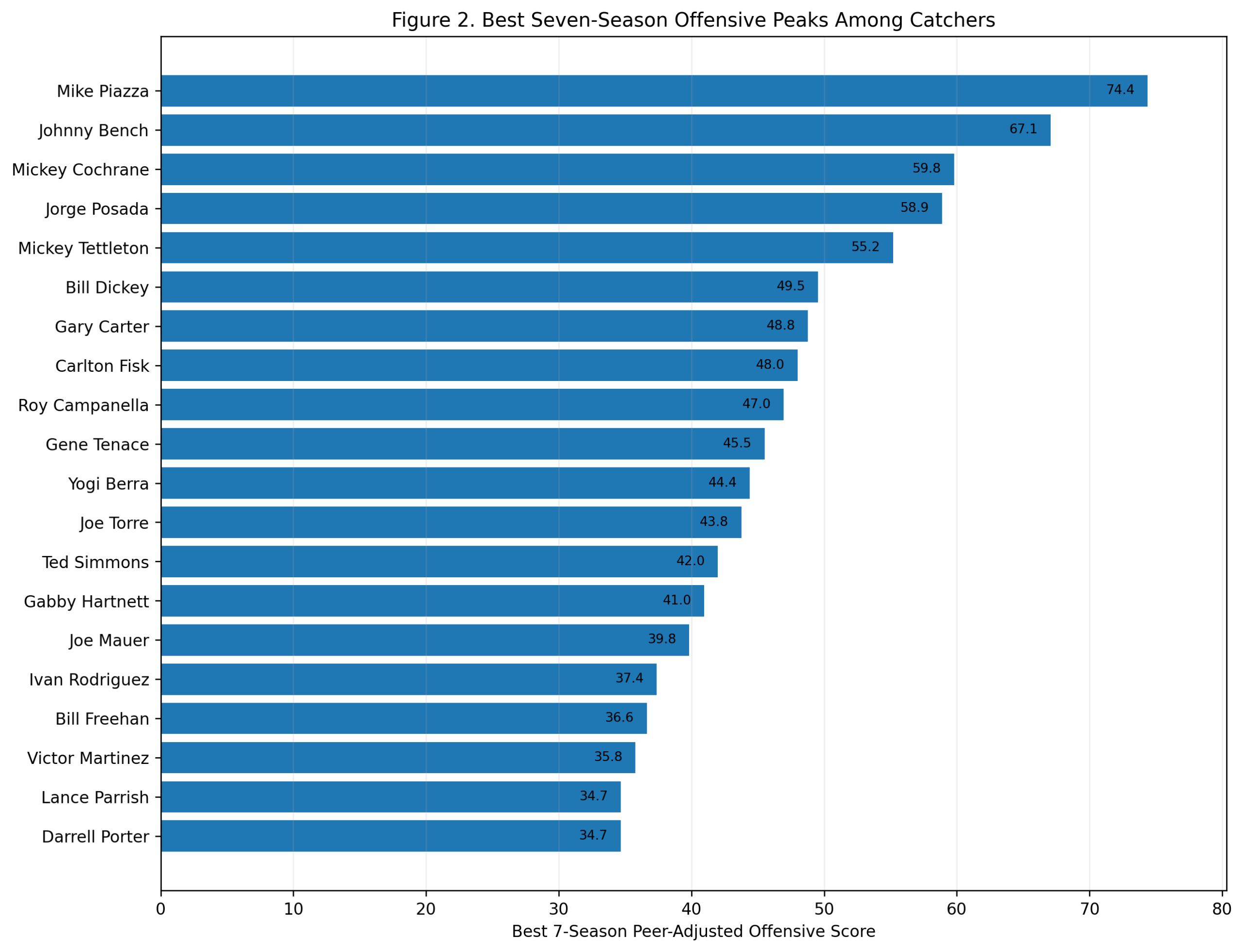
The seven-season peak ranking strengthens Piazza’s case.
Piazza leads with a peak-seven score of 74.4. Bench follows at 67.1. Mickey Cochrane is third at 59.8, Jorge Posada fourth at 58.9, and Mickey Tettleton fifth at 55.2.
This figure matters because a career ranking can sometimes reward longevity more than dominance. Piazza does not merely win by accumulation. He also has the strongest seven-season offensive peak among catchers in the study.
Bench is again close. Cochrane and Posada both grade very well. Tettleton is an especially interesting name because his career as a catcher was shorter, but his peak offensive performance was unusually strong.
The top of the peak chart says something important about Piazza:
He was not just consistent. He was repeatedly elite.
Figure 3: Career Value Versus Peak Dominance
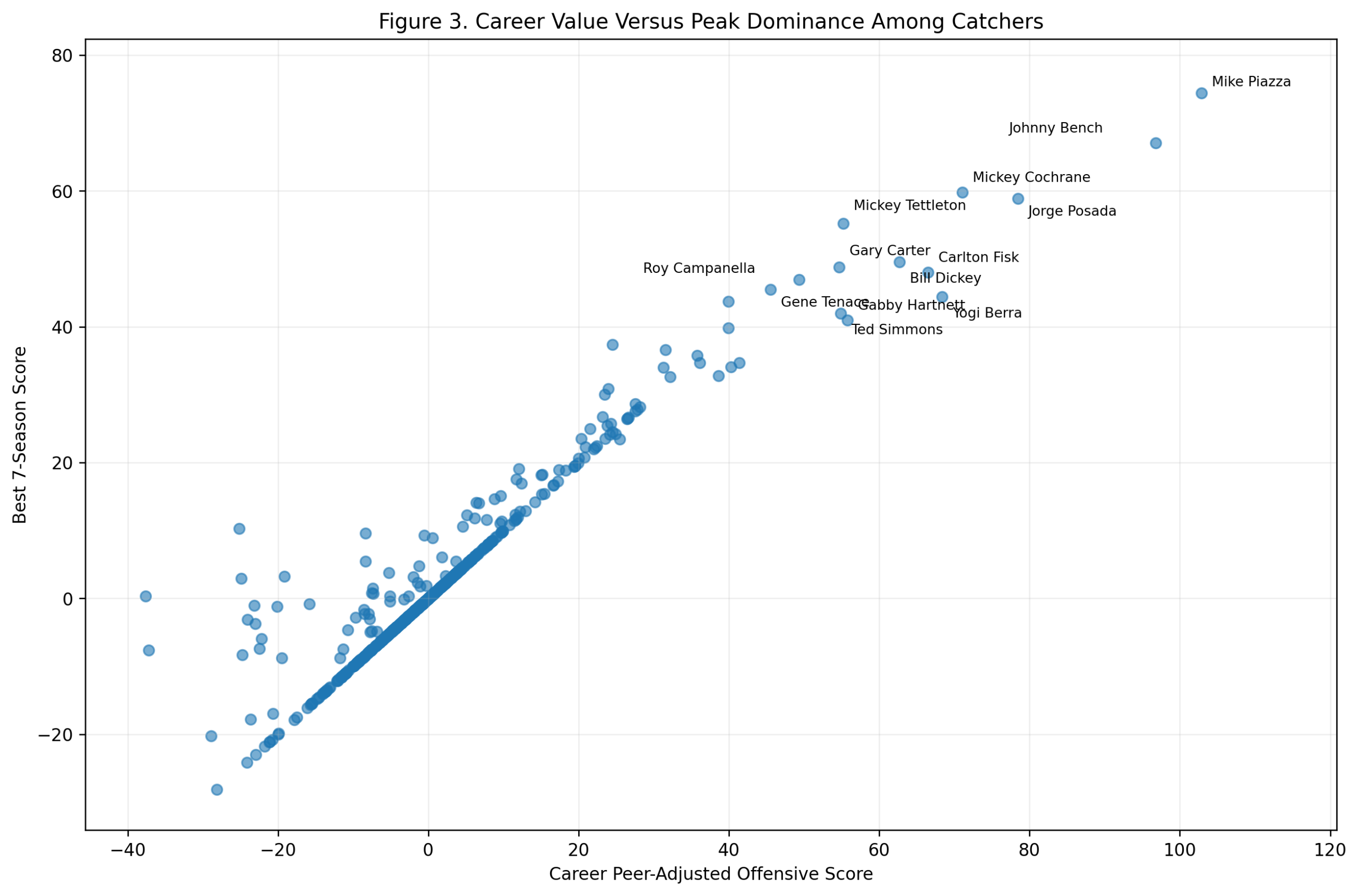
The scatterplot shows the catcher field clearly.
Piazza sits in the upper-right corner. Bench is close, but slightly behind on both career and peak. Cochrane and Posada form the next major group. Yogi Berra, Carlton Fisk, Bill Dickey, Gary Carter, Mickey Tettleton, Roy Campanella, Gene Tenace, Ted Simmons, and Gabby Hartnett fill out the high-value region.
This figure is useful because it visualizes the structure of the debate. Piazza and Bench separate from the field, but not by the same kind of distance we saw with Ruth among right fielders. Catcher offense is more compressed. The demands of the position make sustained offensive dominance harder to maintain.
The chart also shows why Posada deserves attention. He ranks surprisingly high in this offense-only framework. That does not mean he was a greater catcher than Berra, Fisk, Carter, or Dickey overall. It means his bat, measured against catcher peers, was more valuable than his usual historical reputation suggests.
This is one of the strengths of the method. It can recover players whose offensive value may be partly hidden by broader reputation.
Figure 4: Best Individual Offensive Seasons
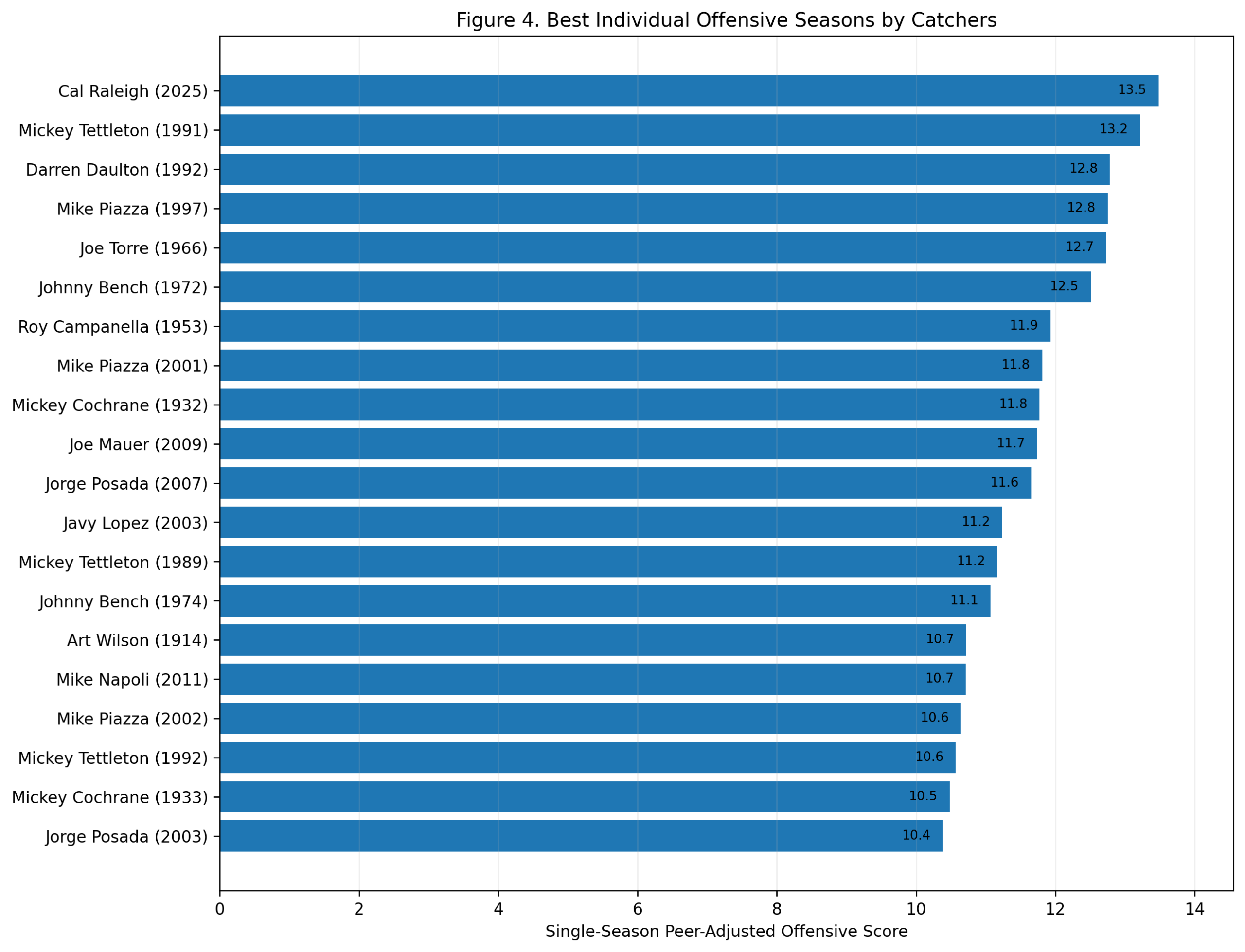
The single-season leaderboard produces the most surprising result of the study.
The top season was Cal Raleigh’s in 2025, with a score of 13.5. Mickey Tettleton’s 1991 season is second at 13.2, followed by Darren Daulton in 1992, Mike Piazza in 1997, Joe Torre in 1966, Johnny Bench in 1972, Roy Campanella in 1953, Piazza in 2001, Mickey Cochrane in 1932, and Joe Mauer in 2009.
Raleigh’s 2025 season stands out because of the combination of power and catcher context. A 60-home-run catcher season is not merely impressive in raw terms. It is almost structurally disruptive. The model captures that disruption by comparing Raleigh to other catchers in the same season.
But one season does not create the career case. Piazza and Bench remain ahead historically because they repeated high-value catcher offense across many seasons. Raleigh’s result is a peak result. It deserves attention, but it is not the same as a career argument.
This figure gives the post its modern hook:
Piazza wins the career study, but Raleigh owns the single most dominant catcher season in the model.
Figure 5: Piazza Versus the Best Non-Piazza Catcher
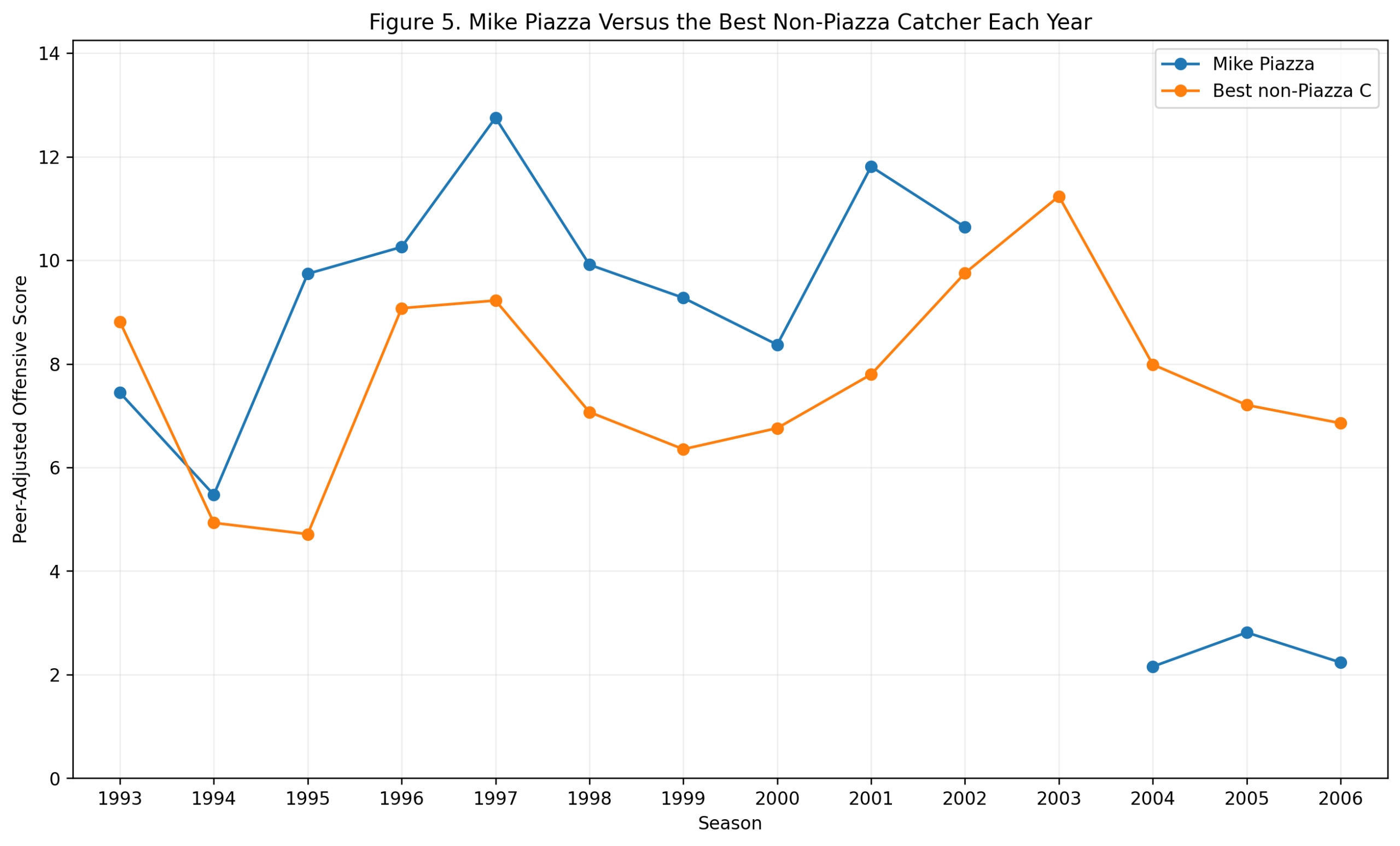
Figure 5 compares Piazza to the best non-Piazza catcher in each season of his qualified catcher career.
The pattern is revealing. Piazza was not always the top offensive catcher in a given season, but he spent much of his prime at or near the top of the positional leaderboard. His strongest years, especially in the late 1990s and early 2000s, show repeated separation from the catcher norm.
The later years show a decline, as expected. Catcher aging is difficult. The position extracts a cost. What matters is the prime period. Piazza’s best seasons were not isolated. They were part of a sustained offensive identity.
This is where the career score becomes meaningful. It is not simply adding numbers. It is adding repeated seasons of distance from the average catcher.
Piazza kept creating that distance.
Figure 6: Balanced Offensive Greatness
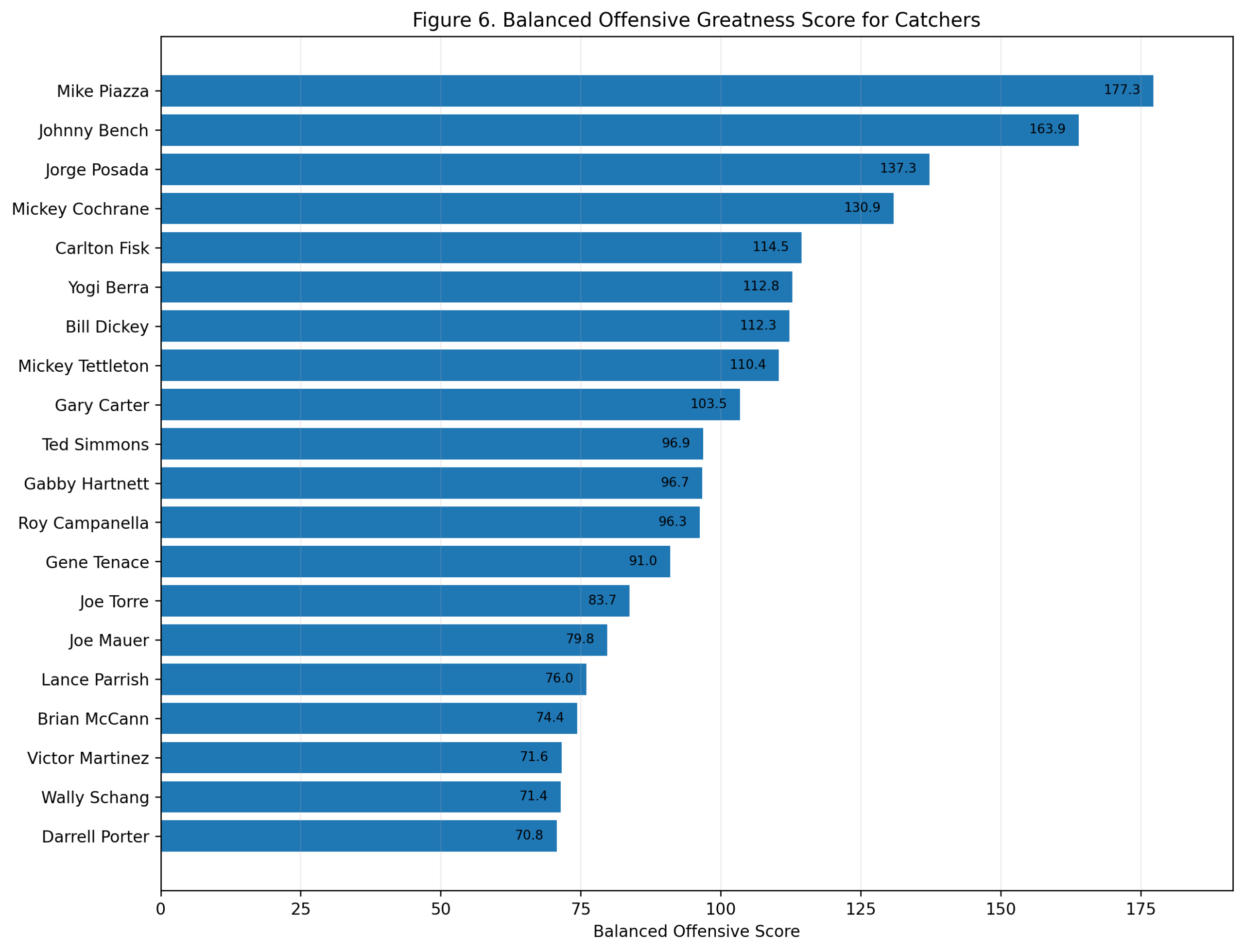
The balanced score combines career value and peak value over seven seasons.
Piazza again finishes first, with a balanced score of 177.3. Bench is second at 163.9. Posada is third at 137.3, followed by Cochrane, Fisk, Berra, Dickey, Tettleton, Gary Carter, and Ted Simmons.
This may be the cleanest single-number summary of the offense-only catcher question. It rewards both longevity and dominance. Piazza wins both categories.
Bench remains close enough that the all-around debate is still alive. In fact, if defense were added, Bench would probably become much harder to beat. But offense alone gives Piazza the edge.
The balanced ranking also raises a useful historical point. Posada and Tettleton look better in this framework than many traditional catcher rankings might suggest. Their bats separated from the catcher baseline in ways that matter.
That is the value of positional peer adjustment. It does not simply repeat conventional memory.
Figure 7: Offensive Component Profile
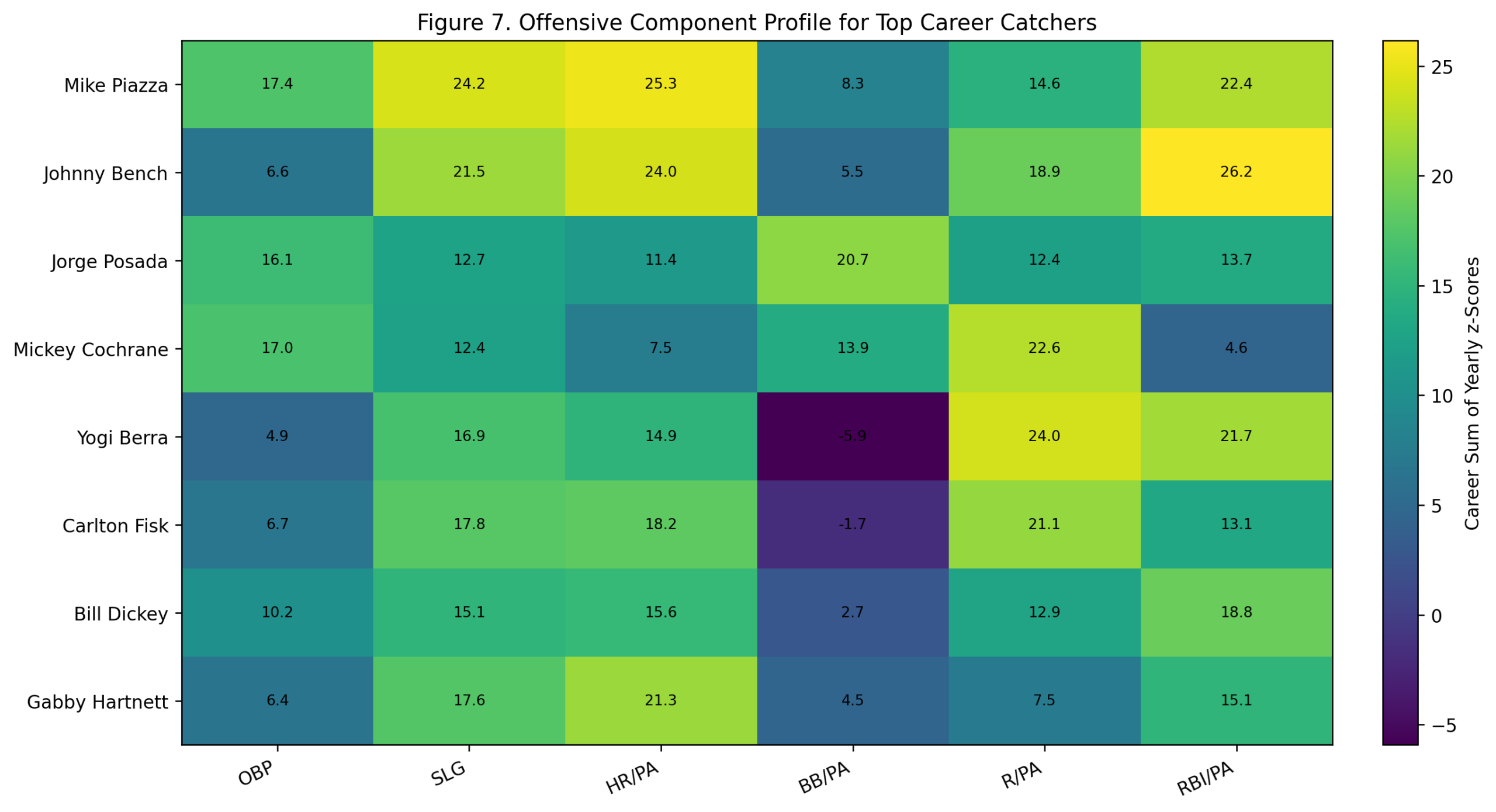
The component profile shows how the top catchers built their value.
Piazza’s profile is built around slugging, home-run rate, RBI production, and strong OBP. That fits the historical picture. He was not merely a catcher who hit well. He was a middle-of-the-order hitter who happened to play catcher.
Bench’s profile is more power-and-run-production driven. His HR/PA and RBI/PA components are especially strong, while his OBP component is lower than Piazza’s. That distinction matters. Bench was a great offensive catcher, but Piazza’s profile is more complete in this offense-only model.
Posada’s profile is different. His walk rate component is outstanding, and his OBP helps drive his high ranking. Cochrane also shows strong OBP and run-scoring value. Berra and Fisk lean more toward slugging and run production. Dickey and Hartnett fit the earlier power-catching tradition.
This figure makes one of the key points of the study clear:
Catcher offense has more than one shape.
Piazza is the best overall offensive shape. Bench is the power-catcher archetype. Posada is the patience-and-OBP surprise. Cochrane is the high-OBP historical great. Tettleton is the concentrated modern peak.
Figure 8: Dendrogram of Top Offensive Catchers
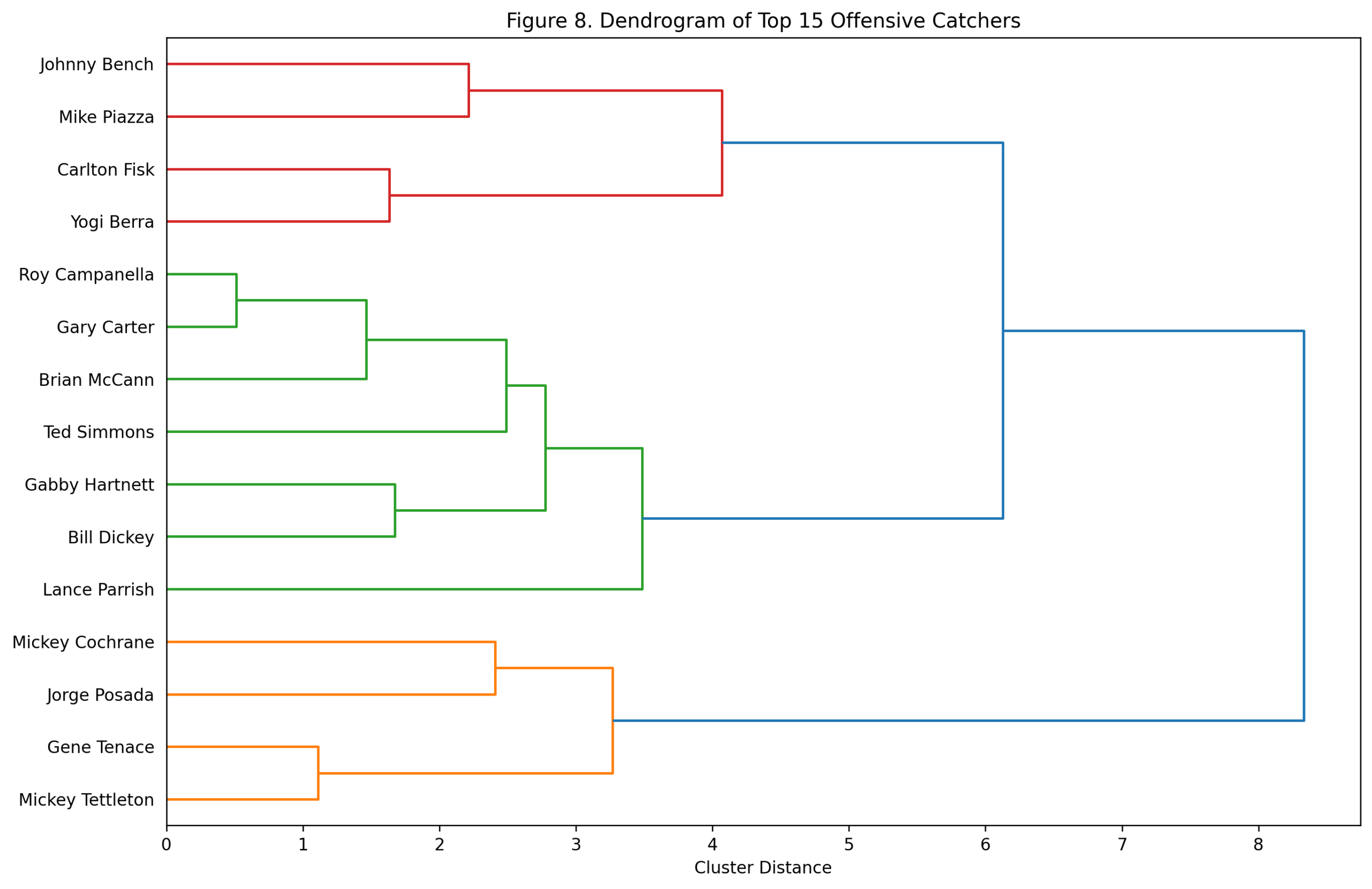
The dendrogram clusters the top 15 catchers by offensive shape rather than by total score.
Piazza and Bench cluster together, which makes sense. Both were elite power catchers, though Piazza’s OBP advantage gives him a slightly different profile. Fisk and Berra also cluster near that general power-production family.
Another branch groups players like Roy Campanella, Gary Carter, Brian McCann, Ted Simmons, Gabby Hartnett, Bill Dickey, and Lance Parrish. These players produced value through varying mixtures of power, RBI production, and longevity.
A different branch includes Mickey Cochrane, Jorge Posada, Gene Tenace, and Mickey Tettleton. That group is especially interesting because it reflects patience and on-base value. Posada, Tenace, and Tettleton all benefit from walk-heavy profiles. Cochrane brings an earlier version of high-OBP catcher offense.
The dendrogram helps explain why the catcher ranking is so interesting. Piazza wins, but he does not win because there is only one way to be an offensive catcher. He wins because his version of catcher offense combined peak, consistency, and middle-order force.
The Bench Problem
No catcher study can avoid Johnny Bench.
In this offense-only model, Bench finishes second. That is not a criticism. It is a sign of how strong Piazza’s bat was. Bench’s case as the greatest catcher ever remains powerful because this model excludes defense. It does not count game-calling, throwing, handling pitchers, or the defensive burden of the position.
If the question is:
Who was the greatest all-around catcher ever?
Bench may still be the answer.
But if the question is:
Who was the greatest offensive catcher relative to his peers?
The answer from this study is Piazza.
That distinction should be kept clear.
The Cal Raleigh Note
Cal Raleigh’s 2025 season deserves special mention.
The model ranks it as the best single-season offensive catcher in the dataset. That does not make Raleigh the greatest offensive catcher. It does mean that his 2025 season was extraordinary within his catcher peer group.
This is exactly what the model is designed to capture. It is not simply asking who had the best traditional reputation. It is asking which seasons most disrupted the positional baseline.
By that standard, Raleigh’s 2025 season is historic.
What the Study Shows
The catcher study yields a strong yet nuanced result.
Piazza wins the career score. Piazza wins the seven-season peak score. Piazza wins the balanced score. Bench is second in all three and remains the all-around counterargument. Posada emerges as a surprisingly strong offense-only catcher. Cochrane, Berra, Fisk, Dickey, Hartnett, Tettleton, Simmons, and Carter all form a rich second tier.
The single-season leaderboard adds a modern surprise with Raleigh. It also reminds us that peak seasons and career greatness are different things.
In short:
Career offense: Piazza
Peak offense: Piazza
Best single season: Raleigh, 2025
All-around catcher counterargument: Bench
Most underrated offense-only result: Posada
Conclusion
Catcher is not a position built for easy offensive comparison. The physical toll is too great. The defensive demands are too large. The historical standards shift too much across eras.
That is why peer adjustment helps.
It asks each catcher to stand next to the catchers of his own time. Not against a century of changing run environments. Not against a modern memory of what catcher offense should be. Just against the positional baseline he actually faced.
By that standard, Mike Piazza stands at the top.
He was not merely a good-hitting catcher. He was repeatedly far above what catcher offense normally looked like. He combined power, slugging, run production, and enough on-base value to separate from his peers year after year.
Bench remains the larger all-around shadow. Raleigh owns the astonishing single-season spike. Posada deserves more attention than he usually receives.
But in an offense-only, peer-adjusted study, the answer is clear enough.
The greatest offensive catcher was Mike Piazza.