First base is where offense is expected.
That makes this study different from the catcher, shortstop, and second-base studies. At those positions, elite offense feels like a bonus. At first base, elite offense is almost a requirement. The positional bar is higher. A good bat is not enough. A first baseman must separate from a peer group already filled with power hitters, high-OBP sluggers, run producers, and middle-of-the-order anchors.
So the question here is demanding:
Who was the most dominant offensive first baseman relative to other first basemen of his own time?
Not the best defender. Not the best all-around player. Not the best postseason player.
The best offensive first baseman.
Methodology
Using the Lahman Database, I identified first-base seasons through Appearances.csv. A player-season qualified if the player had:
At least 50 games at first base
At least 300 plate appearances
For each qualified first baseman-season, I calculated six offensive measures:
OBP
SLG
HR per PA
BB per PA
Runs per PA
RBI per PA
Each category was converted into a z-score within that season’s first-base peer group. The season score was the sum of those six z-scores.
Season Score =
OBP z + SLG z + HR/PA z + BB/PA z + R/PA z + RBI/PA z
Partial seasons were weighted by playing time, with full credit beginning at 600 plate appearances.
The goal is not to compare raw totals across time. A first baseman in 1927 is compared to other first basemen in 1927. A first baseman in 1998 is compared to other first basemen in 1998. A first baseman in 2025 is compared to other first basemen in 2025.
The model measures distance from positional expectation.
Figure 1: Career Offensive Dominance
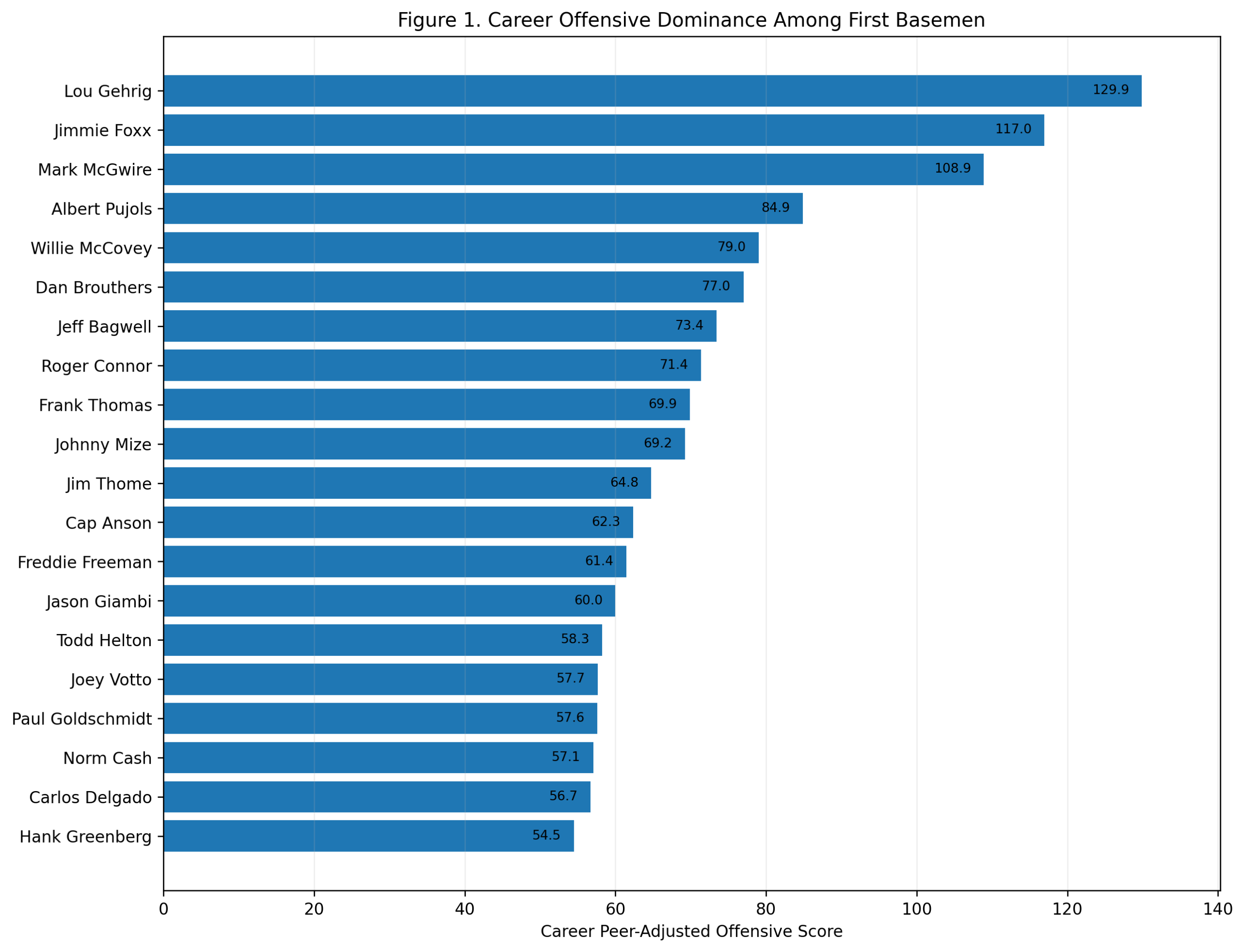
The career ranking begins with Lou Gehrig.
Gehrig finishes first with a career peer-adjusted offensive score of 129.9. Jimmie Foxx follows at 117.0, and Mark McGwire is third at 108.9. Albert Pujols is fourth, followed by Willie McCovey, Dan Brouthers, Jeff Bagwell, Roger Connor, Frank Thomas, and Johnny Mize.
This is a strong top group, but Gehrig’s position is clear. He does not merely benefit from playing in a famous Yankee lineup. He separates from other first basemen of his own time, year after year.
That matters because first base is a difficult position to dominate in this framework. The baseline is already high. A first baseman is not being compared to light-hitting middle infielders. He is being compared to other first basemen, many of whom were offensive specialists.
The first major conclusion is simple:
Lou Gehrig has the strongest career offensive first-base profile in this peer-adjusted model.
Figure 2: Best Seven-Season Peaks
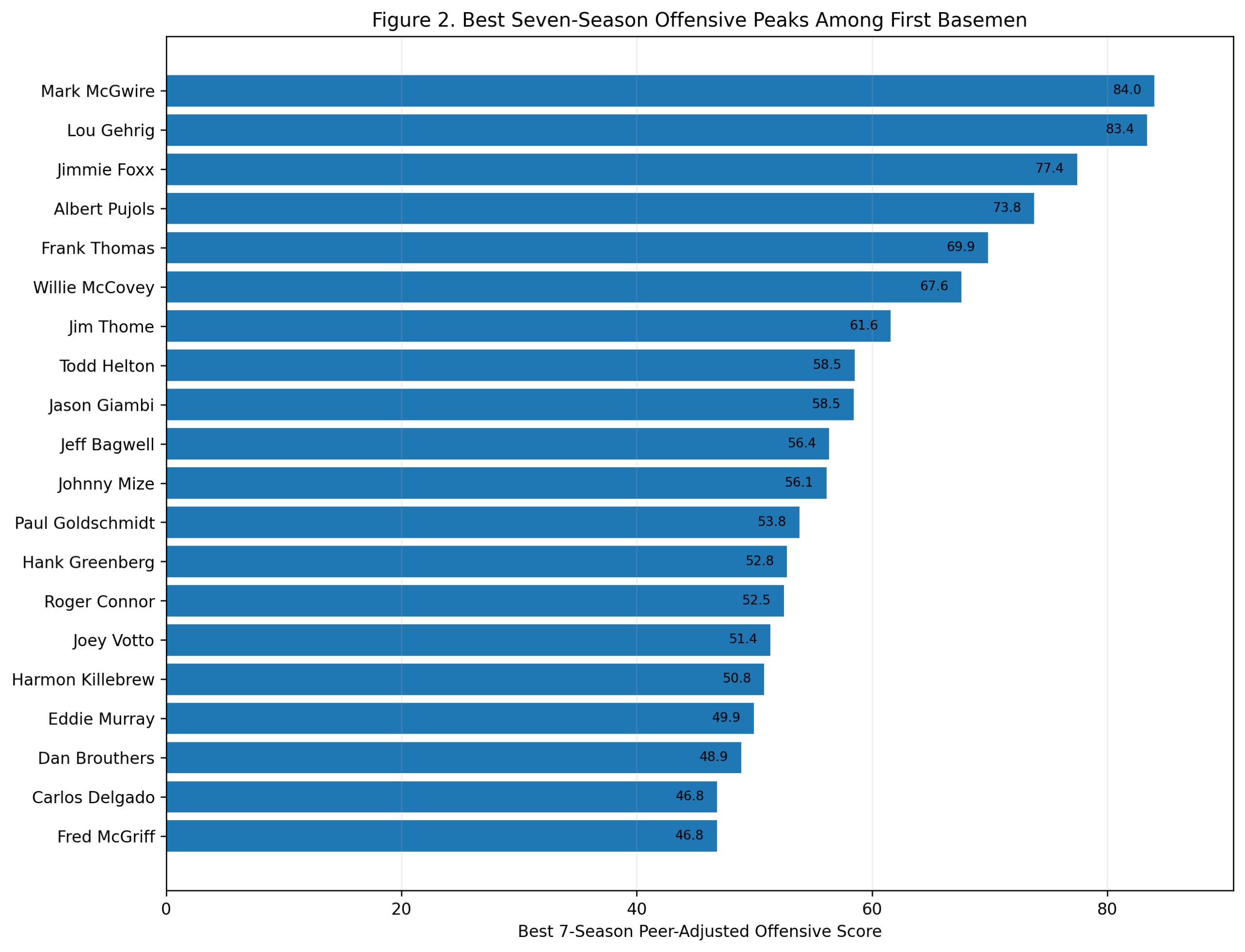
The peak ranking changes the order.
Mark McGwire finishes first with a seven-season peak score of 84.0. Gehrig is just behind at 83.4. Jimmie Foxx follows at 77.4, then Albert Pujols, Frank Thomas, Willie McCovey, Jim Thome, Todd Helton, Jason Giambi, and Jeff Bagwell.
This is the McGwire argument.
His career score does not quite catch Gehrig or Foxx, but his best seven-season run is the strongest in the model. That is not surprising. McGwire’s peak was built around extreme home-run rate, walk rate, slugging, and run production. The model rewards that because those categories represent real separation from the first-base peer group.
Gehrig’s peak, however, is almost equal. The gap between McGwire and Gehrig is tiny. That makes the first-base debate more interesting than a simple career list suggests.
The central tension is:
Career offensive first baseman: Lou Gehrig
Peak offensive first baseman: Mark McGwire
Closest all-around offensive challenger: Jimmie Foxx
Figure 3: Career Value Versus Peak Dominance
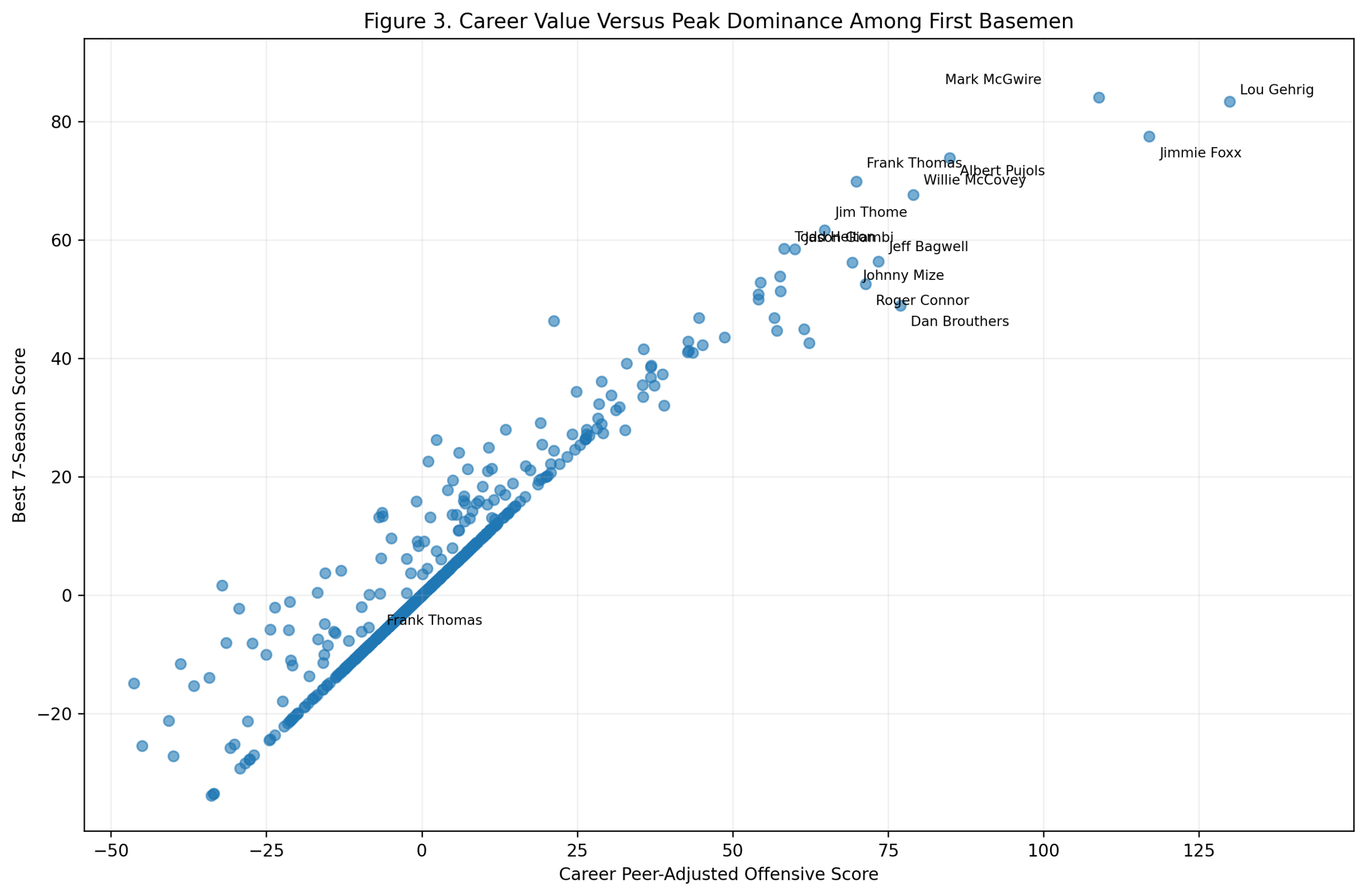
The career-versus-peak scatterplot shows the structure of the argument.
Gehrig sits far to the right and high on the peak axis. Foxx is nearby, slightly lower in both dimensions. McGwire is lower in career value than Gehrig but slightly higher in peak value. Pujols sits below that top trio, with a strong but not quite overwhelming profile. McCovey, Frank Thomas, Bagwell, Thome, Mize, Brouthers, Connor, and others fill out the next tier.
This figure makes the answer clearer.
McGwire owns the sharpest peak. Foxx is the great close challenger. But Gehrig has the best combination of career and peak.
That combination is the key. He was not merely durable. He was not merely a peak player. He was both.
Figure 4: Best Individual Offensive Seasons
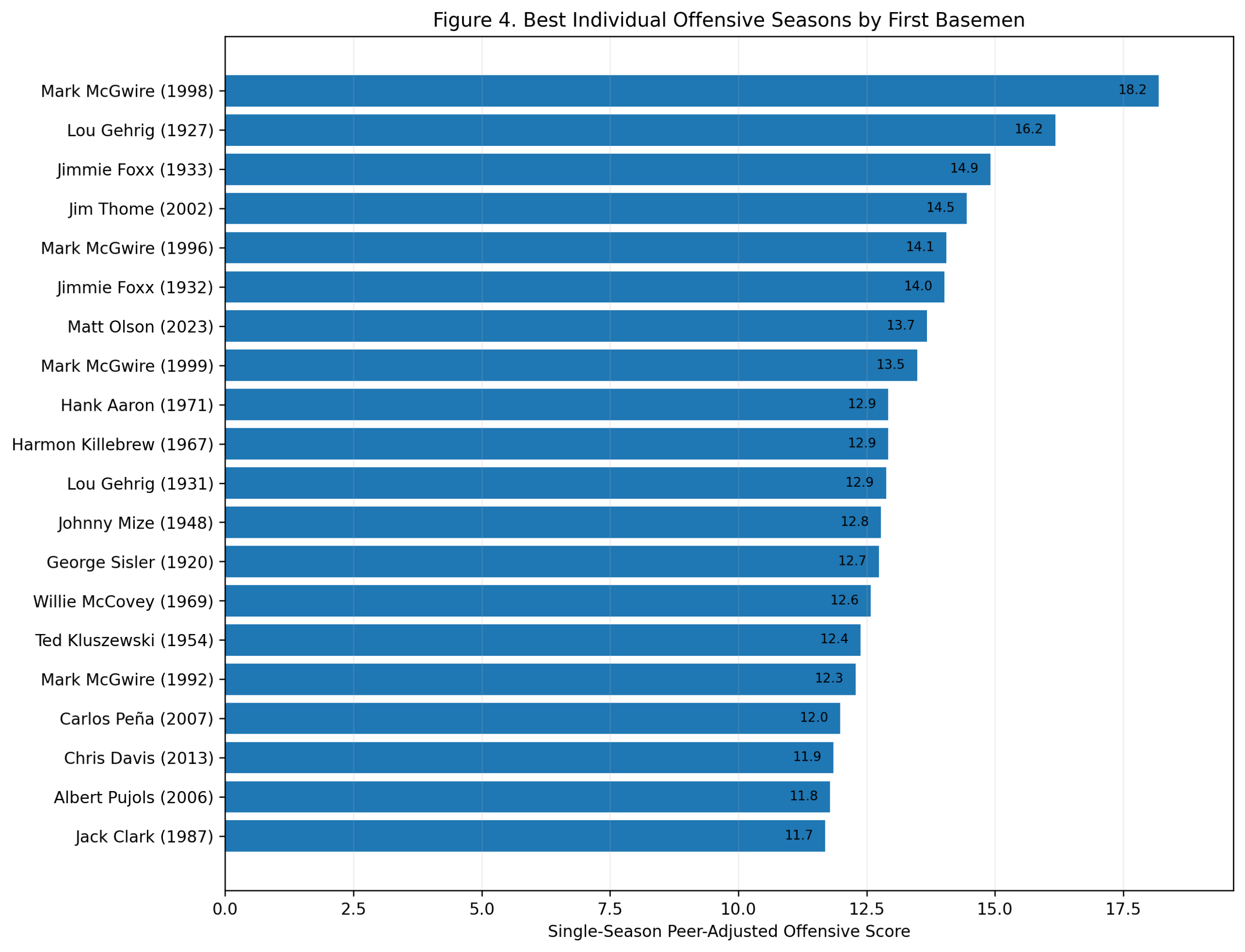
The best individual season belongs to Mark McGwire in 1998, with a score of 18.2.
That season stands above the rest of the first-base leaderboard. Gehrig’s 1927 season is second at 16.2. Jimmie Foxx’s 1933 and 1932 seasons appear near the top, along with Jim Thome in 2002, McGwire in 1996 and 1999, Matt Olson in 2023, Hank Aaron in 1971, Harmon Killebrew in 1967, and Gehrig in 1931.
This figure shows why McGwire cannot be dismissed as a career-only oddity or a one-category slugger. His offensive peak was historically extreme. The combination of home runs, walks, slugging, and run production made his best seasons unusually powerful even against the high offensive standards of first base.
But Figure 4 also shows Gehrig’s presence. His 1927 season remains one of the great first-base seasons in the dataset, and his 1931 season also appears in the top group.
McGwire owns the best single season. Gehrig owns the better total case.
Figure 5: Gehrig Versus the Best Non-Gehrig First Baseman
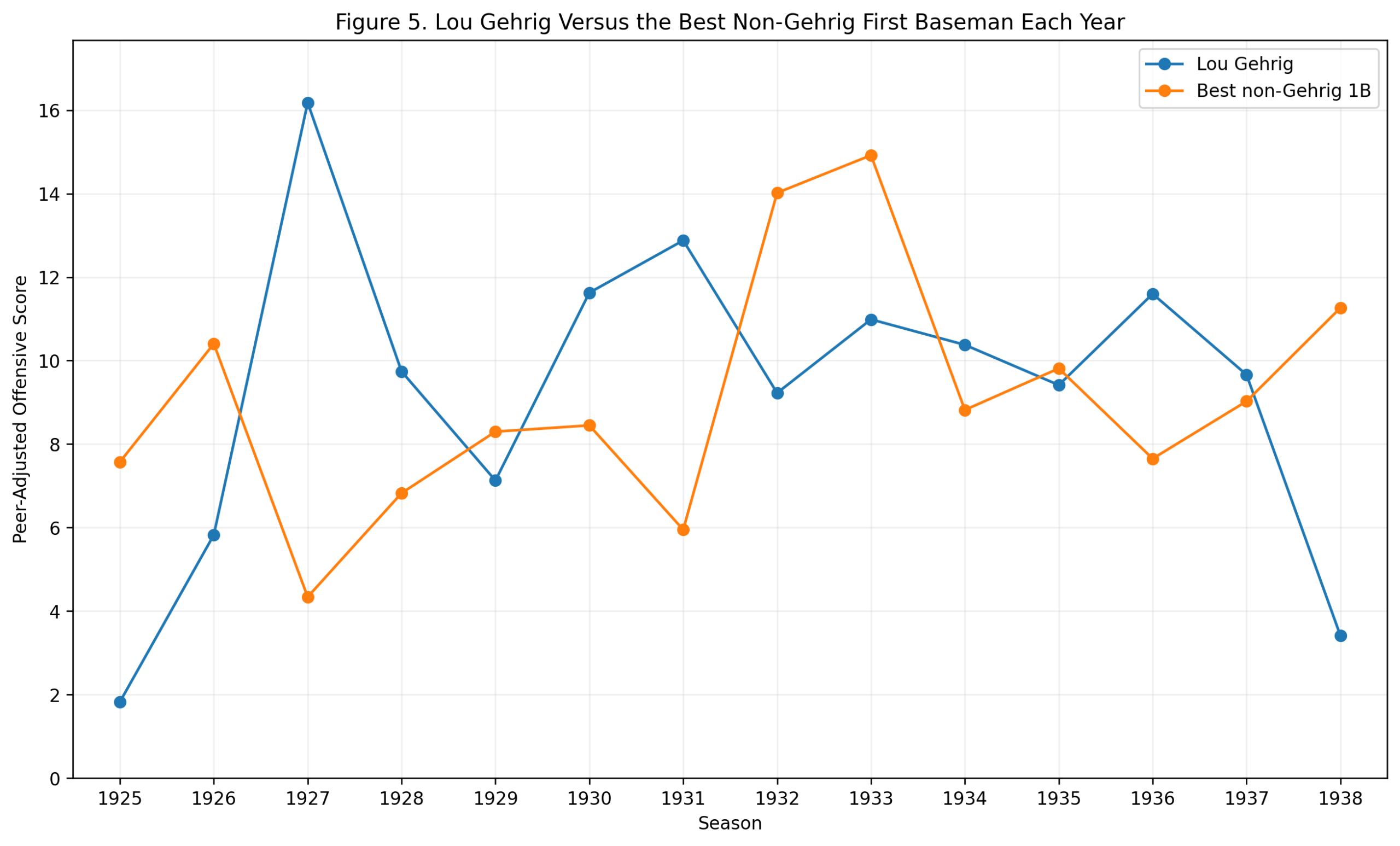
Figure 5 compares Gehrig to the best non-Gehrig first baseman in each season of his qualified first-base career.
The chart is more competitive than the Ruth right-field version. That makes sense. First base is crowded with great bats. Even during Gehrig’s prime, there were other elite offensive first basemen creating strong seasons.
Still, Gehrig repeatedly rises above the field. His 1927 season is the obvious spike, but his value is not limited to that year. He remains near the top across a long stretch. In some seasons, another first baseman beats him. In others, Gehrig is clearly ahead.
That is the point of a career score. It does not require a player to win every single year. It rewards repeated high-level separation.
Gehrig kept returning to the top range.
Figure 6: Balanced Offensive Greatness
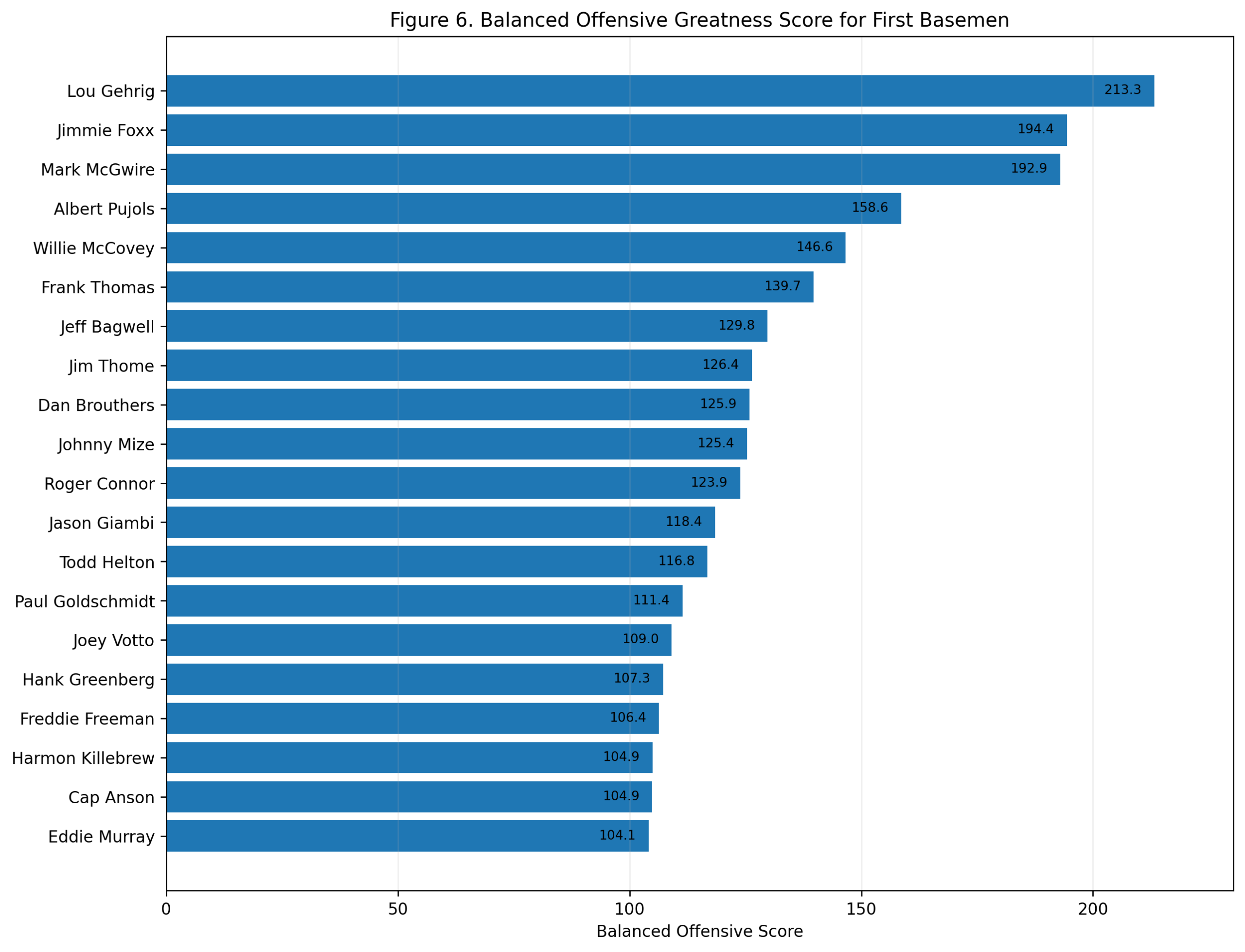
The balanced score combines career value and seven-season peak value.
Gehrig finishes first at 213.3. Foxx is second at 194.4. McGwire is third at 192.9. Pujols follows at 158.6, then McCovey, Frank Thomas, Bagwell, Thome, Brouthers, Mize, Connor, Giambi, Helton, Goldschmidt, Votto, Greenberg, Freeman, Killebrew, Anson, and Murray.
This may be the cleanest summary of the study.
Gehrig wins because he combines elite peak with the strongest career total. Foxx and McGwire are close enough to matter, but not close enough to overturn the result. Pujols is the strongest modern long-career challenger, though his first-base score is reduced by the way his career moved across positions and aging phases.
The balanced score supports the main conclusion:
Lou Gehrig is the best offense-only first baseman by this peer-adjusted framework.
Figure 7: Offensive Component Profile
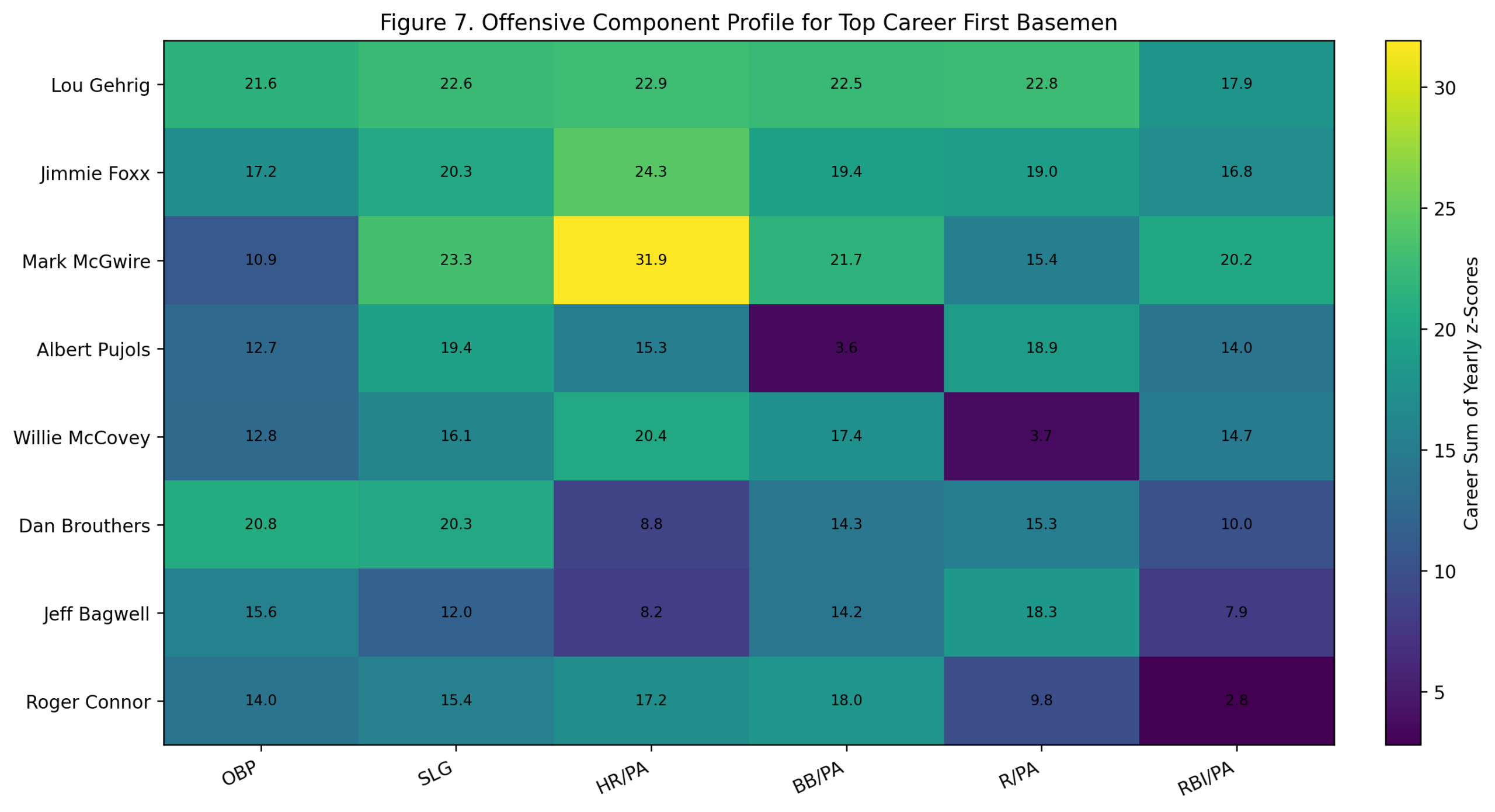
The component profile shows how the leading first basemen built their offensive value.
Gehrig’s profile is strikingly balanced. He scores strongly in OBP, slugging, home-run rate, walks, runs, and RBI. That is his case in miniature. He was not dependent on one category. He separated everywhere.
Foxx has a similar shape, with slightly less overall accumulation. McGwire is different. His home-run-rate component is enormous, and his walk and slugging components are also very strong. His profile is more concentrated, more explosive, and more power-oriented.
Pujols is more slugging-and-run-production driven than walk-driven. McCovey shows power and walks. Brouthers and Connor reflect earlier-era offensive shapes, where first-base dominance did not look like modern home-run dominance. Bagwell is more balanced than some might expect, though his component totals do not reach the Gehrig-Foxx-McGwire level.
The key point is that Gehrig’s greatness is not merely one huge advantage. It is the absence of weakness across the offensive categories.
Figure 8: Dendrogram of Top Offensive First Basemen
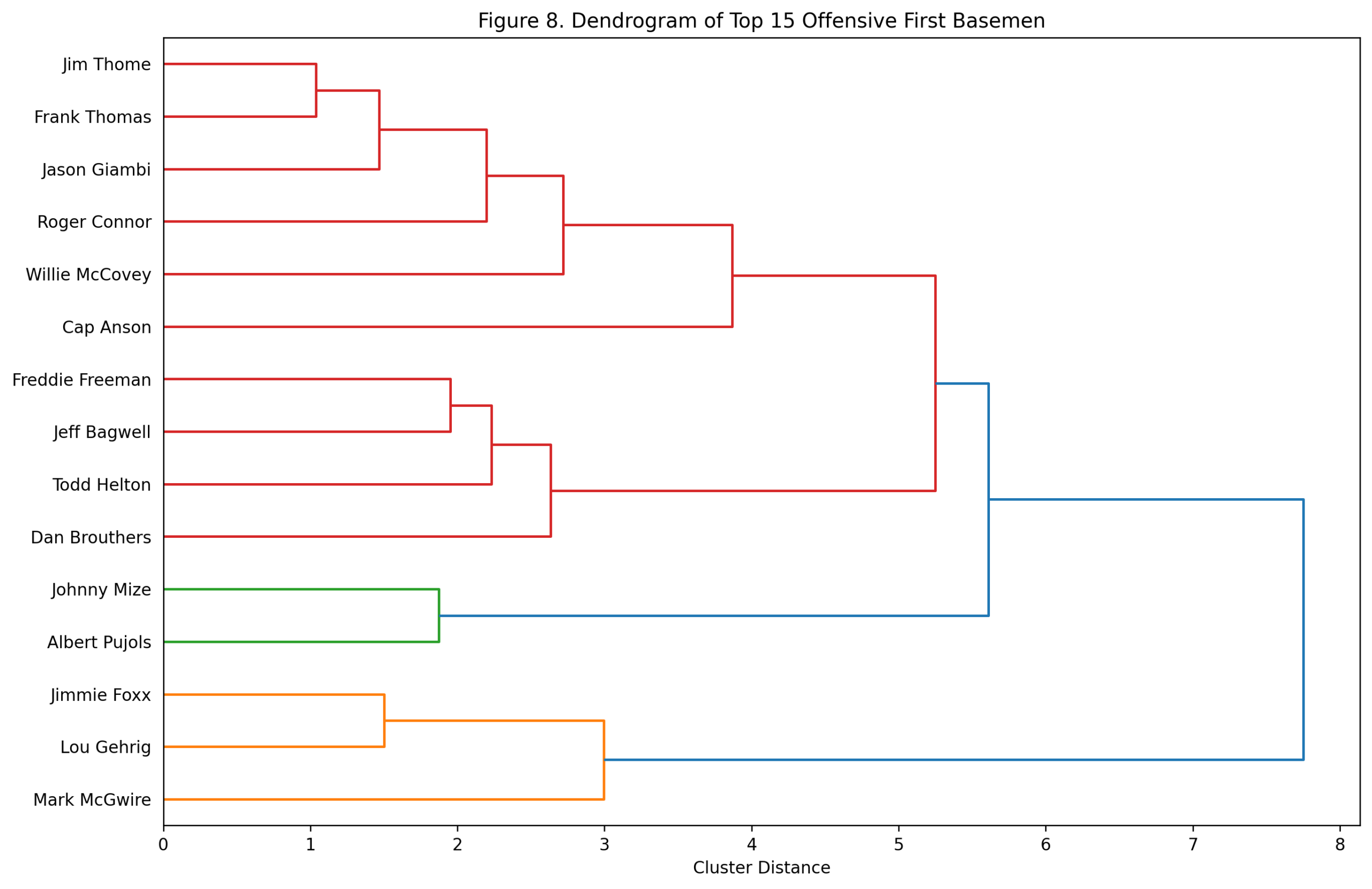
The dendrogram clusters the top 15 first basemen by offensive shape rather than by final score.
Gehrig, Foxx, and McGwire cluster together, which makes sense. They are the most extreme power-and-production players near the top of the study. Pujols and Mize form another close branch, reflecting strong slugging and run-production profiles. Thomas, Thome, Giambi, Connor, and McCovey occupy a patient power region. Bagwell, Helton, Freeman, and Brouthers sit in a more balanced offensive group.
This figure is useful because it shows that first-base greatness has multiple forms. Some players dominate through brute power. Some through OBP and walks. Some through high-average slugging. Some through long-career consistency.
Gehrig wins because his offensive shape is both broad and historically dominant.
The Foxx Question
Jimmie Foxx deserves more attention than he often receives.
He finishes second in career score and second in balanced score. He is not far behind Gehrig, and he stays ahead of McGwire in the full career ranking. His offensive profile is enormous.
The problem for Foxx is that Gehrig is a little better in the career total, while McGwire is a little better in peak. That leaves Foxx in a strange historical position: not first in either headline category, but extremely strong in both.
In many ways, Foxx is the bridge between Gehrig and McGwire.
He has more career value than McGwire.
He has more peak force than most of the field.
He just does not quite pass Gehrig.
The McGwire Question
McGwire is the peak answer.
His 1998 season is the best single season in the first-base study. His seven-season peak is first. His component profile shows exactly why: home runs, walks, slugging, and run production.
But McGwire does not win the overall study because Gehrig’s career score is higher and Gehrig’s peak is nearly as strong.
That is the difference between peak dominance and total dominance.
McGwire’s best version may have been the most explosive offensive first baseman in the model. Gehrig was the greater offensive first baseman overall.
The Pujols Question
Albert Pujols ranks fourth by career score and fourth by peak score.
That is an excellent result, though perhaps a little lower than some traditional rankings might expect. The reason is partly positional. This study counts only seasons in which Pujols qualified as a first baseman under the model’s rules. It is also comparing him against strong modern first-base peer groups.
Even so, Pujols emerges as the strongest modern long-career candidate. His score is well ahead of most later first basemen, and his peak remains elite.
In a broader all-position hitting study, Pujols would likely look even stronger. In this first-base-only framework, he is outstanding but not quite in the Gehrig-Foxx-McGwire tier.
What the Study Shows
The first-base study gives us a clear but layered result:
Career Score: Lou Gehrig
Peak 7 Score: Mark McGwire
Balanced Score: Lou Gehrig
Best Individual Season: Mark McGwire, 1998
Closest career challenger: Jimmie Foxx
Strongest modern long-career challenger: Albert Pujols
Gehrig wins because he combines career dominance and peak dominance better than anyone else. McGwire owns the sharpest peak. Foxx is the great near-equal. Pujols, McCovey, Bagwell, Thomas, Thome, Mize, Brouthers, Connor, and others fill out one of the deepest offensive fields in baseball history.
The important thing is the standard. First base is not easy to dominate because offense is already expected there. Gehrig wins anyway.
Conclusion
First base is baseball’s offensive proving ground.
A great first baseman is supposed to hit. A merely good bat does not create historical separation. To stand out at first base, a player must be more than excellent. He must be excellent in a population built for offense.
That is why Lou Gehrig’s result matters.
He did not simply compile numbers in a famous lineup. He separated from other first basemen in his own time. He paired elite peak with the strongest career score. He scored well across every offensive component. He survived comparison with Foxx, McGwire, Pujols, McCovey, Bagwell, Thomas, Thome, Mize, Brouthers, and Connor.
By this peer-adjusted offense-only framework, the answer is clear.
Lou Gehrig was the greatest offensive first baseman.
McGwire had the sharpest peak. Foxx was the closest full-career challenger. Pujols carried the modern long-career case.
But Gehrig stands at the top.