Random Thoughts from a Nonlinear Mind: Volume 2: The Athena Chapters,
Chapter Thirteen:
Collatz
The Muses are fickle, nasty little figments. They have their own agenda, and they make their own schedule.
The Plumber to Buford Lister after a couple of months of spinning their wheels.
In 1937 a German mathematician named Lothar Collatz offered the world an easy, yet fascinating, problem. One so simple that I recently presented it to my niece (4th grade) and nephews (7th, 5th, and 2nd). They all understood it, and they spent some time looking at it. Here it is:
Take any positive integer you want; if it is even, then divide it by two. If the number is odd, then multiply it by three and then add one. That is it; there is nothing more to the problem. What Collatz said is that all positive integers, when run through this process, will find their way to one. That is The Collatz Conjecture.
If n = odd, then 3n + 1
If n = even, then n/2
EXAMPLE: n=9
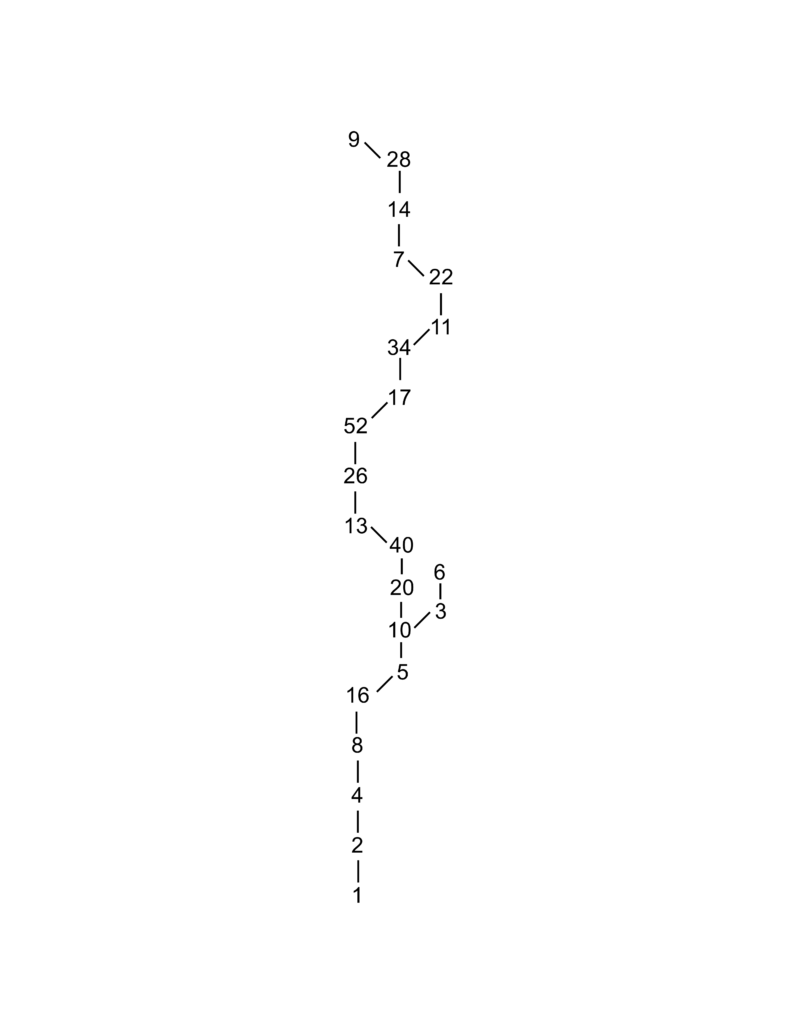
9,28,14,7,22,11,34,17,52,26,13,40,20,10,5,16,8,4,2,1.
To this day, no proof has been offered, and no counterexample has been found.
*****
Buford Lister was getting tired; he was already old (he had been old and tired for a while now). Old and tired, two words that fit together nicely. Whenever anyone bothered to ask him how he was (which, trust me, wasn’t often), he would say, “I am feeling old and tired. How about you?” He virtually never got a proper response. As you and I know, most of the time, when people ask you how you are doing, the last thing they really want to know is how you are doing. They intend the question as a kind of greeting, nothing more.
The worries were starting to outkick their coverage, there were things Buford Lister needed to get done, and he was coming to the realization that his eyes just might be too big for his deteriorating brain. It didn’t help that he was thinking so hard and so deeply that he was falling asleep way too often and sleeping far too long. He now understood why Paul Erdos, one of the most prolific mathematicians who ever lived, took all those drugs. For reasons I am unsure of, he never thought about taking them himself. I think he viewed them as some sort of cheating. At least that is the best I can come up with; contrary to what some might think, he was not an easy man to get to know.
Most afternoons, he could be found haunting the math and science library of a local university. He was more specter than patron. People would see a figure darting through the stacks, on some sort of mission or other, and then, barely a few minutes later, deep into a book while he seemed to scribble on his yellow legal pad in a vicious and random pattern. There was a no beverage policy in the library, but that never stopped him. His backpack was full of beer, cleverly and stealthily concealed in plastic bottles. No one ever bothered to question him as he drained one bottle after the other.
Author’s Note: One day, an odd thing happened. You need to understand that most days passed normally for him. It just so happens that I write about the unusual days, you would not be interested in the others. In no way am I saying that Buford Lister was a magnet for strange and odd things, but he did appear to find himself in unusual situations more than an average person. This is what happened…
Buford Lister was looking for a specific book on elliptic curves. He couldn’t recollect the author, but he remembered what the cover of the book looked like. He was frantically pulling books out of the shelves and then quickly putting them back after he saw that the cover wasn’t the one he was looking for.
“What are you doing? If you pull a book, you have to put it on the table. You can’t just put it back. That is how the books get all mixed up.”
Ah, an incredulous voice…a female no less. Sounds young.
He turned to see a woman who appeared to be in her mid-20s. She was wearing sweatpants and a Harvard sweatshirt, three sizes too big for her. He knew from experience that the baseball cap she was wearing was hiding hair that hadn’t been washed for a week or so.
“I am looking for a book if that is OK with you.”
“What do you need with a book in this section?”
“What business is that of yours?”
“Look, I need all these books.”
She pointed toward the end of the aisle. “My study carrel is right over there. I don’t need anyone messing with these books. Each one of these books needs to be in its proper place when I look for it.”
“Oh, you need them for reference?”
“Yes, of course, I do. What kind of question is that?”
“Can’t remember the relevant facts yourself? When I was your age, I read something once, and I held it right here.”
He shook his right index finger up against his temple. “I didn’t need a damn library for reference.”
She squinted hard at him. “Whatever.”
Buford Lister paused. He had a decision to make. Did he wish to engage this person further, or did he just want to drop the whole thing? Before he could decide, he found himself talking.
“You know, perhaps you should go back and review a little Socrates, he had a lot to say about topics such as this. The more you write things down, the more you risk dulling the mind, right?”
She shook her head. “Leave my books alone. If you have to pull one out, place it on an empty table. Please, just put it on a table.”
She quickly turned and darted back to her study carrel. She put on a large set of headphones and dropped her head. Buford Lister went back to his search.
Author’s Note: When Buford Lister was a young man, he knew a character named Hondo. Hondo always seemed to be at the bar when the guys went out for a drink after a hard day (or in the middle of one). Hondo was always dispensing unsolicited life advice to all the young men who came across his path. No one seemed to know much about him, but everyone liked him. He was interesting enough, but more importantly, he wasn’t some kind of crank or crackpot. He seemed harmless.
One day Hondo sat down to school Buford Lister and a couple of the other guys who happened to be at the table. Buford Lister smiled to himself as he thought back about that day. He could hear Hondo’s voice, that deep, gravely New England voice:
“OK guys, let’s say you are at a big club, lots of women. I mean lots of them. Let’s also stipulate that you are on a mission to see as many of them as possible. Perhaps you are going to do some kind of caveman analysis of how the women look. I would hope none of you would do that, but we all know most of you math and science guys have a hard time unplugging. Let’s just say that you want to view as many women as possible, whatever your reasons. What do you do? What…Do…You…Do?”
Buford Lister could see Hondo’s thick fingers pointing at each of the young men in turn. What…Do…You…Do? His smile was growing larger as he took himself back to that long-ago time and place.
One guy said he would systematically walk around the place and look. “Wrong,” Hondo said.
“On the face of it, that seems to be reasonable, but no, I think there is a better way. You boys have any idea?”
Buford Lister remembered nodding “No” along with the other guys.
“Now listen, what you do is you get a seat near the women’s restroom. The odds are very good that almost all the women are going to come to you. This strategy worked very well for my friends and me when I was young. The best strategy really is as simple as that.”
Buford Lister did not tell Hondo that strategy had been a “go-to” for years. It didn’t hurt anything if they all let Hondo feel good about himself for a bit. It didn’t hurt anything at all.
Buford Lister shook his head a little and got his focus back; he ran his index finger along the rows of books. He was sure the one he needed had a red cover and was written by some Italian guy. He kept searching; he knew the information he needed was in one of the appendices, either the first or the second. Finally, he found it. He was pretty close. The cover was red, the author was an Indian guy, and the information he was after was in Appendix II.
He scribbled in his pad (Take that Socrates!). He wrote down the citation he needed and some cryptic symbols that meant something to him. They must have been intended to represent the contents of Appendix II even though I have no idea how that is possible. After he got done, he looked over at the woman in the carrel. C’mon get up…
Sure enough, she did get up. Earlier in the day, he had noticed the 44-ounce plastic cup on her desk. Like most things, it was just a matter of time.
He got up and moved toward her desk. He had to; the compulsion was nearly overwhelming. He knew Hondo would be proud of him, applying his advice in an inverse fashion. He had to know: What was a strange woman doing in his section of the library, at least the section that he had his most recent claim on it? He sat down in her chair and looked over her notes. He saw the crude, hand-drawn figure (a series of numbers connected to form something resembling the branch of a tree) in her notebook and, in a few seconds, got all the confirmation he needed. He was furiously nodding his head when she turned and started screaming at him.
“Hey, get away from there. What are you doing? Get away from my table. What is wrong with you? Now! I mean it, get up right now!”
Buford Lister slowly stood up. He knew the days were long gone when he could charm such a person. She wasn’t interested in anything he had to say. If he were substantially younger, then there wouldn’t have been any problem, he simply would have asked her what she was doing, and she would have obliged with a guided tour. The difficulty is that person vanished into the ether decades ago.
“Oh, settle down. Number one, those are my books. That is my shelf. I owned it long before your parents even knew each other. Number two, if you need that much caffeine to concentrate, then you should take it in pill form. And finally, and by finally I mean number three, you need a simpler problem. You will never, ever solve that!” He pointed to her notebook and then turned to go back to gather his things. He almost made it to his desk.
“Who the hell do you think you are to tell me what I can and can not do? I fully intend to solve that problem, and I do not need an old fossil crawling out of some basement to tell me that I can’t do it. You don’t know me; you don’t know anything about me.”
“Sure, I do.”
“All right then, who am I?”
He wanted to say You are me about 40 or 50 years ago. Instead, he said, “I have seen young people like you, in one incarnation or another, for decades now.”
She paused and took a good, hard look at him. He was relieved when he saw no sense of recognition in her eyes. He was looking away when she glanced down at his shoes. She seemed to relax a little.
“What do you mean by that?”
“Exactly what I said. And I will tell you another thing, your adviser didn’t give you that problem, and he or she certainly does not know that you are seriously working on it.”
“I am done with school. I got my degree a few years ago. I am an assistant professor at…”
“OH BOY! Are you from a parallel universe or something. Were you sent here to torment me? Is this another one of those “Watch This” moments I have read so much about?”
“What are you talking about?”
“Nothing, nothing at all. So, let me get this straight, you are a number theorist, and you think you can solve that problem?”
“Yes.”
“You can’t.”
“I believe I can.”
“And if you don’t, you will never get tenure at a good university. You will find yourself teaching uninteresting mathematics to uninterested students at some fifth-rate university.”
“What makes you say that?”
“That is just the way of the world.”
She seemed stunned. She was definitely off-kilter. Perhaps, for the first time in her life, she heard a harsh reality.
She decided she needed to keep the conversation going. “Have you tried to solve Collatz?”
“In a serious way? Of course not. The mathematics needed to solve that piece of nonsense does not yet exist. If you are going to solve it, you are going to need to invent whole new branches of math. You up for that? You think that is easily done? You think you can just whip that up with the wave of a hand?”
“I think I have a good approach in mind.”
“I saw it.”
“You couldn’t have possibly seen it.”
“I saw enough. You are striding head-on into a very large and stout mathematical wall. You just are too young and blind to see it.”
She crossed her arms and looked sternly at the old man.
“Similar approaches have been tried for decades. Unfortunately for you, there is no good repository of dead ends. There is no reward for becoming a contributing member of the journal of failed results. The only reason I know about them is the Mathematical Grapevine, a thing you have yet to become a dues-paying member of.”
She actually stomped her right foot on the ground, quickly turned, and walked back to her carrell. Buford Lister packed up his things and left out a side door marked Emergency Exit Only. No alarms went off as it shut behind him.
*****
“Mathematics may not be ready for such problems.”
Paul Erdos on The Collatz Conjecture.
Terence Tao was a child prodigy. When he was 7, he started learning calculus. Fortunately for all of us, he did not burn out; he is now a professor of mathematics at UCLA. Back in 2011, he wrote a fascinating blog post about The Collatz Conjecture. He referred to the problem as “One of the most notorious in elementary mathematics…” He also wrote that the problem was “unlikely to be proven by current technology.” Simply stated, the problem is very hard.
It has been shown that all numbers up to 260 do comply with the conjecture. Of course, this is not a proof; there are infinitely more numbers to test. In fact, such approaches (taking the numbers in sequence and running the algorithm) are usually undertaken to find a counterexample, thereby disproving the conjecture. When my computers are idle, one of the things they do is crunch numbers in an increasingly vain attempt to disprove The Collatz Conjecture. I think nearly everyone with a stake agrees that the conjecture is most likely true. That said, good luck proving it. To give everyone a better understanding of the problem, I have included a figure, the only one in this volume. Below is a Collatz Tree for the numbers 1 through 10. You can see that all 10 numbers work their way to 1. Imagine what the tree would look like with hundreds or thousands (or trillions) of numbers. Some people think the trees are quite beautiful.
*****
Buford Lister walked the three blocks to his favorite bar; it was his best haunt because it was never busy, had lots of beer, and the food was edible. He found his preferred table, a large one near the back by doors with the signs that said Dudes and Chicks.
Before he was able to sit down, his usual server walked over. They instantly began their vaudeville routine, presented exclusively for the enjoyment of themselves.
“So, what will you have?”
In a deep and aggressive tone, he said, “I shall have a cheeseburger and a coke.”
“Very good, sir.” With that, she was off to the kitchen.
Buford Lister unpacked his yellow pad. He started spinning a pen between two of his fingers in his right hand. He drew a square on the center of the page. He was about to draw another when he spotted her. The woman from the library had apparently followed him. She came directly to his table and sat down across from him.
“Who are you? Are you who I think you are?”
“How could I possibly know who you think I am?” He looked her directly in the eye, and he did not like what he saw. He glimpsed a hint of recognition.
“I am an old man trying to sit in peace. That is what I am.”
“OK, old man. I am going to tell you a story. A few years ago, when I was in graduate school, I was at a party. There were a bunch of academic types there, writers, actors, that type of thing.”
“Boy, does that sound exciting. Sorry I missed it.”
“Actually, a very interesting thing happened that night. Bruno Suarez was there holding court as he always did. You ever heard of Bruno?”
Buford Lister did not like where this was going, but she was not going to leave him alone. That much was clear.
“Never heard of him.”
She looked him over with a skeptical eye. “Well, he is a Nobel Laureate physicist. He has written a bunch of popular books. He is one of those public intellectuals, on TV quite a bit and…”
She stopped because Buford Lister could not contain himself anymore. He had started chuckling. He wanted to tell her that he had stories about Bruno that would curl her toes, but he thought better of it.
“Ugh, of course you know who he is. That was a stupid question for me to ask.”
“So, why bring up my buddy Bruno? What did he do now?”
“Well, at that party, he told an interesting story about a young man who was on the cusp of a brilliant mathematical insight that was going to directly impact almost every academic discipline, at least those that had a quantitative component to them.”
“Being at the cusp of anything does not get you home.” He took a big swig of beer. “What did Bruno say happened to this brilliant young man?”
“He told a story about this conference where the young man presented his research. It was a major deal, lots of buzz. People showed up from all over the world to hear this lecture.”
“Then what happened?”
“I think you know damn well what happened.”
“What makes you think that?”
“I think that because there are not a lot of 70 or 80-year-old men walking around wearing Vans held together with duct tape and sporting farmer’s overalls to complete the ensemble. You know, I think at some point those used to be shoes even though you are wearing them like slippers. It is almost like they used to fit you when you were a kid, but as your feet started to flatten out, you crushed the back part and turned them into slippers. You have to be Buford Lister, the only man I know of to have special thinking shoes.”
Buford Lister tugged on his beard while she reached in her backpack.
“Here, recognize this?”
She handed a book to him. He looked hard at it. He flipped it over and glanced at the front cover.
In big block letters, it said THE LISTER AFFAIR. It was embellished with mathematical symbols, most prominently large “-1s” appearing in a random sequence throughout the cover.
“Interesting.” He placed the book on the table between the two of them. “What do you want?”
“So, it is you. I have been reading and rereading this book since I heard Bruno tell me the story of what happened.”
“He told you his version of what he thought happened.”
“I suppose that is true.”
“It is. So, what do you want?”
Just as she was about to answer, the server came back to the table with a turkey sub and a large stein filled with beer.
As she set it down, Buford Lister looked at her. “What is this?”
“Your order, you said you wanted a turkey sub and a beer.”
“I said no such thing. I ordered a cheeseburger and a Coke.”
“You most certainly did not. You ordered a turkey sub and a beer.”
“I may be old, but I remember what I ordered a few minutes ago. I wanted a cheeseburger and a Coke.”
“Sir, you ordered a turkey sub and a beer.”
Buford Lister stood up, pounded the table, said, “I think not!” and then disappeared into the restroom.
The server looked at the young woman and said, “He does that every day. We go through the same routine.”
“Every single day?”
“Just about.”
Minutes went by until Buford Lister returned to the table.
“Nice routine. Does that get funnier every time you do it?”
“Do what?”
She let out a great sigh. “Do you want to help me?”
“Help you with what?”
“I am tackling Collatz, and I could use your insight.”
“What makes you think I would have anything to say about that mess?”
“I think we both know the answer to that.”
Buford Lister took a long swig from his personal stein, one kept in the cooler, especially for him.
“You, young lady, are sadly mistaken. Even if I wanted to, and I don’t, I couldn’t help you. No one can help you. The mathematics required to solve that problem do not yet exist. I believe I told you that already.”
“I think they do. I think I have a route to a solution.”
“Good for you. The road to perdition is paved with people a hell of a lot smarter than you who said the same thing.”
“Drink your beer. Maybe it will calm you down. I don’t want to have to watch you keel over at the table.”
He took a long series of gulps. One glance at the server, and she took the stein for the first of its daily refills.
“I can’t help you. And I do not understand why you would want my help anyway.”
She held THE LISTER AFFAIR up in the air and waved it at him. “Have you read this book?”
“No. I was there. Why would I read that nonsense?”
“There was a time that you would have taken a problem like this by the throat. The book makes that very clear.”
“That was way before you were born.”
“There is nothing left of that man?”
“No. He is long gone.”
She took out a sheet of paper with a crudely drawn Collatz Tree. “See anything interesting about this?”
“Young lady, I have seen thousands of those. I have seen a lot more of those than you have. I have looked at them sideways, long ways, upside down, and backward. I have put the funnel to the side, on top, the bottom. I have used base 2 and 6. I have painted a large 4, 2, and 1 on a wall at my house. There is nothing you have seen that I have not.”
“So, what did you see? What can you tell me that could possibly give me some insight?”
He ripped some turkey from the sub. “I always tell them not to bring me a pickle, and yet there it is. I hate pickles. Want my pickle?”
She grabbed the pickle.
Buford Lister called the server over. “Get her whatever she wants and put it on my tab.”
Buford Lister got up to go back to the bathroom. “One of the wonders of age,” he said as he walked away.
When he got back to the table, he saw another sandwich and another very large beer.
“Isn’t it a bit early for you to be drinking?”
“I could say the same to you.”
She took a bite of her sandwich. “You know, I can see the young man in this book,” she said as she looked him in the eye. “He isn’t readily evident, but when I look real close, I can see him.” She opened the book to a page of pictures. They were pictures Buford Lister hadn’t seen in a very long time. Some of them he had never seen before. He grabbed the book from her and looked through the 16 pages of pictures that were included in the middle section. In the photos that showed his feet, he saw the very same shoes he was wearing, his now-famous thinking shoes.
“This stuff is very dangerous. Why did you show me that? Do you think that was a particularly happy time in my life? Do you think I look back on that time and smile?”
“I don’t know. I never really thought about it.”
“I try never to look back. Lots of ghosts back there. I tell you what, when they find me, they are going to see that I was looking through the windshield, not the rearview mirror. I try to leave the past buried, right where it belongs.”
“You don’t like to think about your good old days?”
“Young lady, I am delusional enough to think that my good old days, as you call them, are still in front of me. I base my life on that dubious proposition.”
“OK. I understand.”
“No, you don’t. You can not possibly understand until you get much older. Only then will you fully understand the depth and consequence of the seemingly inconsequential decisions you made along the way.”
When Buford Lister looked at her, he saw a confused young lady looking back at him.
“Time is the only commodity I have. You don’t know it yet, but it is the only commodity you have, too. You may think it is on your side, but it is stalking you. It is not your friend; you are not on a casual stroll together. It is the enemy, and you are up against an opponent who is undefeated.”
“So, you won’t help me with Collatz because you don’t have the time?”
“I won’t help you because I can’t. I looked at the problem. I spent lots of time on it. I went through Wiles’ paper on Fermat just looking for a hint, a subtle clue as to how even start. I found nothing. I looked at the patterns. I wrote computer programs to do the calculations and then graph the results. I looked for any patterns, any at all. If they are there, they remain hidden, elusive. I studied the steps, just the number of steps. I did a statistical analysis of the steps required to get home, and I found nothing. If there is a pattern, it is well hidden. If there is a reason for the numbers falling the way they do, then it exists in a realm unknown to me. There might well be a pattern, a simple explanation, maybe even one straight from Erdos’ book, but if it is there, it resides in a dimension that I have not been granted access to.”
“Maybe you were just knocking on the wrong doors. Maybe there is a way in. Just because you couldn’t find it does not mean it is not there.”
“Of course. I understand that better than you ever will. There are patterns all around us, the lives we choose to lead create new patterns out of the ether. Perhaps there is a sublime beauty in there somewhere if only we look hard enough. Let me ask you, is there a purposefulness in the patterns of your life?”
“I don’t know. I would like to think so.”
Buford Lister laughed out loud. “Of course, you hope so. No one wants to actually believe that the universe isn’t put there for their edification. Deep down, everyone wants to believe that they are the center of the universe, that everything was put there just for them. They want to believe that all the other people are simply actors in a play centered around their own lives. Just like Job’s kids, everyone else is just a prop. Birth happens under a Proscenium Arch, and everyone else in the world is a figment of some unimaginable power’s imagination. The patterns you see in your life can only be explained if you take such a view. Be it Collatz or any other patterns; it is all the same. You, like everyone else, have a very difficult time believing that the patterns you see are random, the result of massive piles of chaos, happening and then happening again.”
“What are you trying to tell me? I believe I can solve Collatz because of…what exactly?”
“Oh, I don’t want to ruin your day. I am not the type of person who walks around thinking that everything happens for a reason, and what does not kill me only makes me stronger. Do not think for an instant that you somehow found that problem, that you were somehow lead to it. That the universe is hinting that it is your destiny to solve it. No such thing exists. You found the problem. You want to see patterns in the trees, in the data. You desperately want it to be there. You are imagining what the feeling would be like to present the solution. You are looking for attention, for glory.”
“I am looking for the satisfaction of solving a problem that no one else has been able to solve, ever.”
“And all that goes along with it.” He took another big swig of beer.
“I desperately wanted to find those patterns. It appears they are not ready to give themselves up, if they exist at all.”
“Are you sure you weren’t looking for redemption?” She held the book up in the air and waved it in his face.
“You should be a little nicer to someone who is buying your lunch.”
“I’m just saying…”
Buford Lister clenched his teeth, his left hand forming a fist. He started rhythmically tapping his left hand on the table. She didn’t need to remind him that his life had turned into nothing more than a cautionary tale for ambitious young people.
“So, do you love your husband?”
She was about to ask him how he knew she was married, but then she remembered the large ring she wore. “Of course I do. What kind of question is that?”
“I am going to tell you what the rarest thing in the world is. And no, it is not a solution to Collatz. Let me begin by asking you: What is the rarest thing in the world?”
“Easy. True love is the rarest thing there is.”
“Right, I had a good idea that is what you would say. Nearly everyone says that,
and nearly everyone is wrong. You may well love your husband now, and if you do, that is good. But let me tell you people change, circumstances change. The day may well come when you don’t love him anymore, and do you know what you will probably do? You will bend over backward to convince yourself that you still love him because it will be incredibly inconvenient for you if you can’t convince yourself of that. Maybe you will have kids; maybe you won’t. In any event, people convince themselves all the time that they love someone they don’t love because lots of bad stuff will happen if they are no longer in love with each other. People convince themselves they are in love with someone all the time. All the time.”
“I suppose you are right.”
“I know I am.”
“OK.”
“The rarest thing there is, a thing much rarer than true love, is inspiration. You will never, ever, as long as you live, talk yourself into being inspired. It is not possible. You can put on a brave face and step out in the world and try to convince everyone you are inspired, but it will never work. Why? Because the only person that matters is you. You either are inspired, or you are not. It is very simple. The Muses either will be with you, or they are against you. It really is very simple. You can try to bribe them, coax them, beg them. None of it will work. You will find inspiration, or you won’t. It really is that simple. The mystery of The Muses is a fact of our existence.”
“OK. Well, I am inspired.”
“Good for you. I am not. I have lost all inspiration. I have no idea where to look for it. The Muses no longer speak to me. I have been drained of all of it. There is no more left. I am spent.”
“That is not true.”
“How would you know that? It is quite possible that you have never been inspired, properly inspired. But let me ask you, have you ever had an inspired idea? An idea no one but you could have ever had? My educated guess is NO; you have not. Almost all of us will go through our lives being uninspired. That is the way it is.”
“You had to be inspired before, right?” She held up the book once again.
“Put that damn thing back in your bag.”
She complied as he took another bite of his sandwich.
“Yes, I was, but that was a long, long time ago.” He had no intention of telling her the specifics about the inspiration.
“So, what happened?”
“It slowly drained out of me. Maybe it is old age, but I doubt it. I can still think, and I work nearly as hard as I ever have. There is simply nothing in the well. It is dusty.”
She sat and ate. She gulped down her beer.
They both sat in silence.
She finished her meal. As she got up, she said, “Thanks for lunch.”
Buford Lister nodded. As she started to walk away, she turned back to the table.
“You know…”
Buford Lister held up his right hand. She turned and walked out the door.
Author’s Note: This is what happened next. I know, I was there.
Buford Lister asked for another beer. As the stein was being lifted from his table, he took a yellow legal pad out of his backpack. He opened it to a blank page somewhere in the middle. He started to write.
Once upon a time, there was a young woman named Sally. She was prancing through a trail in the woods at her grandparent’s house. It was a day full of promise. She was having a great time until the moment came that she wasn’t. She looked off into the cornfield, and she saw a large, circular metallic object hovering over the crops. Her instinct was to run, but she was paralyzed with fear.
The next thing she knew, she was in a small room with two beings who clearly were not human. Her fear was gone, she didn’t know why, but she knew that these beings were not going to hurt her.
One of the beings offered its hand; she took it. She was lead to a large window. When she took a look, she found herself gazing at Earth, all of it. Her perspective was that of a person beyond the moon. She was seeing something no other human being had. She felt great serenity.
“Why am I here? Why did you take me?”
“Oh, don’t worry, we didn’t take you. We are just borrowing you.”
“For what?”
They looked at each other and, without their lips moving, talked to each other. Sally could feel their thoughts.
“Hang on a minute; we need to recheck a couple of things.” One of the beings went into another room while the other stayed with Sally.
“You know,” the being said with his lips moving, “I never tire of this view.”
She nodded her agreement.
The other being came back. “OK, she is a little younger than we wanted. We didn’t pay careful enough attention to our calculations. We came a little early.”
“Is that a problem?”
“Well, it is not optimal, but I think we will be OK.”
“What is this about?” Sally asked.
“Sally, we are here to deliver a message to you that, when the time is right, you will deliver to the world. It is not a message you will actively remember. We are putting it in your subconscious. You will not remember it until you are reminded of it. This will happen at the proper time. Do you understand?”
“Yes. I do understand. But why me? Why am I being given this message?”
“You will be in a position where people will listen to you. You will have a voice; it will be strong.”
“I understand.”
“Of course you do. Sally, mathematics can only take your species so far. Our species is millions of years older than yours. We found a wall, a big one. When it comes time for your voice to be heard, that is what you are going to tell the world. You are going to tell them that the ultimate explanations for the hows and whys of the universe are not to be found in mathematics, they are to be found elsewhere.”
“Where is that?”
“Sally, that is for you to find out. When the time comes, you will know.”
“How?”
“You will know that, too.”
Buford Lister ripped the paper from the pad, folded it, and put it in his pocket. After he finished his lunch, he went back to the library and placed the note inside a book on the young woman’s desk. He fashioned the page so that it appeared to be a bookmark.
It looked good; he knew she would easily spot it. He thought for an instant and then pulled the page back out. He turned it over and started to write. This is exactly what he wrote…
Number 1. Do not ever, under any circumstances, tell anyone how smart you are or how important the work you are doing is. That is an indication of a third rate mathematician. If you really are smart and if you are doing important work, people will know. The last thing you will ever need to do is tell them.
Number 2. Do not be a solitary person working in secret. Unfortunately, people do not usually publish failed approaches to problems like Collatz. You need to talk to lots of people to get a sense of the approaches that have failed. This could save you years of fruitless work.
Number 3. Find an easier problem.