Introduction
This project began with a simple question:
Who were the greatest third basemen?
But the longer the study went on, the less simple that question became.
Third base is not first base. It is not a position where offense alone usually defines the job. But it is also not shortstop or second base, where defensive value and up-the-middle responsibility have historically borne the greater burden.
Third base lives between those worlds.
It is a reaction position.
It is an arm-strength position.
It is a power position.
It is a two-way position.
That is why third base is so interesting analytically. The position resists one-dimensional ranking. A player can dominate the position through offense, as Mike Schmidt, Eddie Mathews, Chipper Jones, George Brett, and Jose Ramirez did. A player can dominate it through defense, as Brooks Robinson did. A player can become historically important through balance, as Scott Rolen, Adrian Beltre, Nolan Arenado, and Wade Boggs did in different ways.
The point of this final chapter is not to introduce another ranking. It is to bring the project together.
The central claim is this:
Third base is baseball’s hybrid position.
It is not merely a corner power position.
It is not merely a defensive position.
It is the place where power, reaction defense, arm strength, durability, and era context all meet.
A Note on Era Context
Comparing baseball players across eras is difficult. The game has changed. The league has expanded. The talent pool has changed. Integration, globalization, training, travel, medicine, equipment, ballparks, strategy, and offensive environments all matter.
The Full House Modeling paper by Yan, Burgos, Kinson, and Eck makes this point directly. Their framework builds on Stephen Jay Gould’s “full house” idea by treating player achievement as part of a broader distribution of performance, while also considering the changing baseball talent pool over time. Their method is more ambitious than the one used here because it explicitly models talent-pool size and era-adjusted performance.
This project does not implement Full House Modeling. It uses a narrower, more transparent adjustment:
Compare third basemen to other third basemen in the same season.
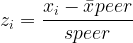
That is the role of the z-score method.
z_{i,y,m} = \frac{ x_{i,y,m} - \overline{x}_{p,y,m} }{ s_{p,y,m} }Where:
i = \text{player} y = \text{season} p = \text{primary position} m = \text{metric}In plain English, the question becomes:
How far did this third baseman stand above or below other third basemen in the same season?
That does not solve every era problem. But it does control for one of the most important things: the player’s immediate positional environment.
Defining the Position
Before ranking third basemen, we first need to understand the position itself.
For the home run study, each player-season was assigned a primary position based on where the player appeared most often:
\mathrm{PrimaryPosition}_{i,y} = \operatorname*{arg\,max}_{p \in \mathcal{P}} G_{i,y,p}Where:
G_{i,y,p} = \text{games played by player } i \text{ at position } p \text{ in season } yThe main home run study used regular player-seasons:
PA \geq 300The full time frame was:
1871–2025
That gave us a broad historical view of how home runs have been distributed by position.
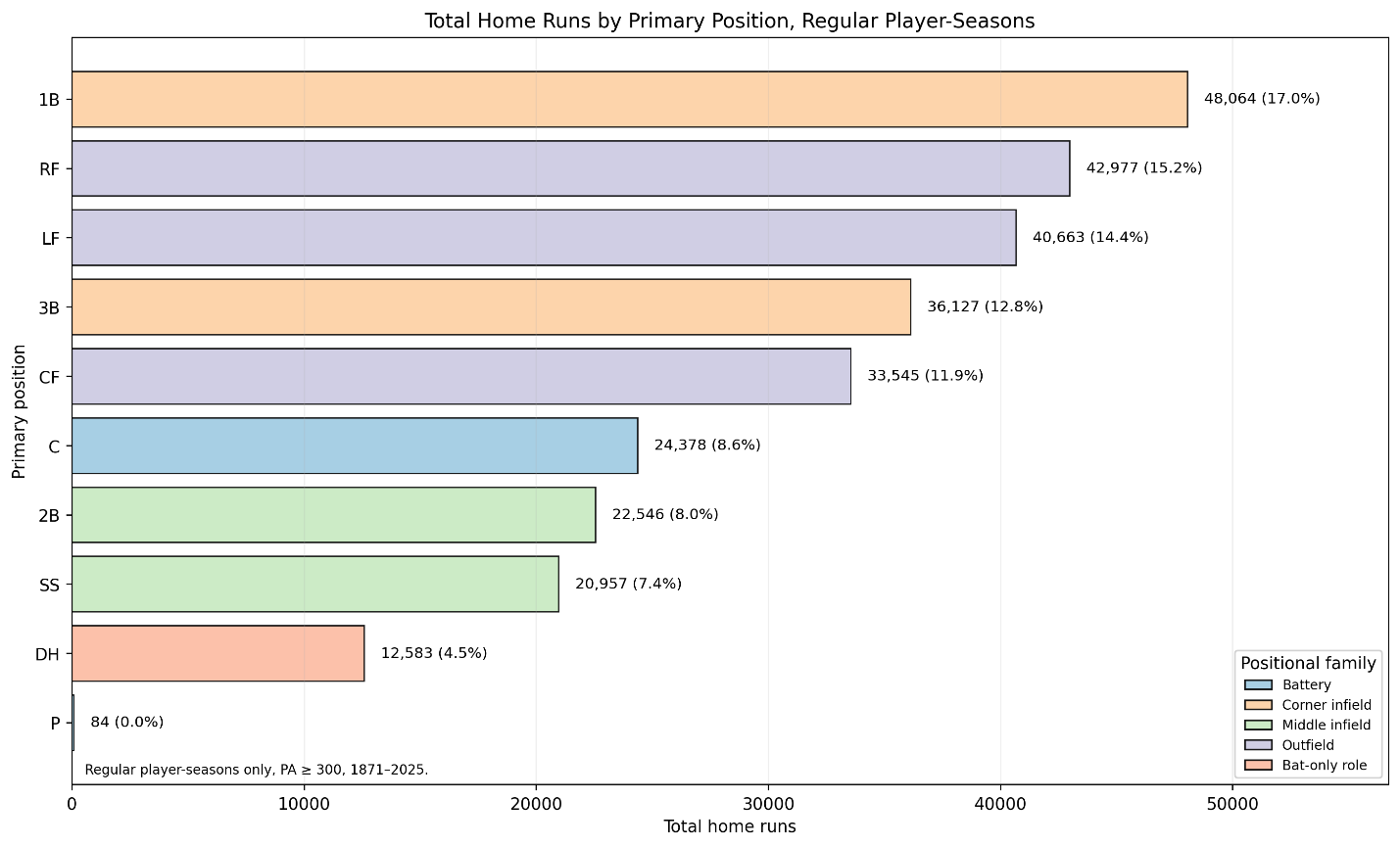
Figure 1: Total Home Runs by Position
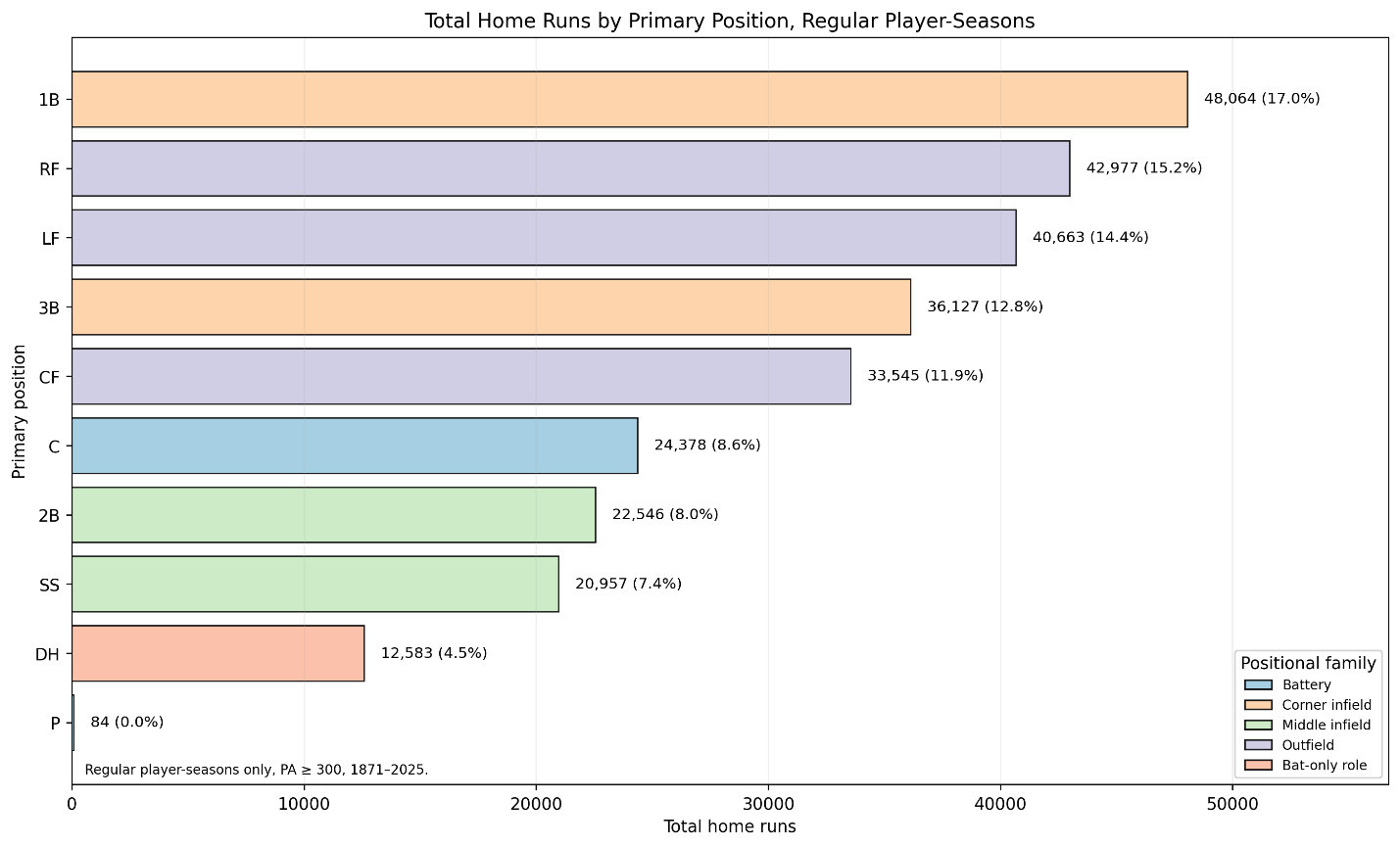
Figure 1. Total home runs by primary position, regular player-seasons, PA ≥ 300, 1871–2025.
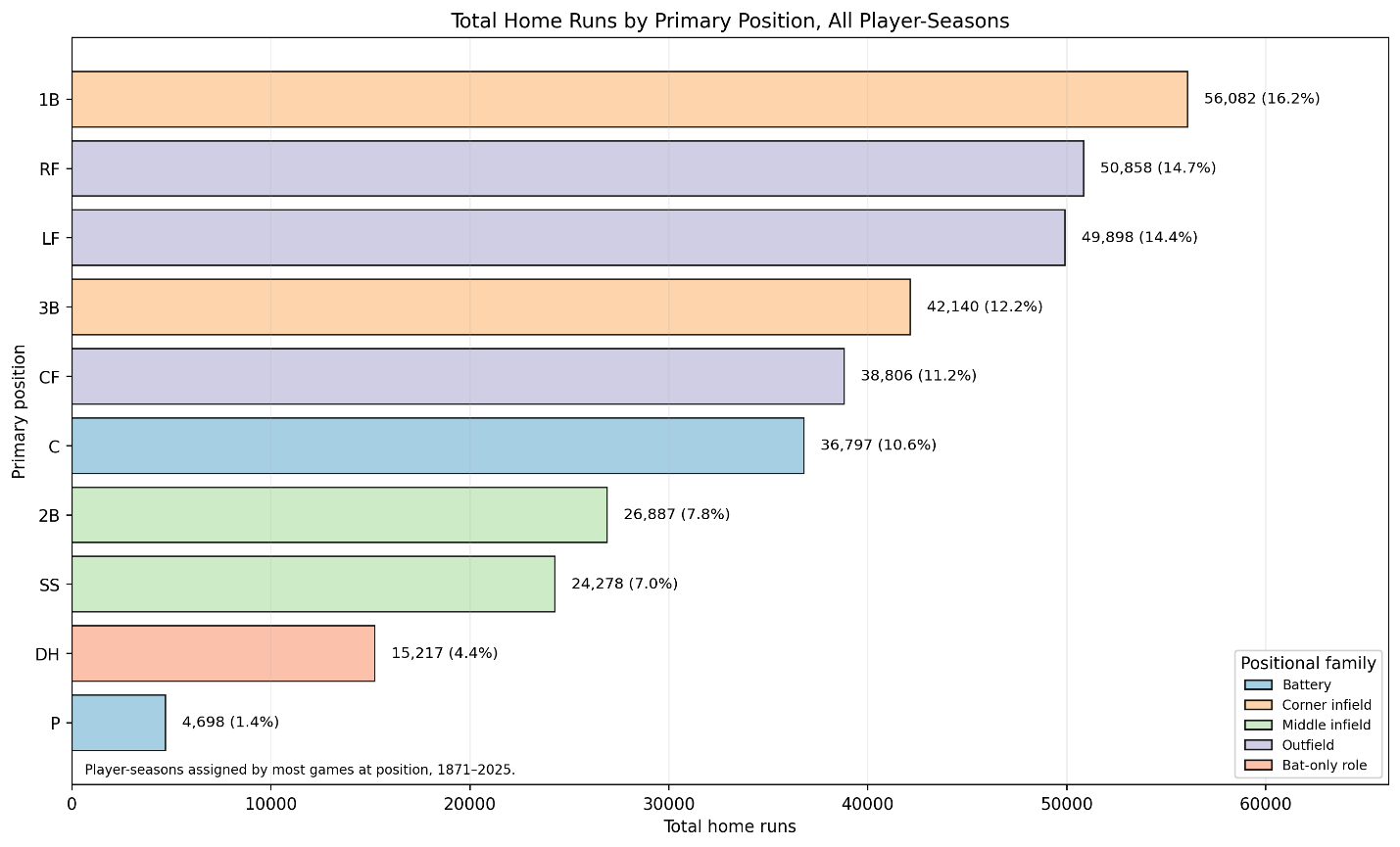
The total home run bar chart gives the project a useful starting point. It shows where the historical home run volume has come from.
For regular player-seasons:
\mathrm{TotalHR}_{1B} = 48{,}064 \mathrm{TotalHR}_{RF} = 42{,}977 \mathrm{TotalHR}_{LF} = 40{,}663 \mathrm{TotalHR}_{3B} = 36{,}127Third base ranks behind first base and the corner outfield positions, but ahead of center field, catcher, second base, and shortstop.
That matters.
It shows that third base has historically been a significant power source. It is not a middle-infield power-light position. But it is not first base either. Third base carries a heavier defensive burden than first base and a higher power expectation than second base or shortstop.
That is the hybrid identity of the position.
The total home run formula is simple:
\mathrm{TotalHR}_{p} = \sum_{i,y} HR_{i,y,p}The conclusion is not subtle:
Third base belongs among the power-producing positions,
but it is not purely a power position.
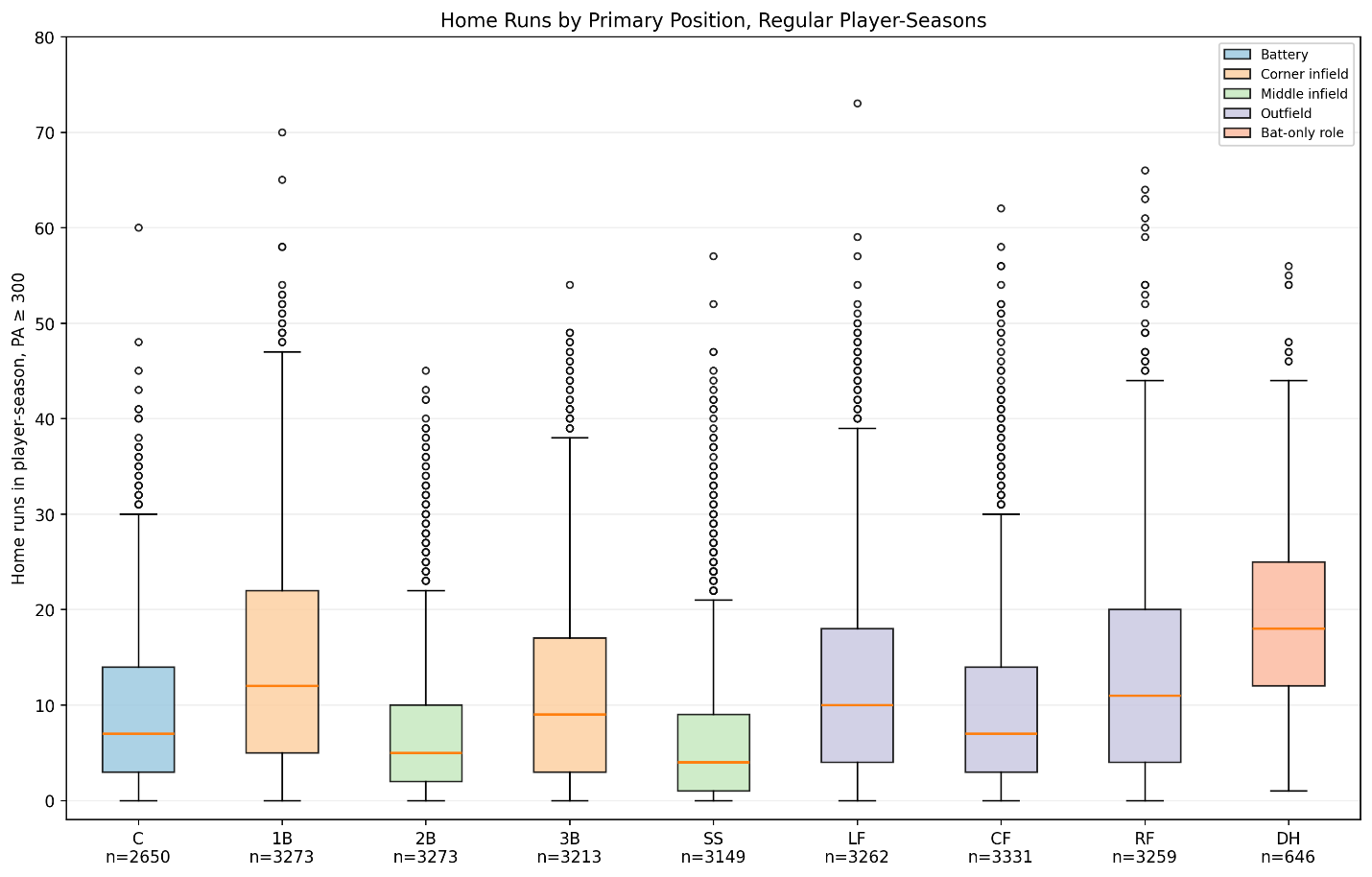
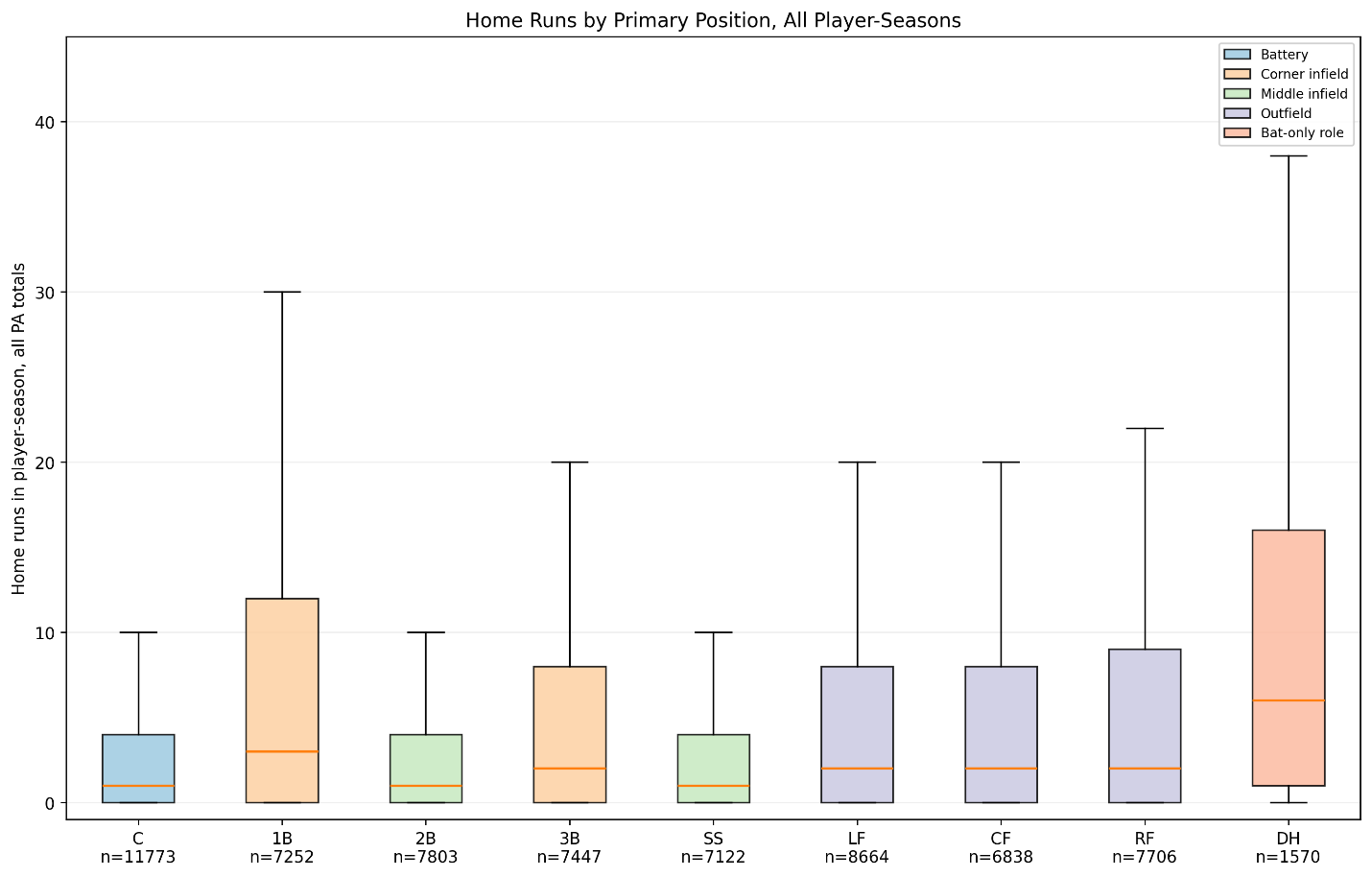
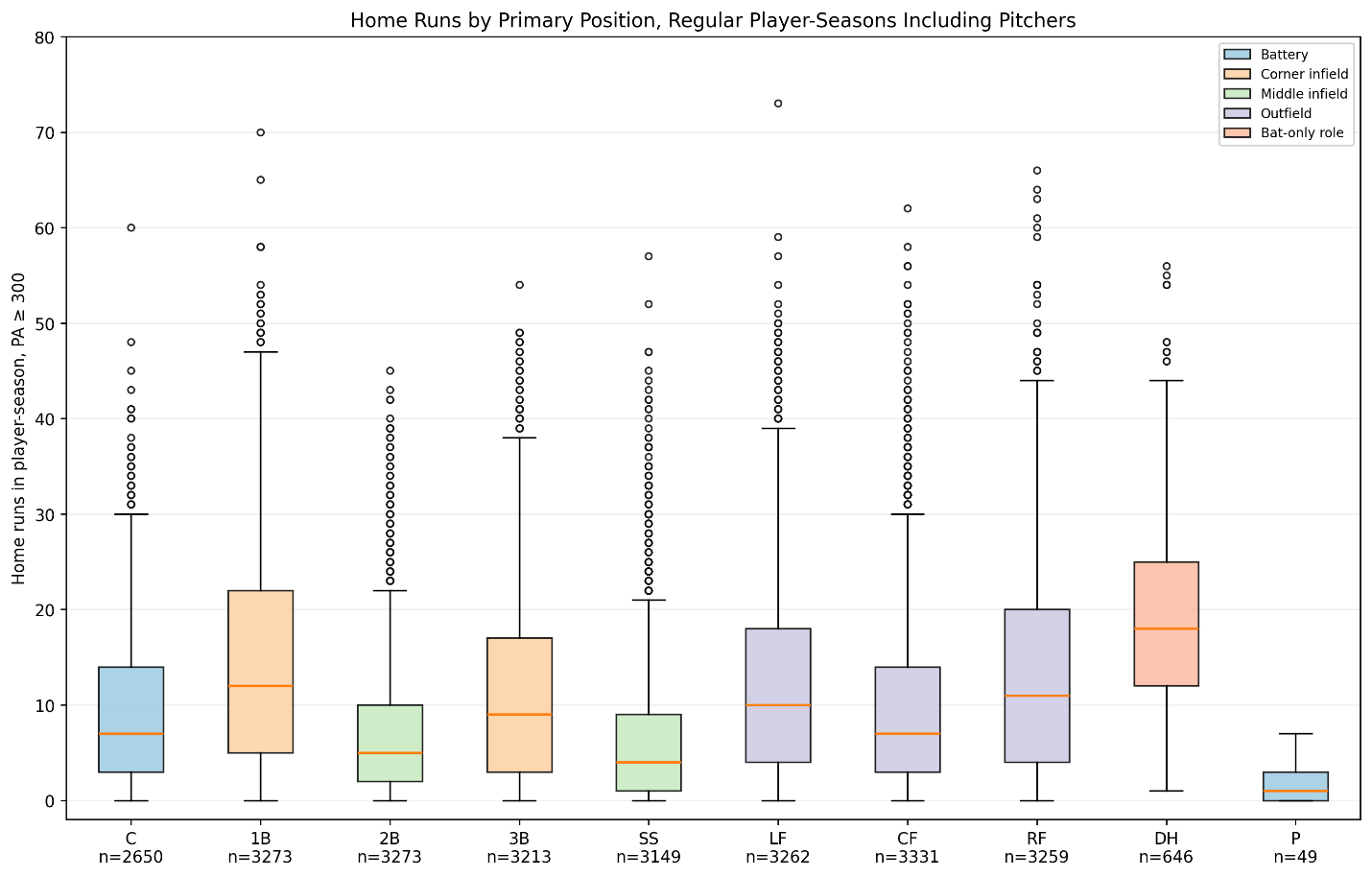
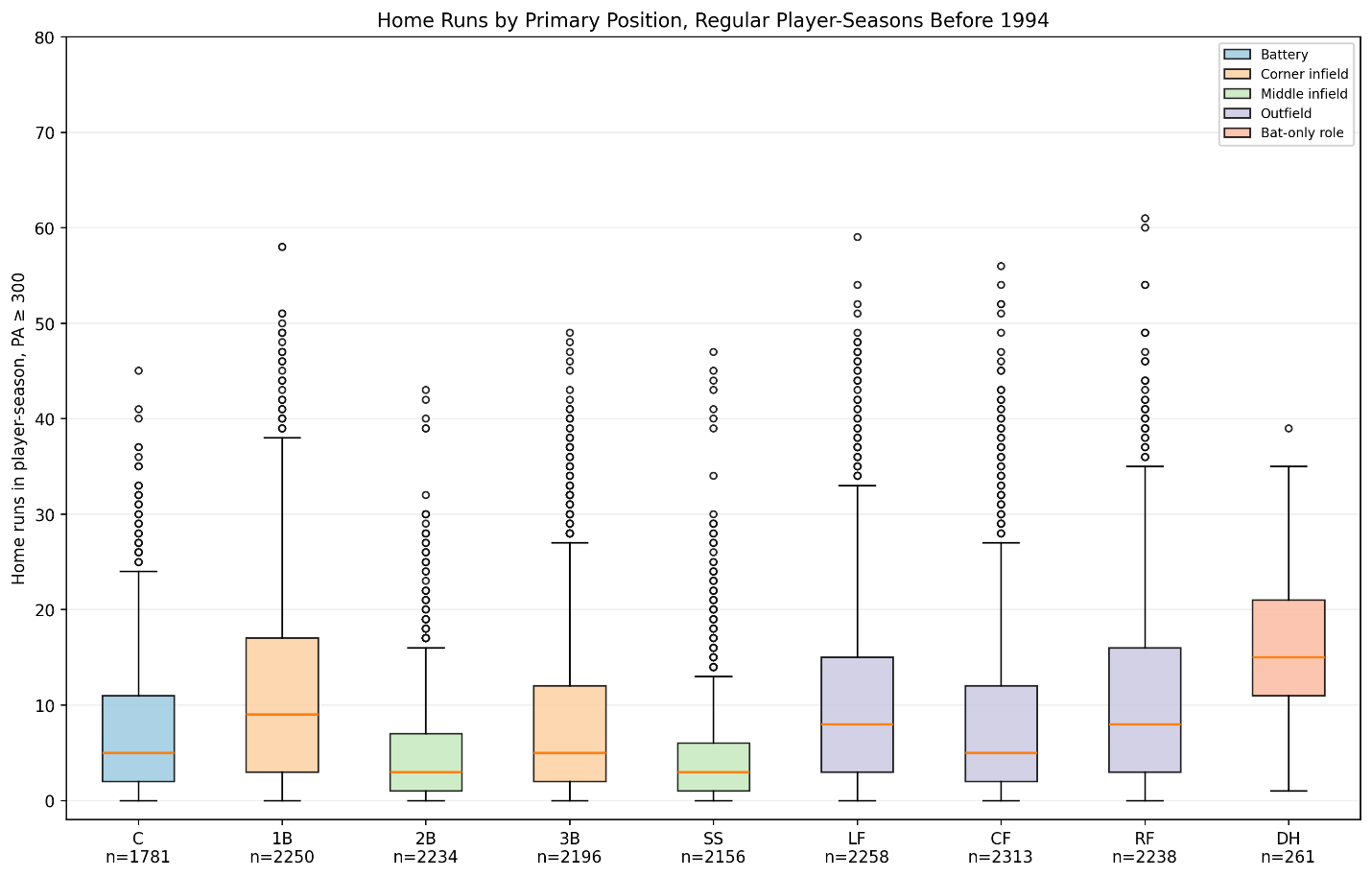
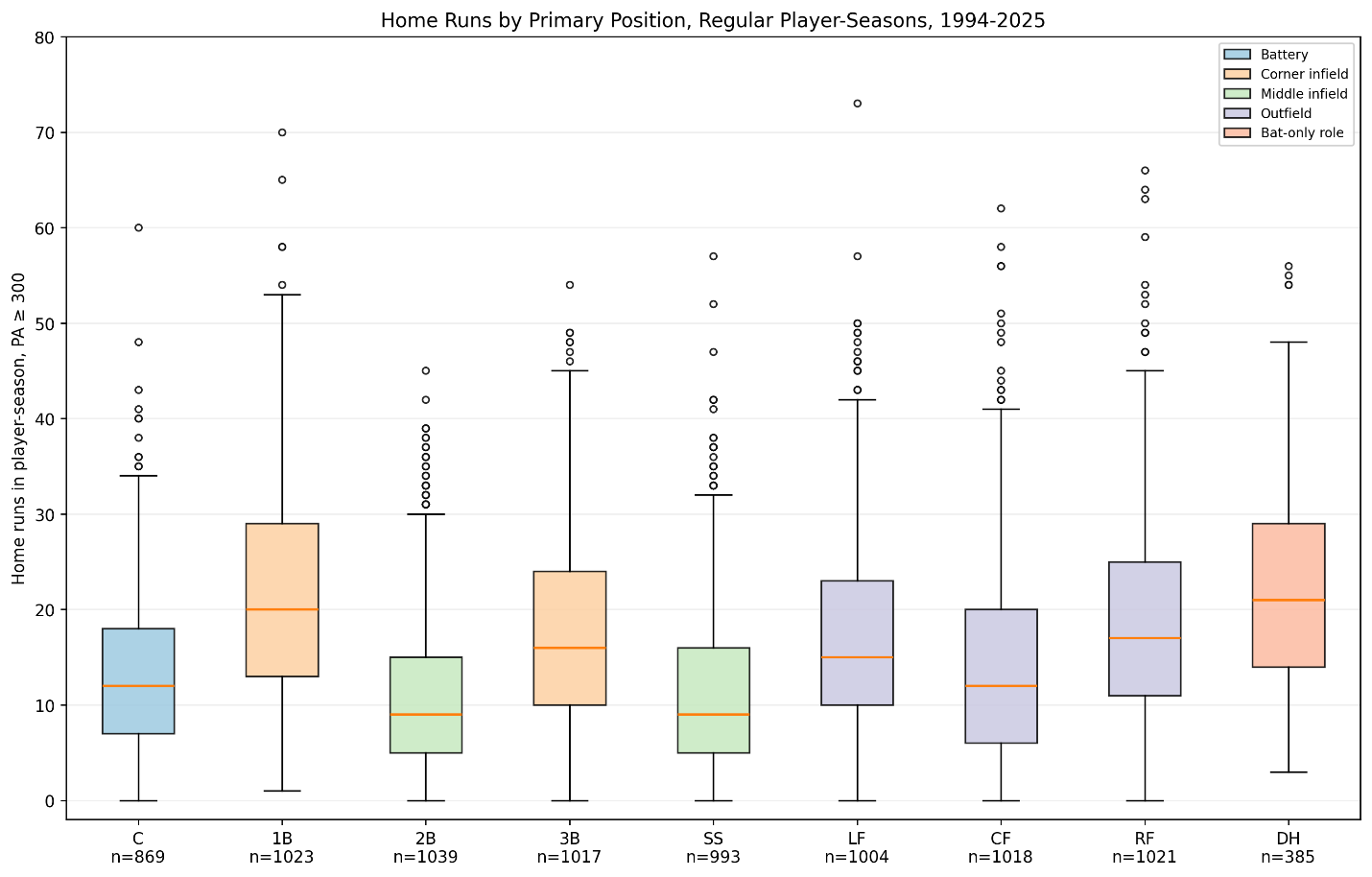
Figure 2: Home Run Distribution by Position
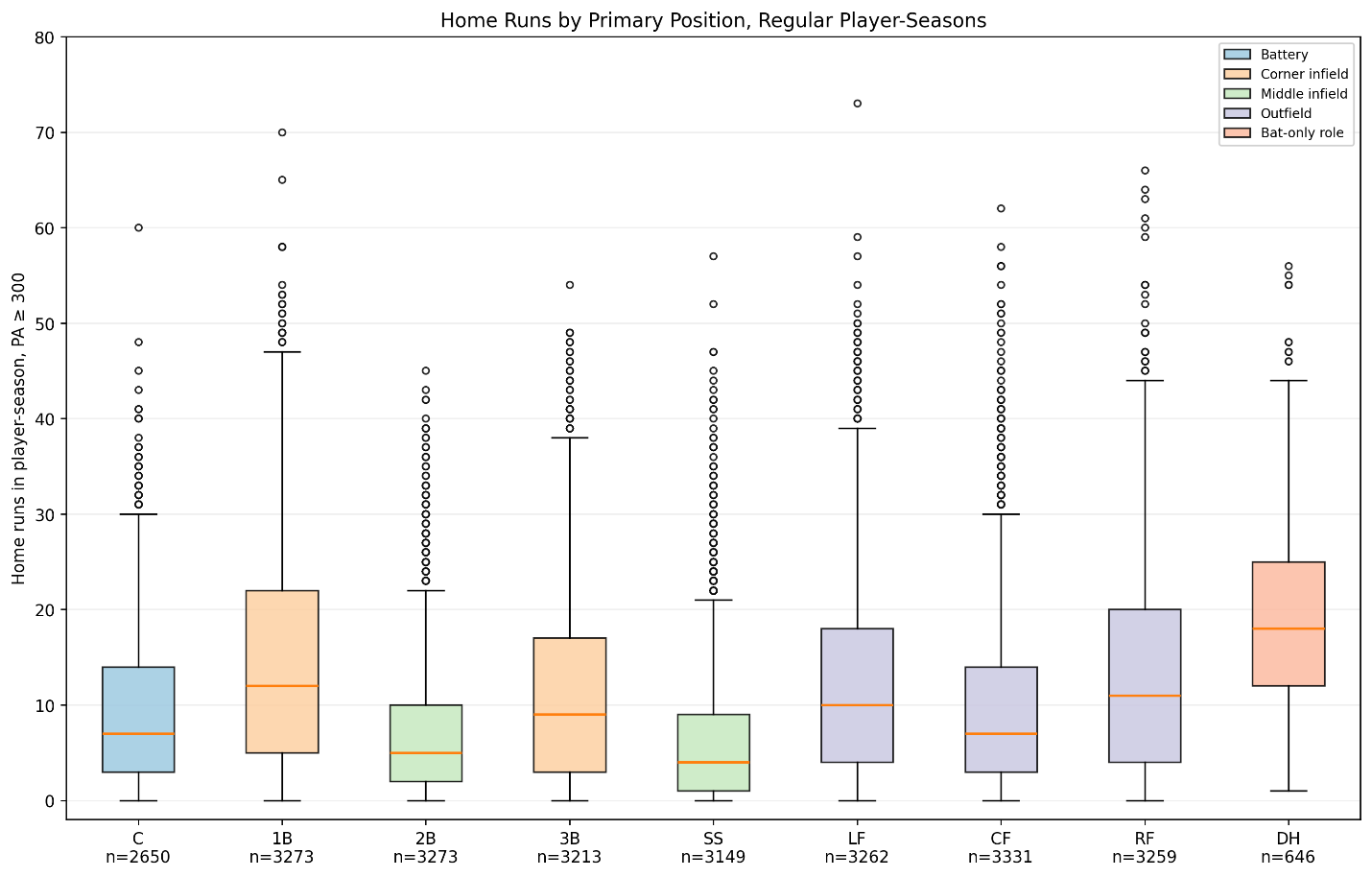
Figure 2. Home runs by primary position, regular player-seasons, PA ≥ 300, 1871–2025.
The box plots add another layer.
The bar chart showed total historical volume. The box plot shows the distribution of individual player-seasons.
For regular player-seasons, the median home runs by position were:
DH: 18
1B: 12
RF: 11
LF: 10
3B: 9
C: 7
CF: 7
2B: 5
SS: 4
In compact form:
\widetilde{\mathrm{HR}}_{\mathrm{DH}} > \widetilde{\mathrm{HR}}_{\mathrm{1B}} > \widetilde{\mathrm{HR}}_{\mathrm{RF}} > \widetilde{\mathrm{HR}}_{\mathrm{LF}} > \widetilde{\mathrm{HR}}_{\mathrm{3B}} > \widetilde{\mathrm{HR}}_{\mathrm{C}} \approx \widetilde{\mathrm{HR}}_{\mathrm{CF}} > \widetilde{\mathrm{HR}}_{\mathrm{2B}} > \widetilde{\mathrm{HR}}_{\mathrm{SS}}Again, third base sits in the middle-to-upper part of the power spectrum.
That position explains why third-base rankings are hard. A third baseman who hits like a first baseman is unusually valuable. A third baseman who fields like an elite shortstop-adjacent defender is also unusually valuable. A third baseman who does both is historically rare.
The Offensive Summit
The offensive studies showed that Mike Schmidt remains the defining offensive third baseman.
Using the Model C offensive framework, the season score combined on-base ability, isolated power, walk rate, strikeout avoidance, baserunning, run scoring, and run production.
\begin{aligned} \mathrm{ModelCOffensiveScore} &= z_{\mathrm{OBP}} + z_{\mathrm{ISO}} + z_{\mathrm{BB/PA}} + z_{\mathrm{LowSO/PA}} \\ &\quad+ z_{\mathrm{NetSB/PA}} + z_{\mathrm{R/PA}} + z_{\mathrm{RBI/PA}} \end{aligned}The career score was the sum of weighted season scores:
\mathrm{CareerScore} = \sum_s \mathrm{WeightedSeasonScore}_{s}And peak value was measured through a player’s best seven seasons:
\mathrm{Peak7Score} = \sum_{k=1}^{7} \mathrm{BestSeasonScore}_{k}Schmidt’s greatness came from both career value and peak value. He was not merely a compiler. He was not merely a short-peak slugger. He combined long-term production with enormous seasonal dominance.
The offensive group around him included Eddie Mathews, Chipper Jones, George Brett, Jose Ramirez, Alex Rodriguez, Wade Boggs, Home Run Baker, Ron Santo, and David Wright.
But they were not all the same kind of offensive player.
Schmidt was power and patience.
Boggs was on-base dominance.
Brett was batting skill and all-around production.
Chipper was switch-hitting offensive force.
Jose Ramirez was compact modern power, baserunning, and peak efficiency.
Mathews was long-career left-handed power.
The offensive rankings showed that third-base greatness has several offensive forms.
The Defensive Summit
The traditional defensive study told a different story.
The defensive model used assists per game, putouts per game, double plays per game, fielding percentage, and low errors per game.
\mathrm{TraditionalDefensiveScore} = z_{\mathrm{A/G}} + z_{\mathrm{PO/G}} + z_{\mathrm{DP/G}} + z_{\mathrm{FPct}} + z_{\mathrm{LowE/G}}The defensive peak and career results were clear:
Brooks Robinson is the traditional defensive summit.
Robinson stood apart because his defensive career was both excellent and enormous. He was not only a peak defender. He was a long-duration defensive institution.
The next group included Nolan Arenado, Gary Gaetti, Willie Kamm, Buddy Bell, Clete Boyer, Adrian Beltre, Scott Rolen, Matt Chapman, Graig Nettles, Mike Lowell, and Wade Boggs.
This defensive list is important because it changes the shape of the third-base conversation.
If we looked only at offense, Brooks Robinson would not appear near the top. If we looked only at defense, Chipper Jones would not appear near the top. Third base requires us to keep both dimensions visible.
Figure 3: Offense and Defense Together
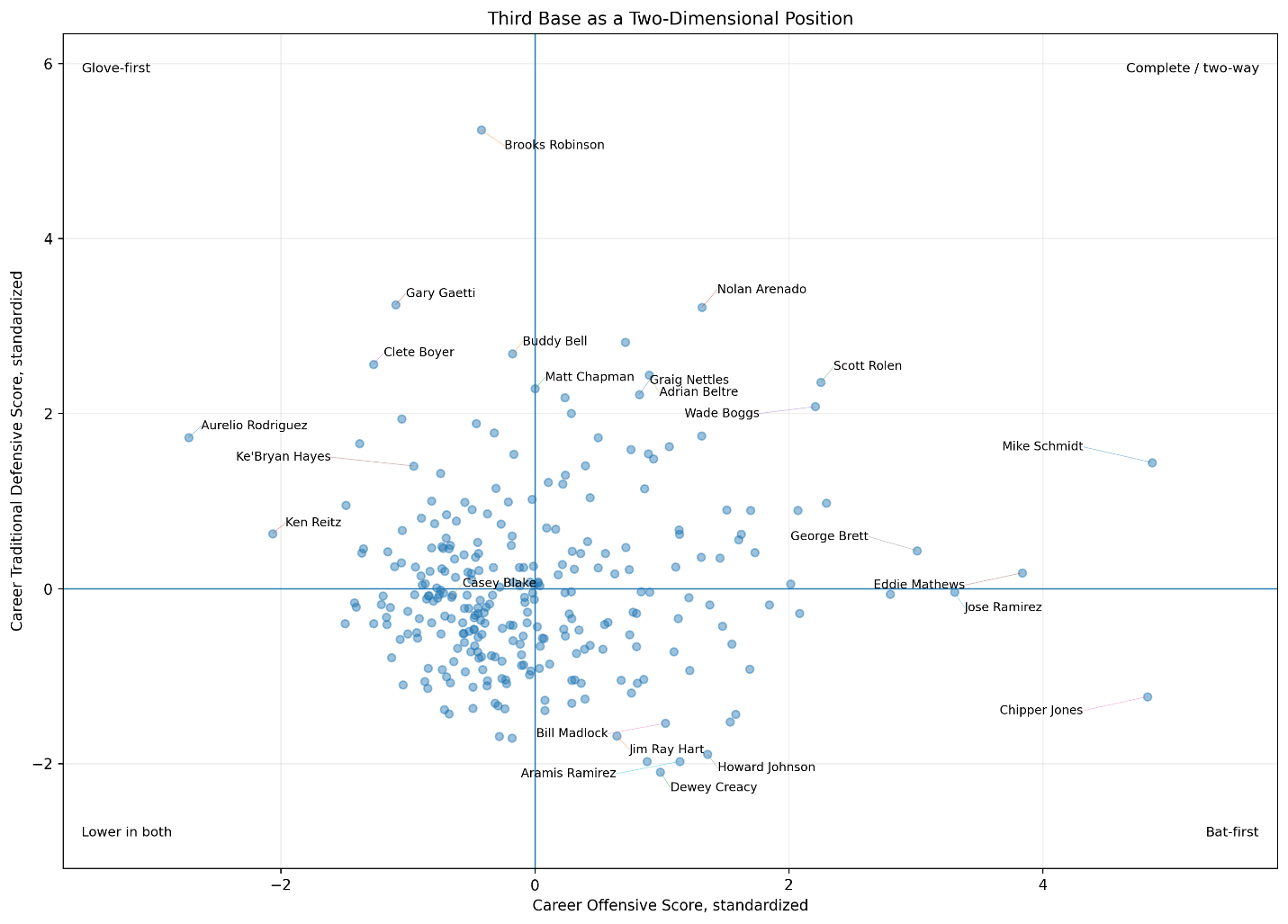
Figure 3. Career offensive score versus traditional defensive score for third basemen.
The two-dimensional scatterplot is one of the most important figures in the project.
It shows that third basemen do not fall along a single line from bad to great. They occupy different regions of the offensive-defensive space.
The combined two-way score was built by standardizing the career offensive and defensive dimensions:
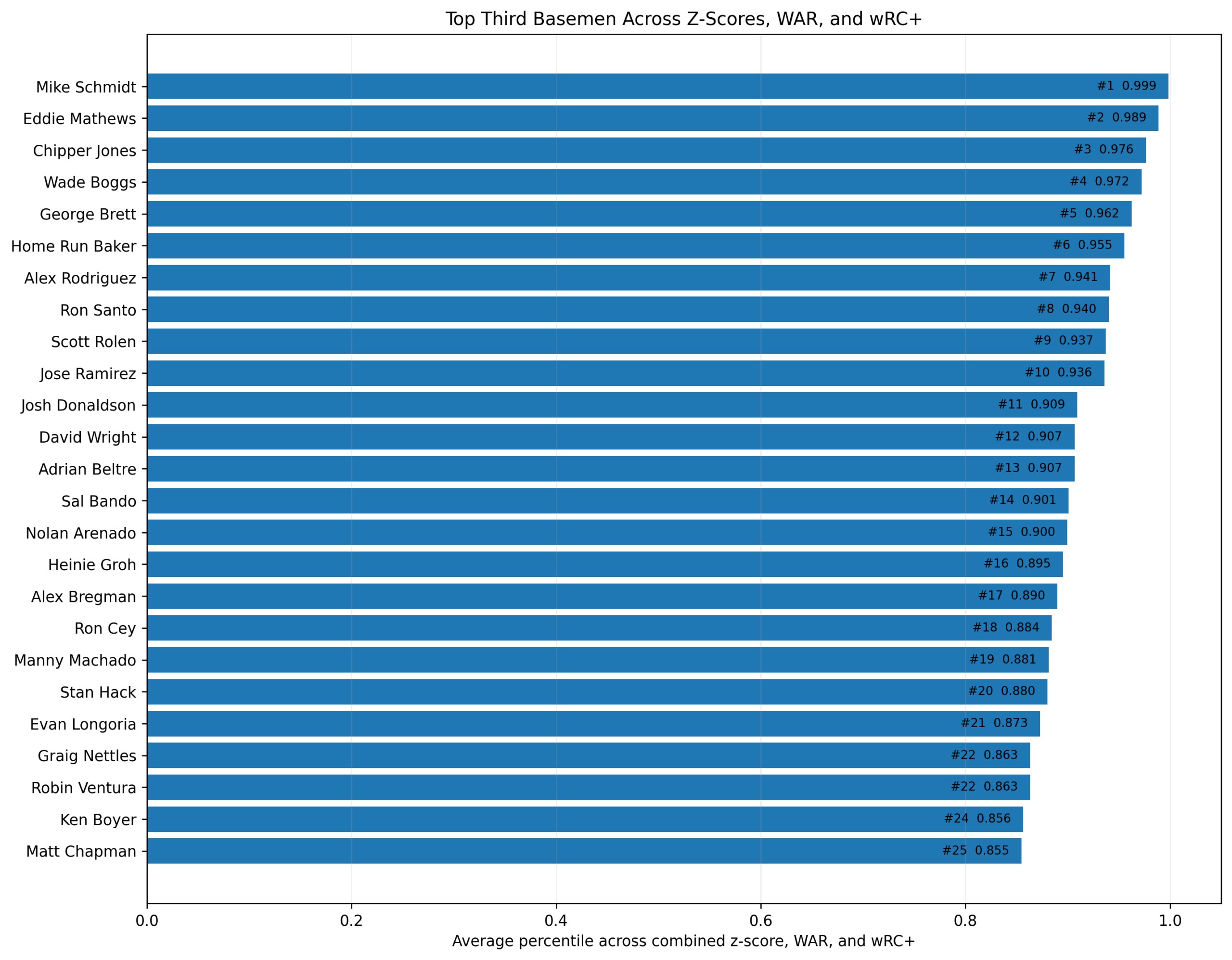
\mathrm{CombinedZ}_{i} = z_{\mathrm{Offense},i} + z_{\mathrm{Defense},i}The top of the combined list included:
Mike Schmidt
Brooks Robinson
Scott Rolen
Nolan Arenado
Wade Boggs
Eddie Mathews
Chipper Jones
Willie Kamm
George Brett
Adrian Beltre
This is the key result of the project.
Mike Schmidt wins because he was historically great on offense and still positive on defense.
Brooks Robinson ranks so high because his defensive value was so extreme that it overcame a more modest offensive profile.
Scott Rolen and Adrian Beltre matter because they represent the two-way ideal. They were not Schmidt-level offensive forces or Brooks-level defensive singularities, but they were excellent in both directions.
Nolan Arenado appears as a modern defense-heavy two-way star. Wade Boggs appears as a batting-and-defense star whose value is not captured by power alone.
Third base becomes clearest when seen as a two-axis position.
Figure 4: Dendrogram of Top Combined Third Basemen
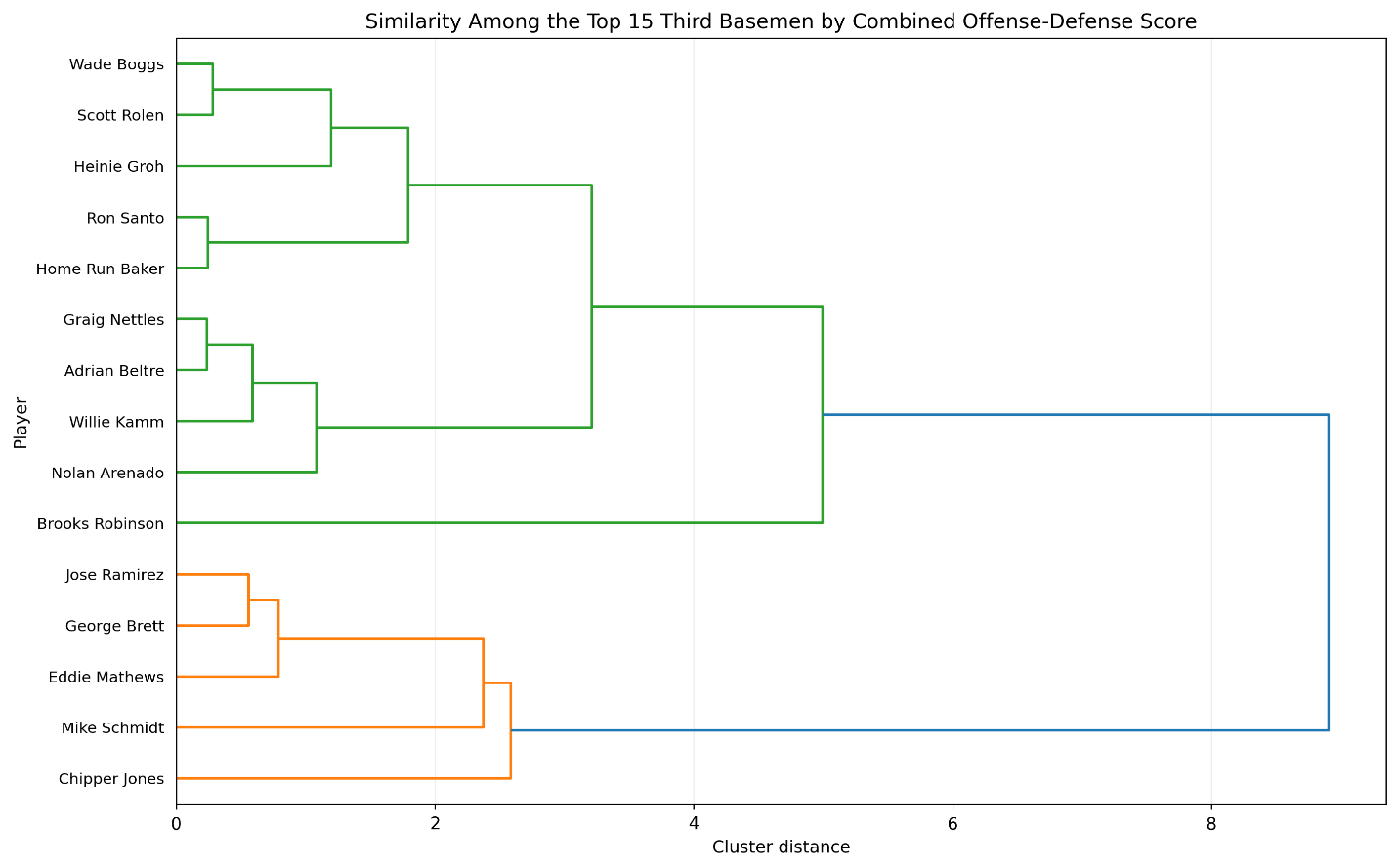
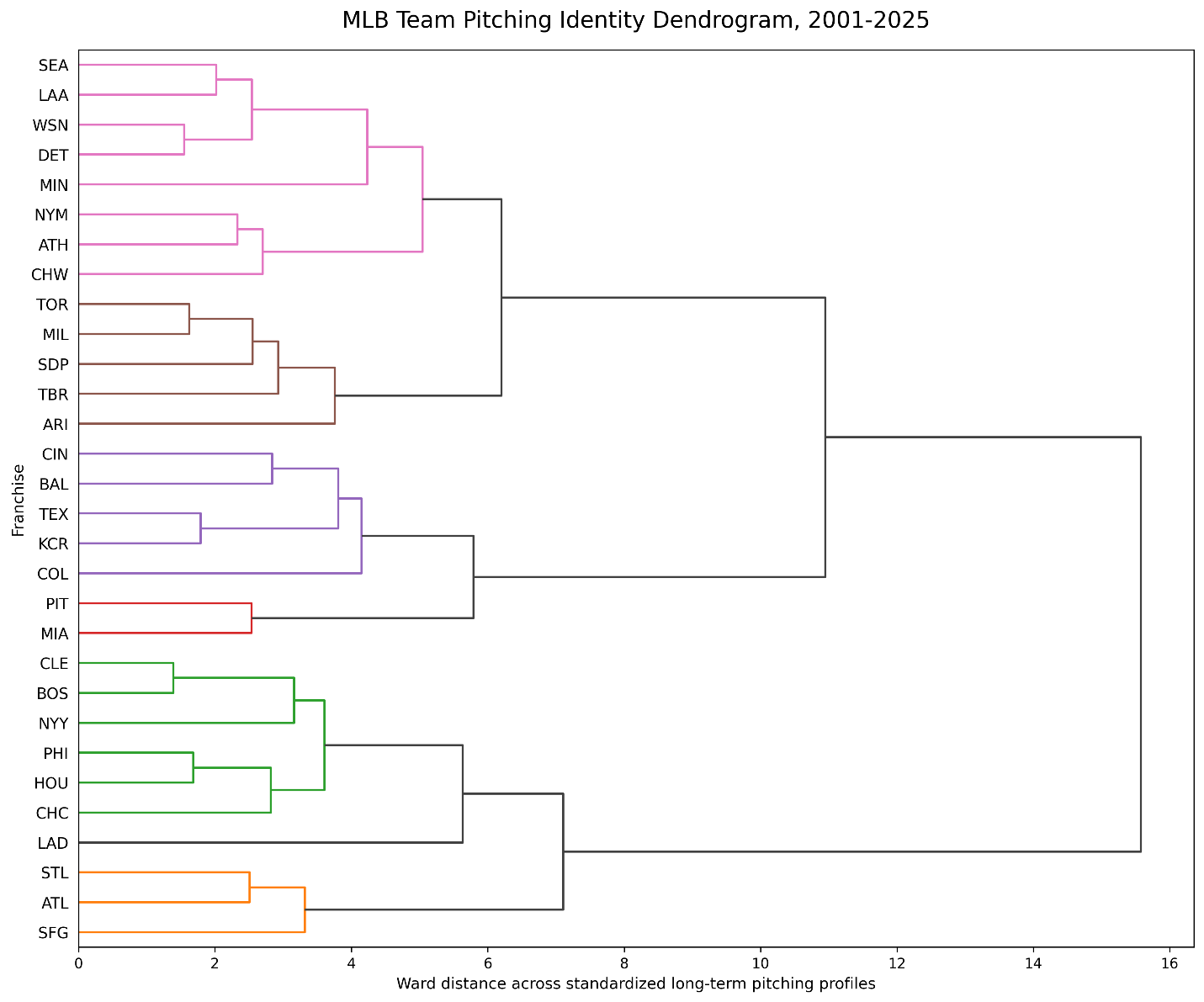
Figure 4. Dendrogram showing similarity among the top 15 third basemen by combined offense-defense score.
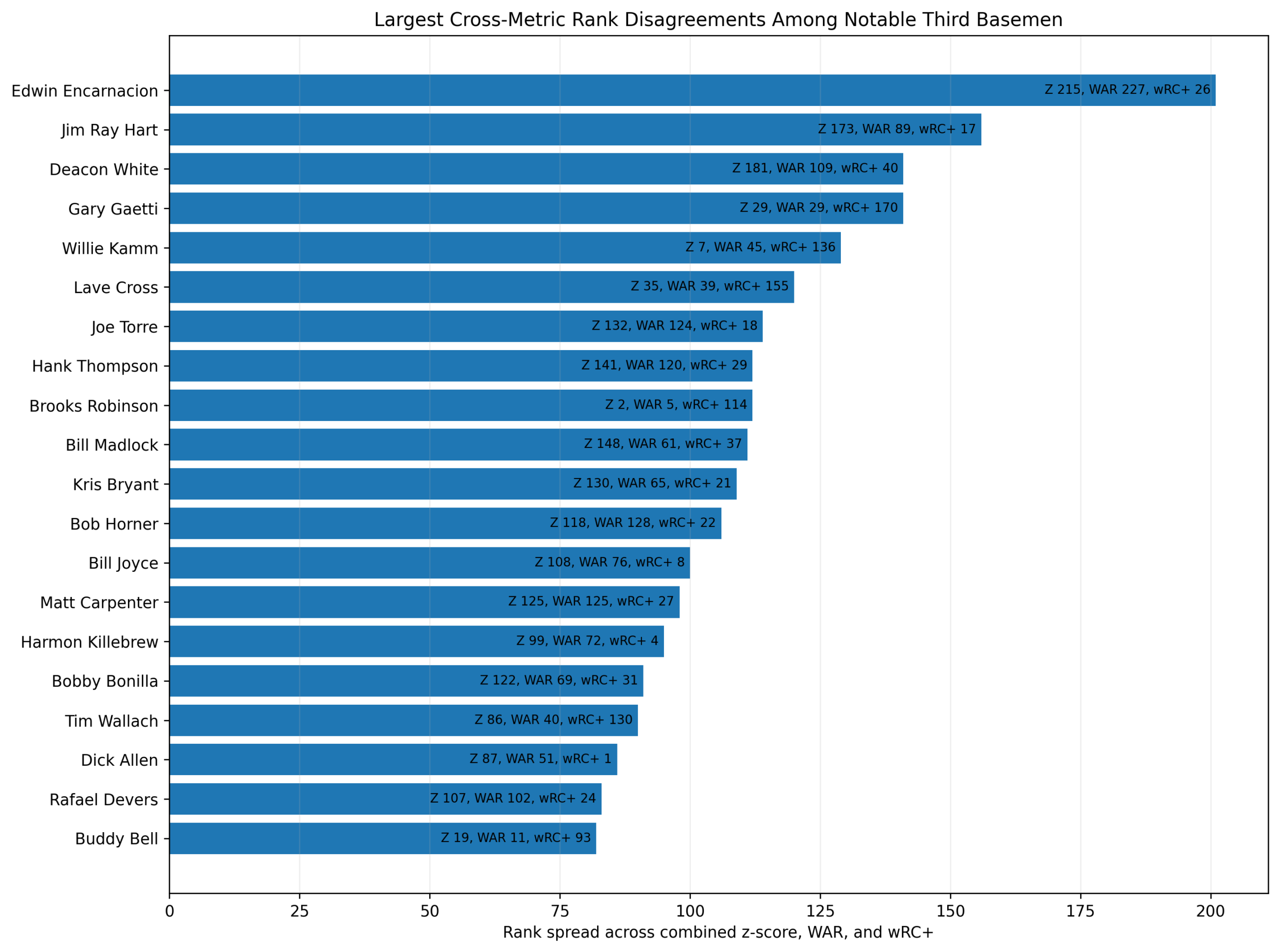
The combined top list is not the same as the top offensive or top defensive lists.
That is the point.
A one-stat answer hides the different paths to value. The combined score helps reveal those paths.
The general model is:
\mathrm{TwoWayScore}_{i} = z_{\mathrm{Offense},i} + z_{\mathrm{Defense},i}But the interpretation matters more than the arithmetic.
Schmidt is the best answer because he dominates the total landscape.
Robinson is the best defensive answer.
Chipper is one of the best offensive answers.
Rolen and Beltre are among the cleanest two-way answers.
Boggs and Brett show that contact, on-base skill, and complete offensive value can compete with pure home run power.
Arenado shows how a modern elite defender can push into the historical top tier.
The final ranking should therefore not be read as a single flat list. It should be read as a map of greatness.
The Center of the Position
The middle of the project may have been just as revealing as the top.
When we searched for the most average third basemen, we found different kinds of centers.
Offensively, Casey Blake represented a kind of Model C center.
Defensively, Eddie Mathews appeared surprisingly close to the traditional defensive center.
In the two-dimensional offense-defense space, Bill Melton emerged as the closest player to the combined center.
The two-dimensional typicality calculation was:
\mathrm{Typicality}_{i} = \sqrt{ z_{\mathrm{Offense},i}^{2} + z_{\mathrm{Defense},i}^{2} }A low value means the player is close to the center of the third-base population.
This was useful because the average player gives meaning to the extremes.
Without the center, Schmidt is just a big number.
With the center, Schmidt becomes distance from normal.
Without the center, Brooks Robinson is just a defensive legend.
With the center, we can see how unusual his profile really was.
The middle defines the scale.
Figure 5: Closest Third Basemen to the Offense-Defense Center
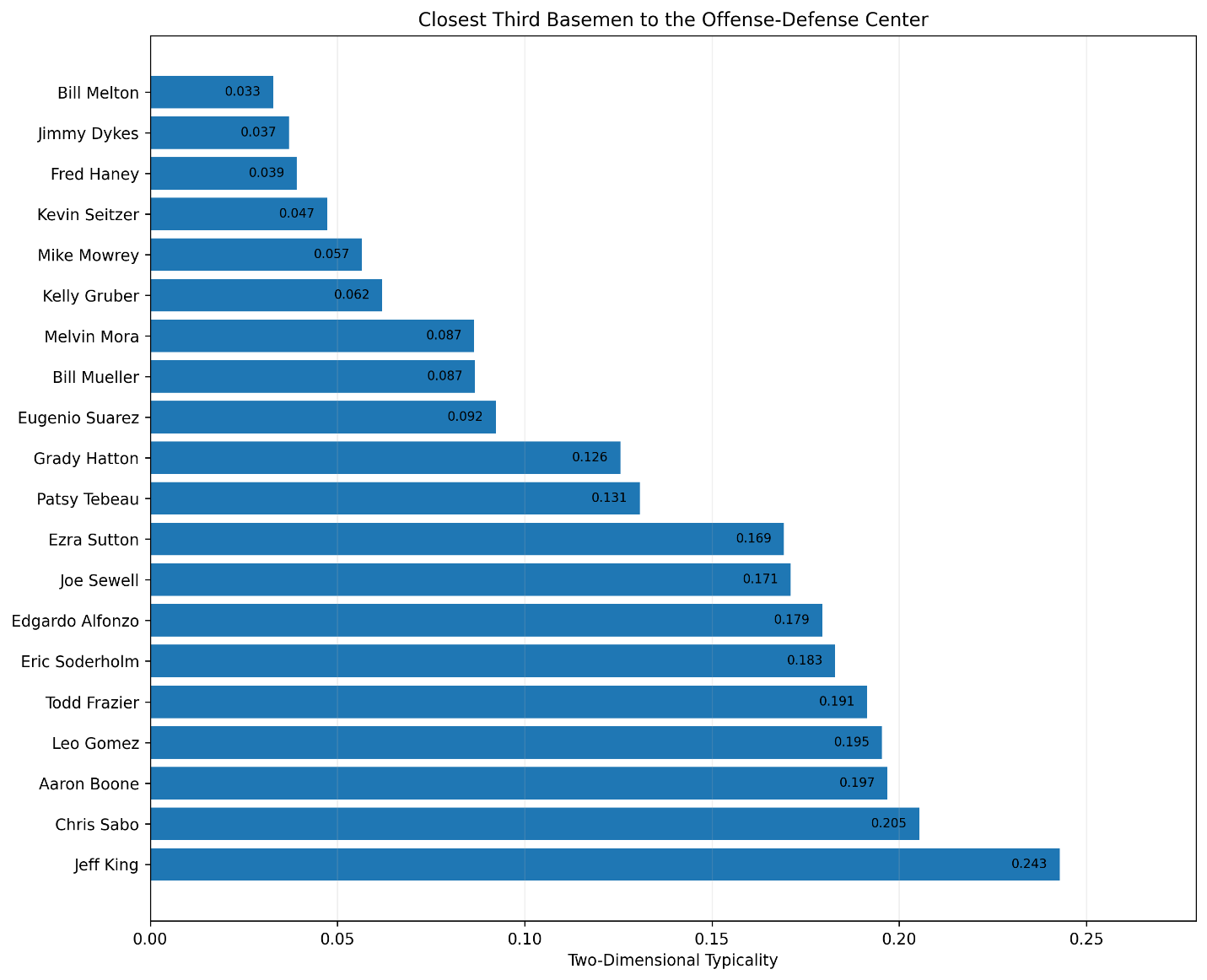
Figure 5. Third basemen closest to the two-dimensional offense-defense center, measured by typicality.
The Lower Tail
The lower-tail studies also mattered.
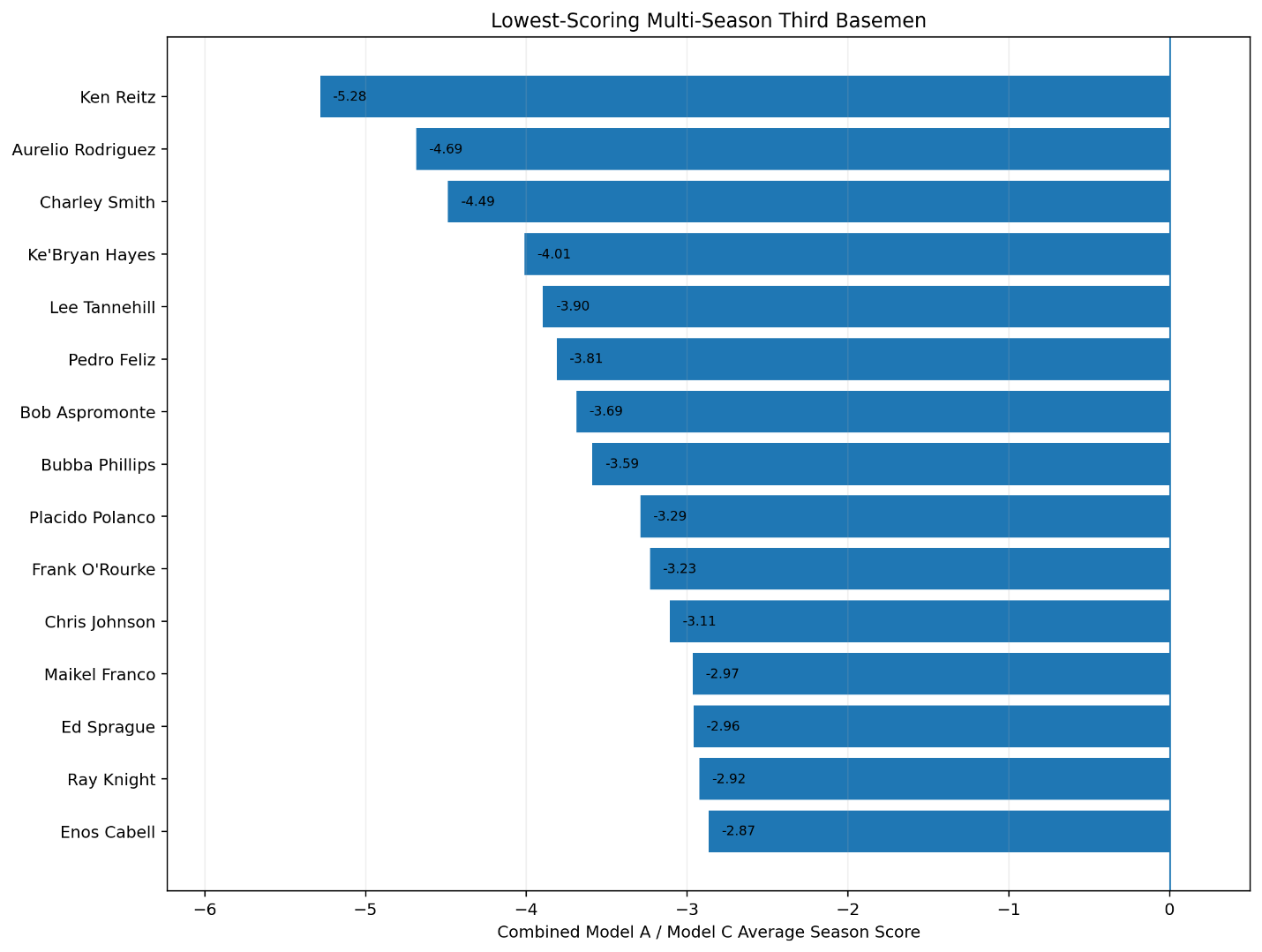
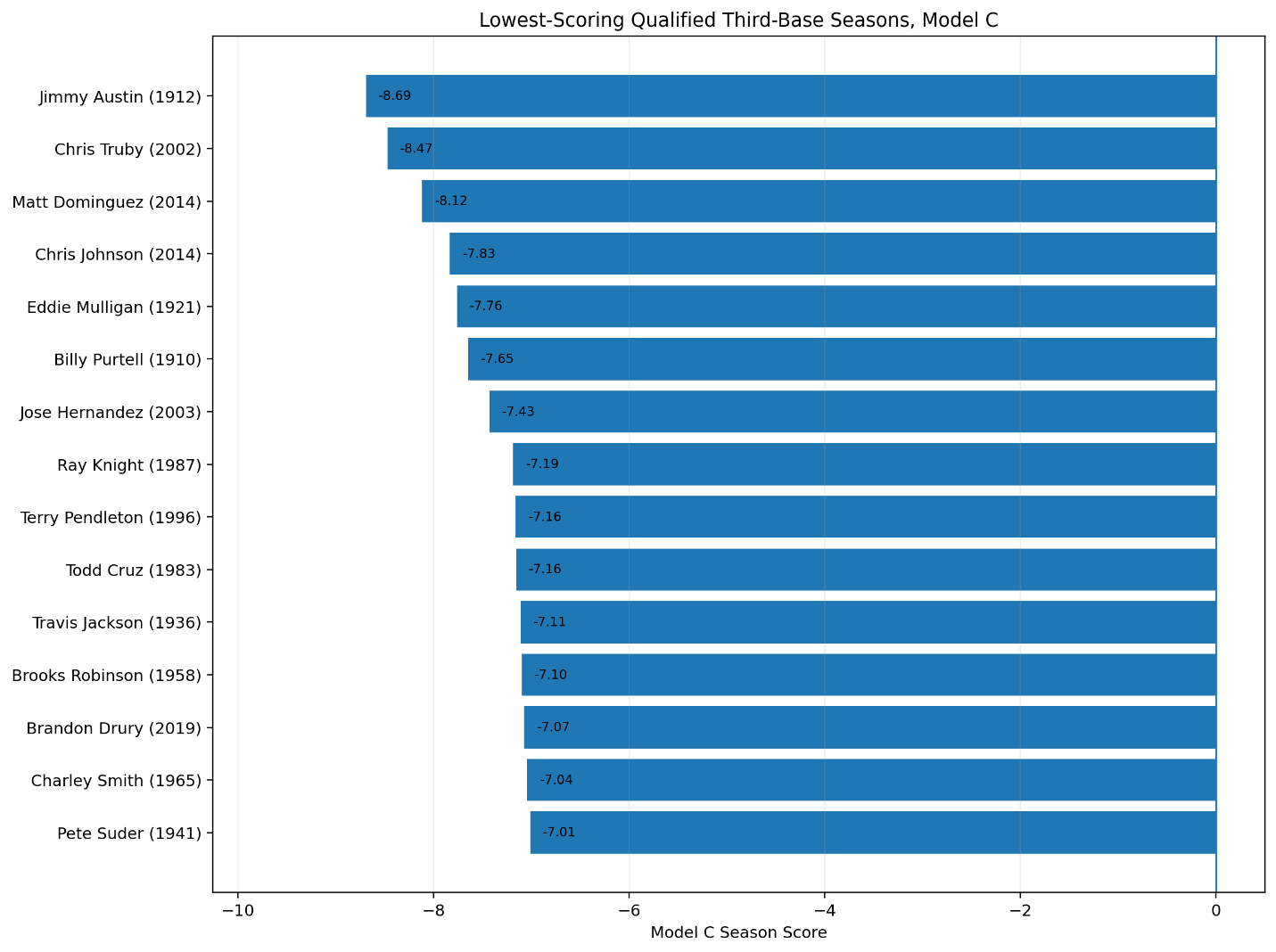
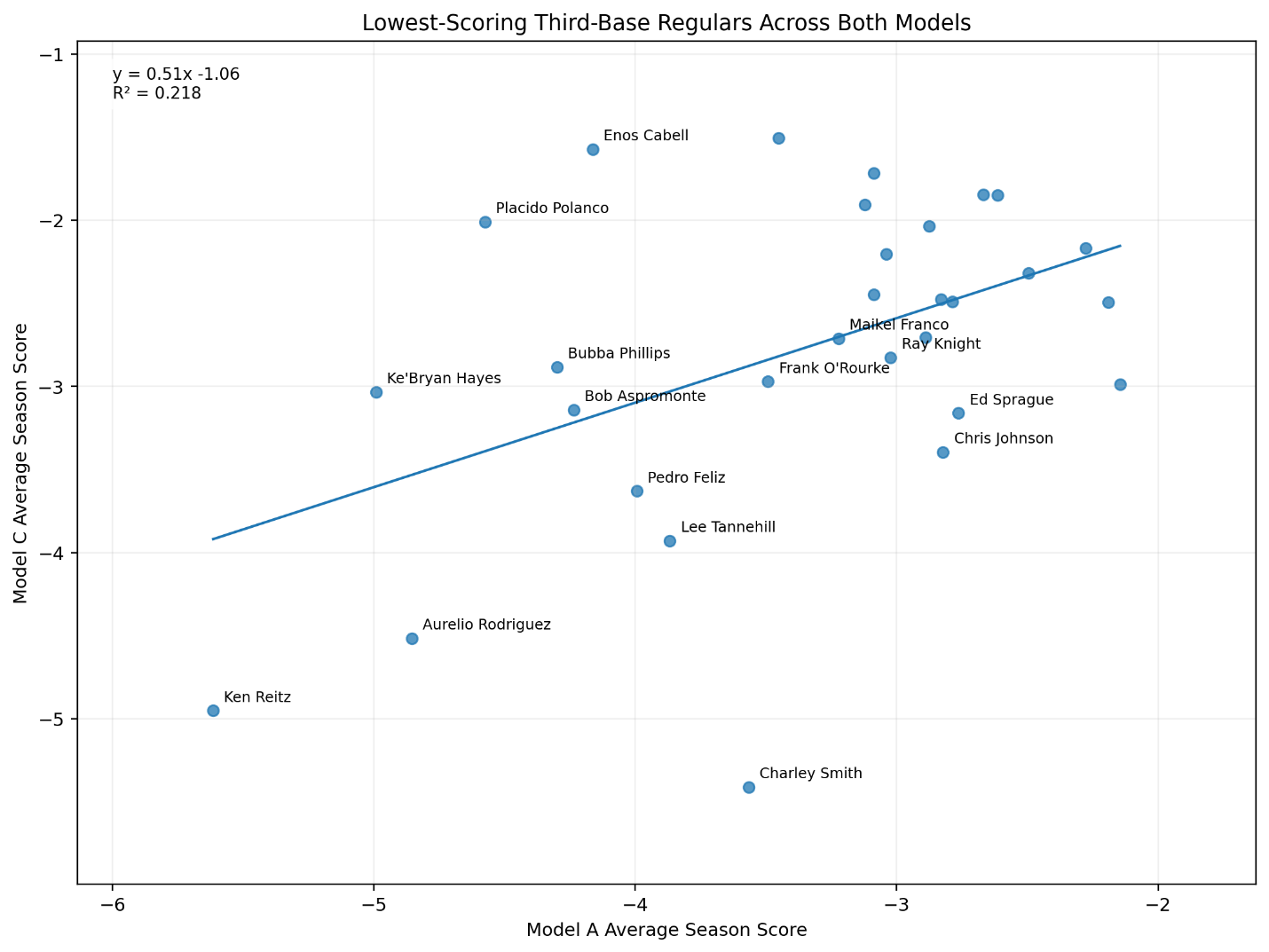
Ken Reitz appeared as the lower offensive tail among third-base regulars, but his traditional defensive profile was positive. That makes him more interesting than a simple “worst hitter” label.
Chris Johnson emerged as a lower-tier tailback because he combined a weak offensive standing with a weak traditional defensive standing.
Figure 6: Lowest Combined Offense-Defense Third Basemen
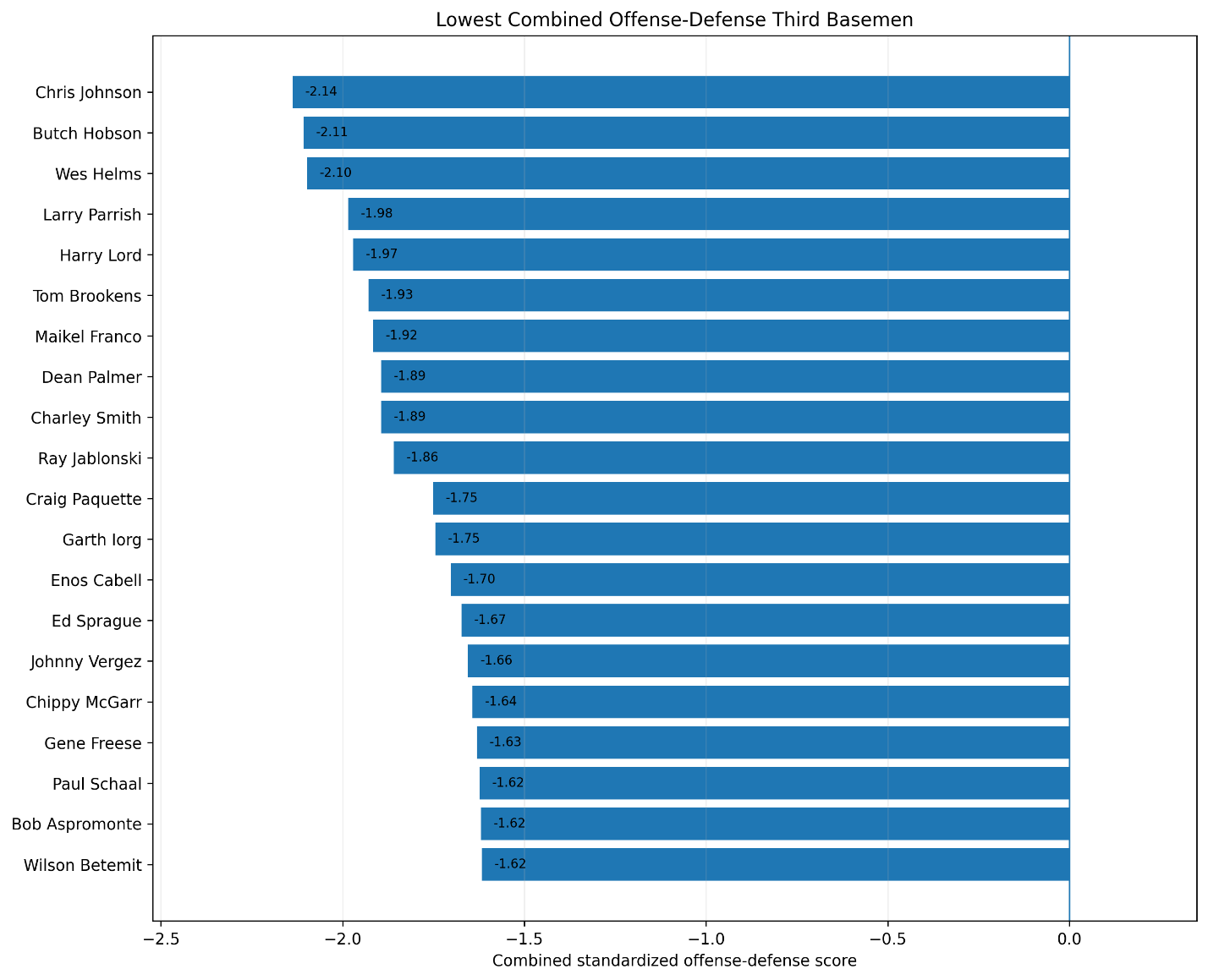
Figure 6. Lowest combined offense-defense scores among third-base regulars.
The lower-tail combined score was:
\mathrm{LowerTailScore}_{i} = z_{\mathrm{Offense},i} + z_{\mathrm{Defense},i}The lowest combined players included:
Chris Johnson
Butch Hobson
Wes Helms
Larry Parrish
Harry Lord
Tom Brookens
Maikel Franco
Dean Palmer
Charley Smith
Ray Jablonski
The lower tail reinforced a point that runs through the whole project:
A bad offensive third baseman is not necessarily a bad third baseman.
A bad defensive third baseman is not necessarily a bad third baseman.
But a player weak in both dimensions falls quickly.
Third base gives players several ways to survive. But it also exposes players who cannot contribute either way.
Validation with WAR
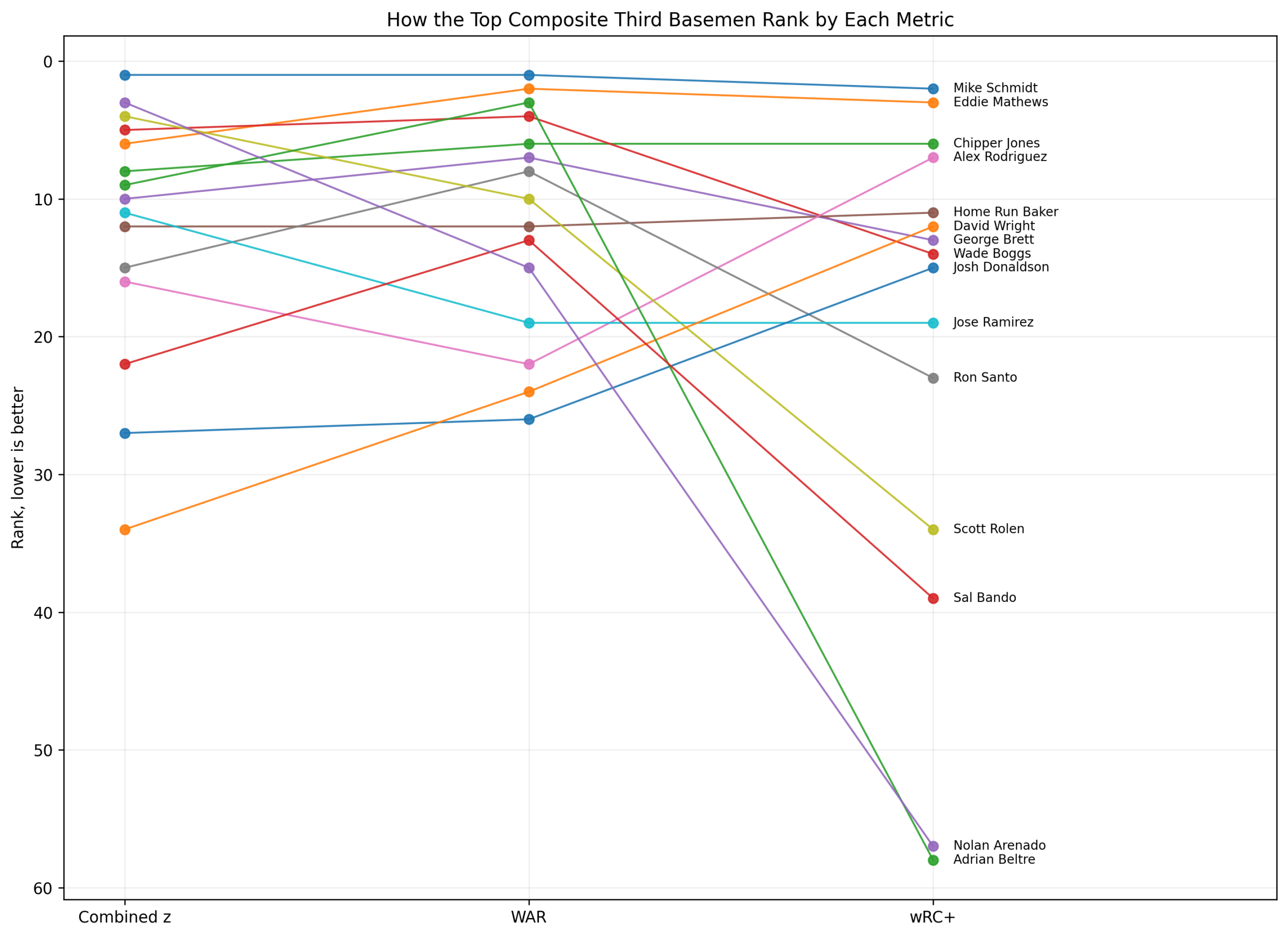
The WAR validation study gave the project an external check.
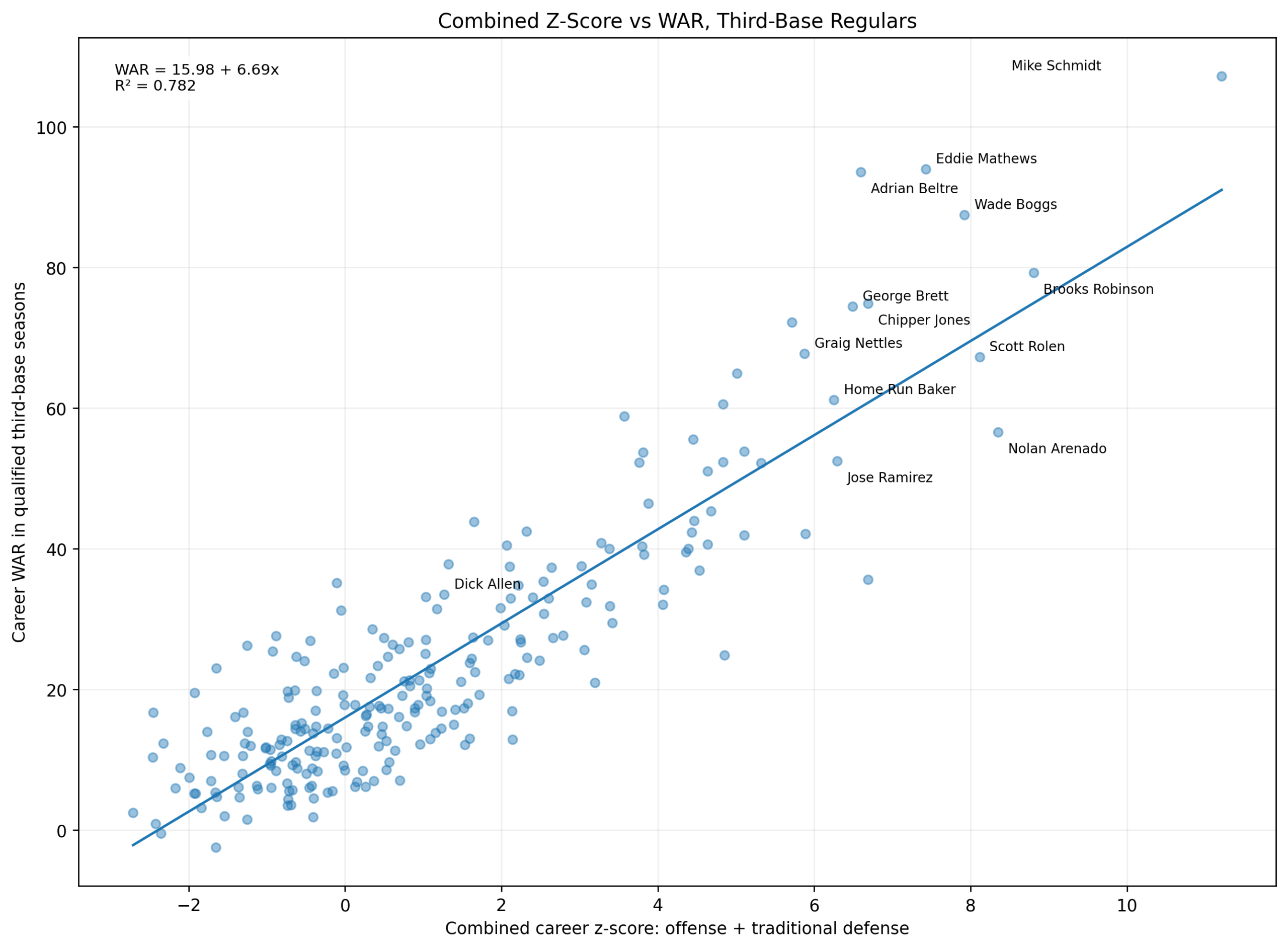
The model was not designed to reproduce WAR exactly. But if the offensive and defensive scores were meaningful, they should explain a substantial portion of WAR variation.
At the career level for regular third basemen, the offense-plus-defense model was strong:
\mathrm{WAR} = 14.90 + 0.60(\mathrm{CareerOffensiveScore}) + 0.59(\mathrm{CareerDefensiveScore}) R^2 = 0.814That is an important result.
It means the simple, transparent framework captures much of what WAR captures, even though WAR is built on a more complex run-value framework.
The validation did not prove the model was perfect. It showed that the model was sensible.
Offense mattered.
Defense mattered.
Together they explained much more than either alone.
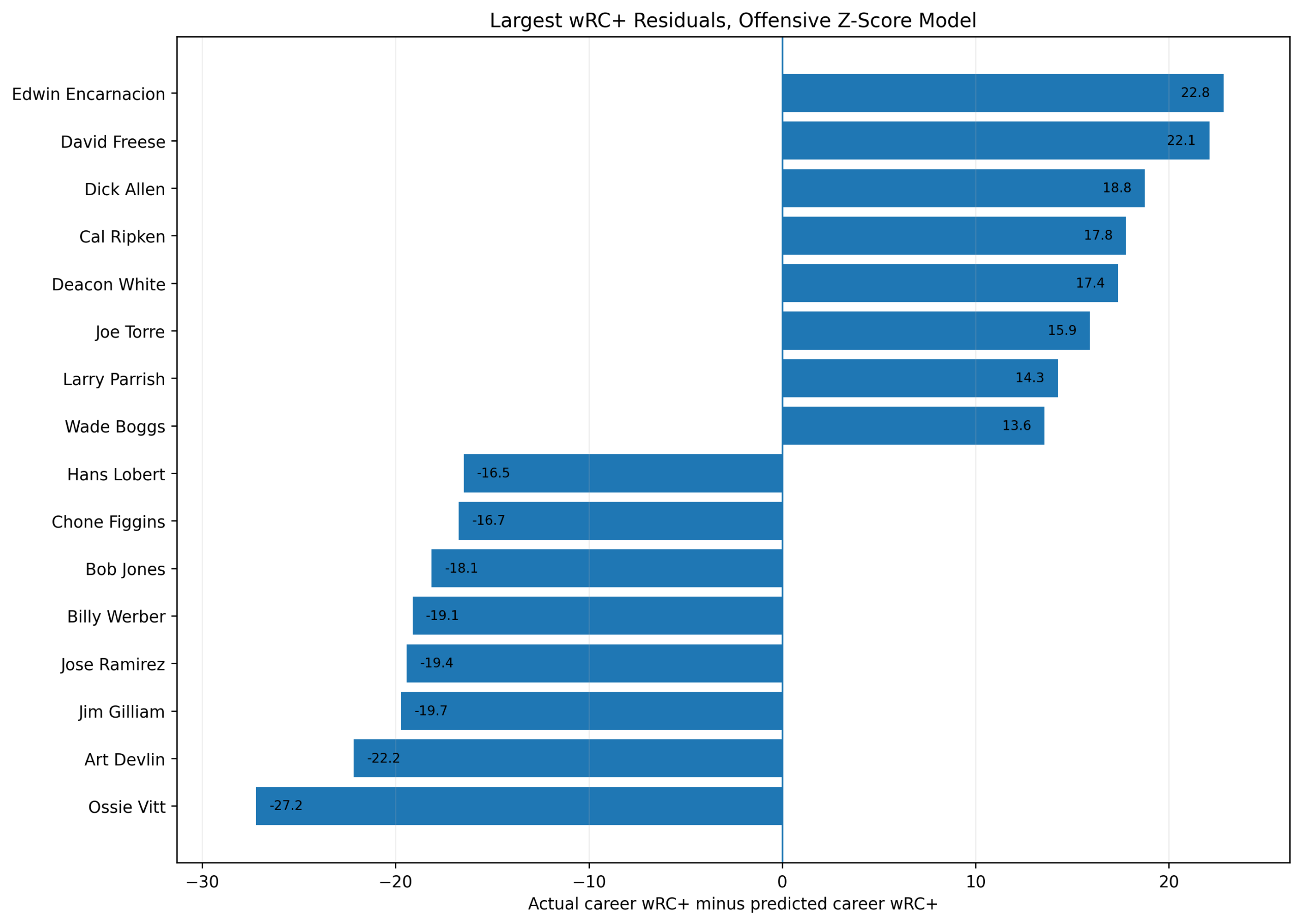
Validation with wRC+
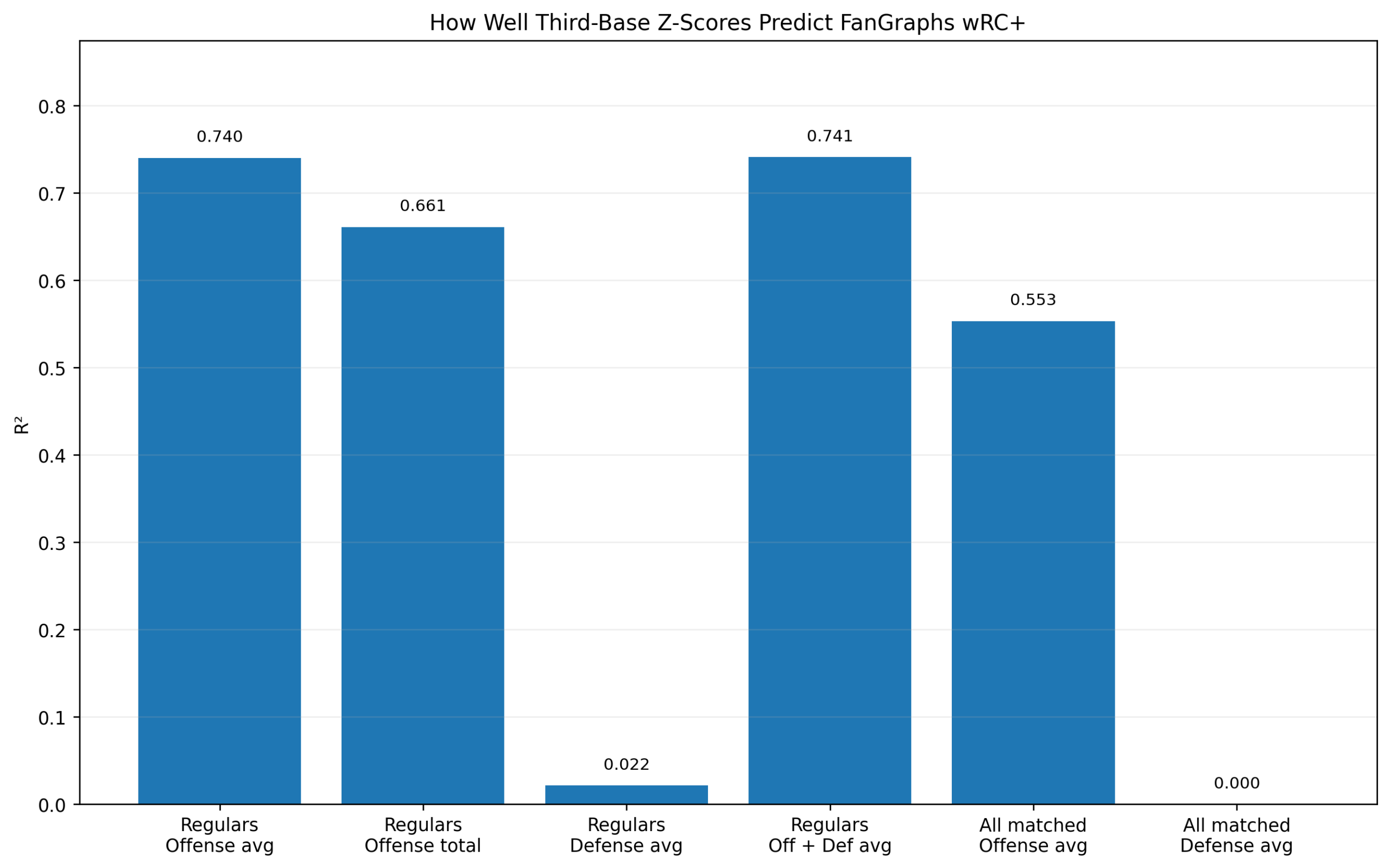
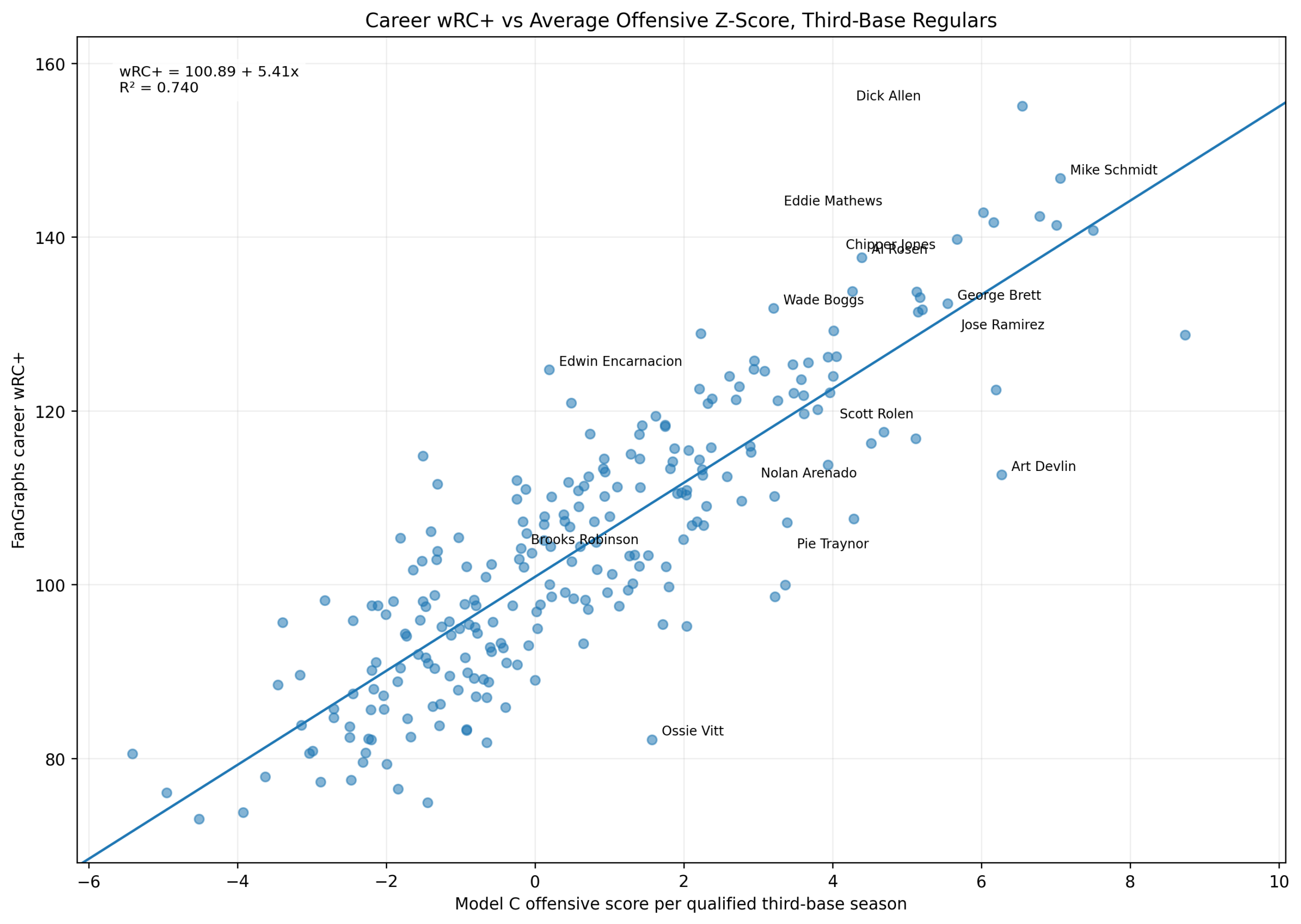
The wRC+ validation was equally useful because it directly tested the offensive side.
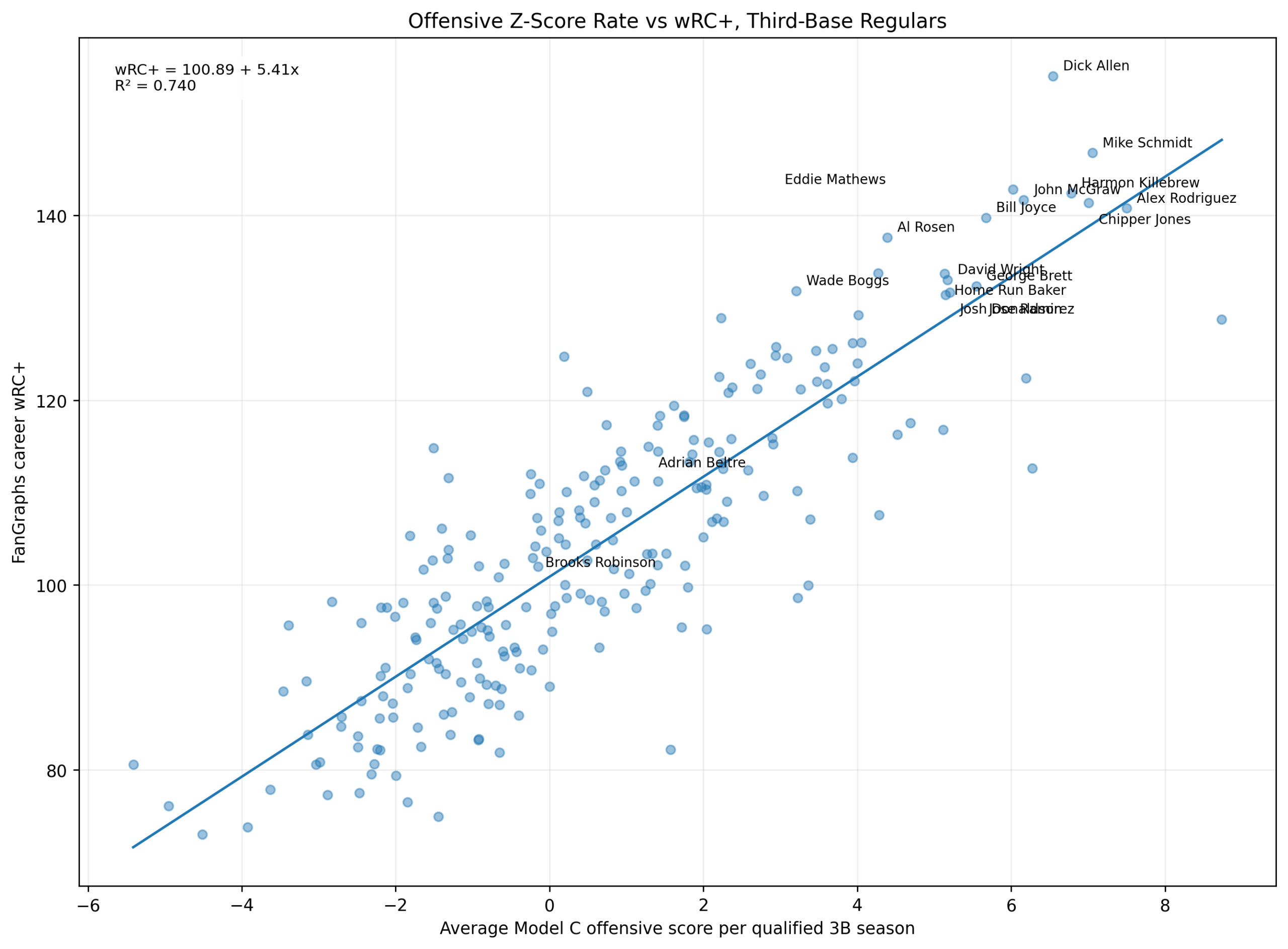
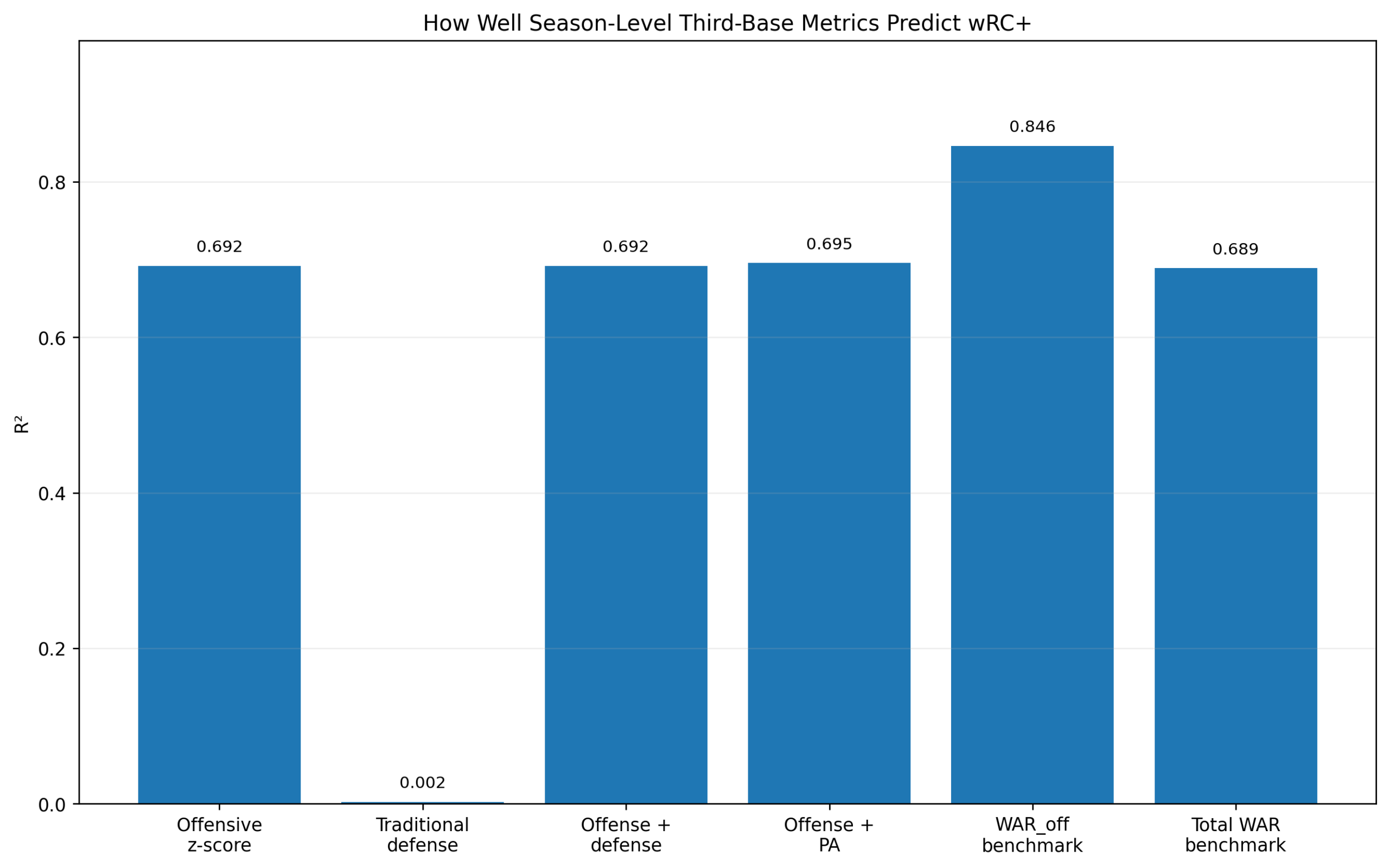
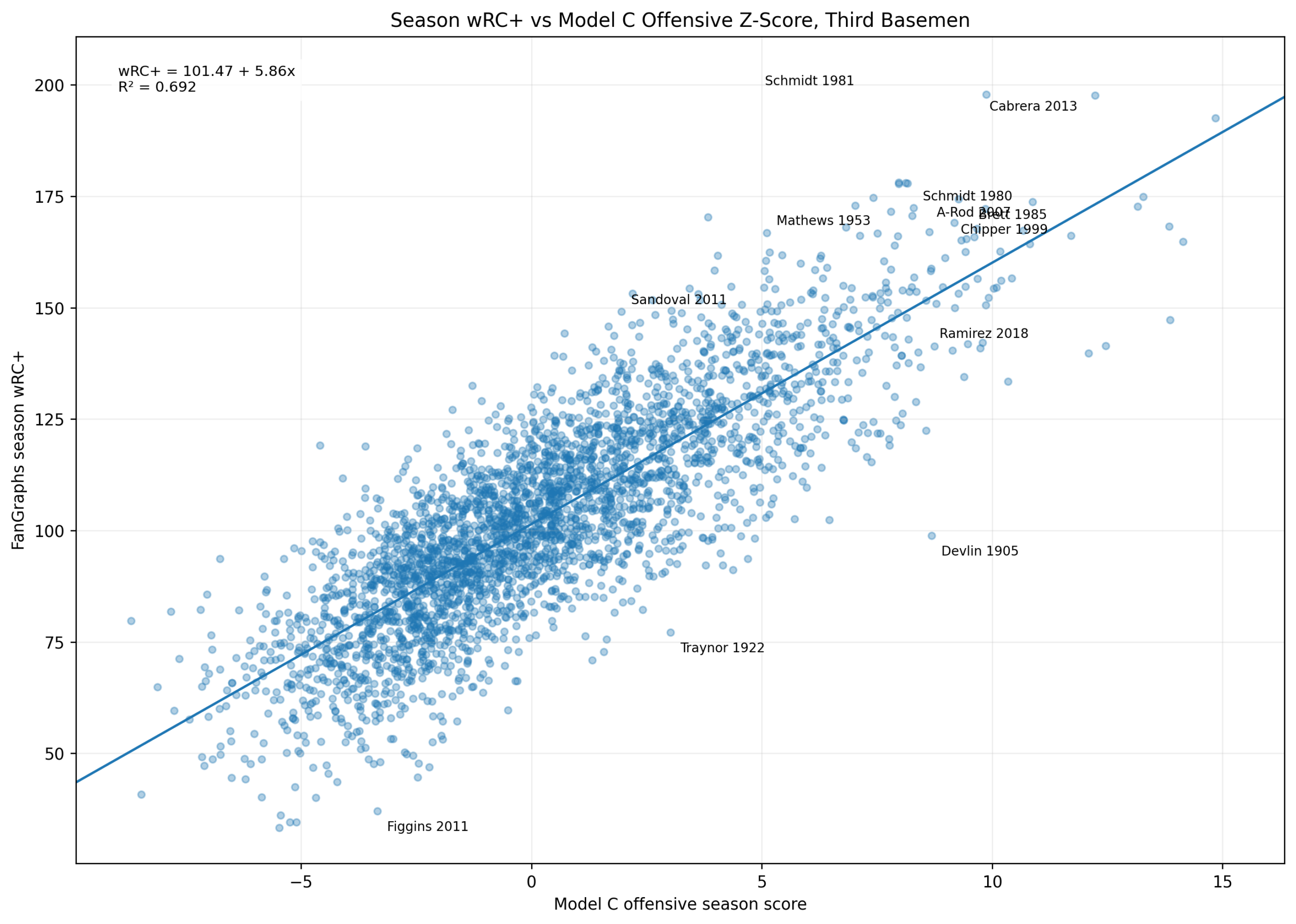
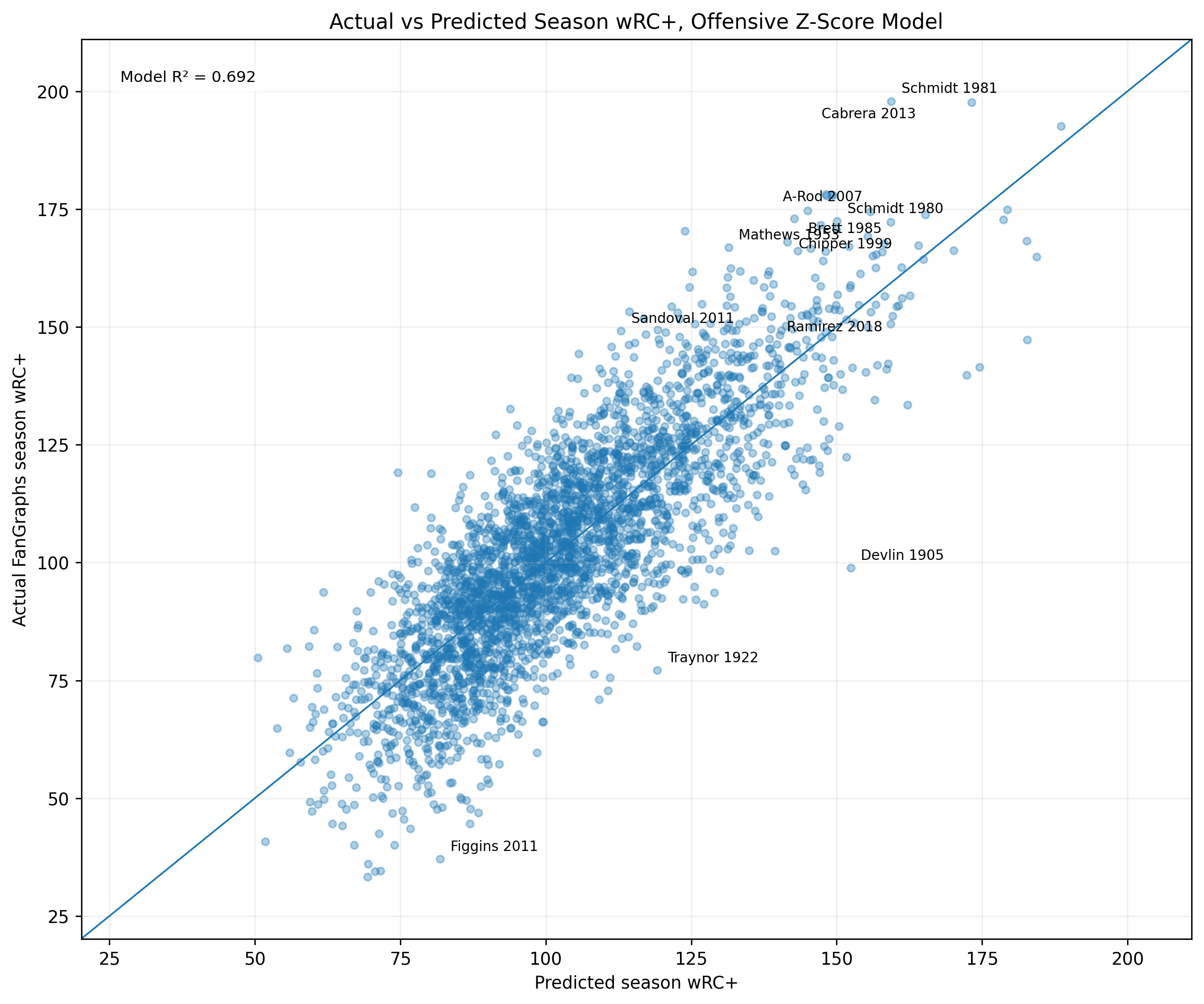
At the season level, Model C offensive score predicted wRC+ well:
wRC^+ = 101.47 + 5.86(\mathrm{ModelCOffensiveScore}) R^2 = 0.692At the career level, the offensive score also connected strongly to career wRC+:
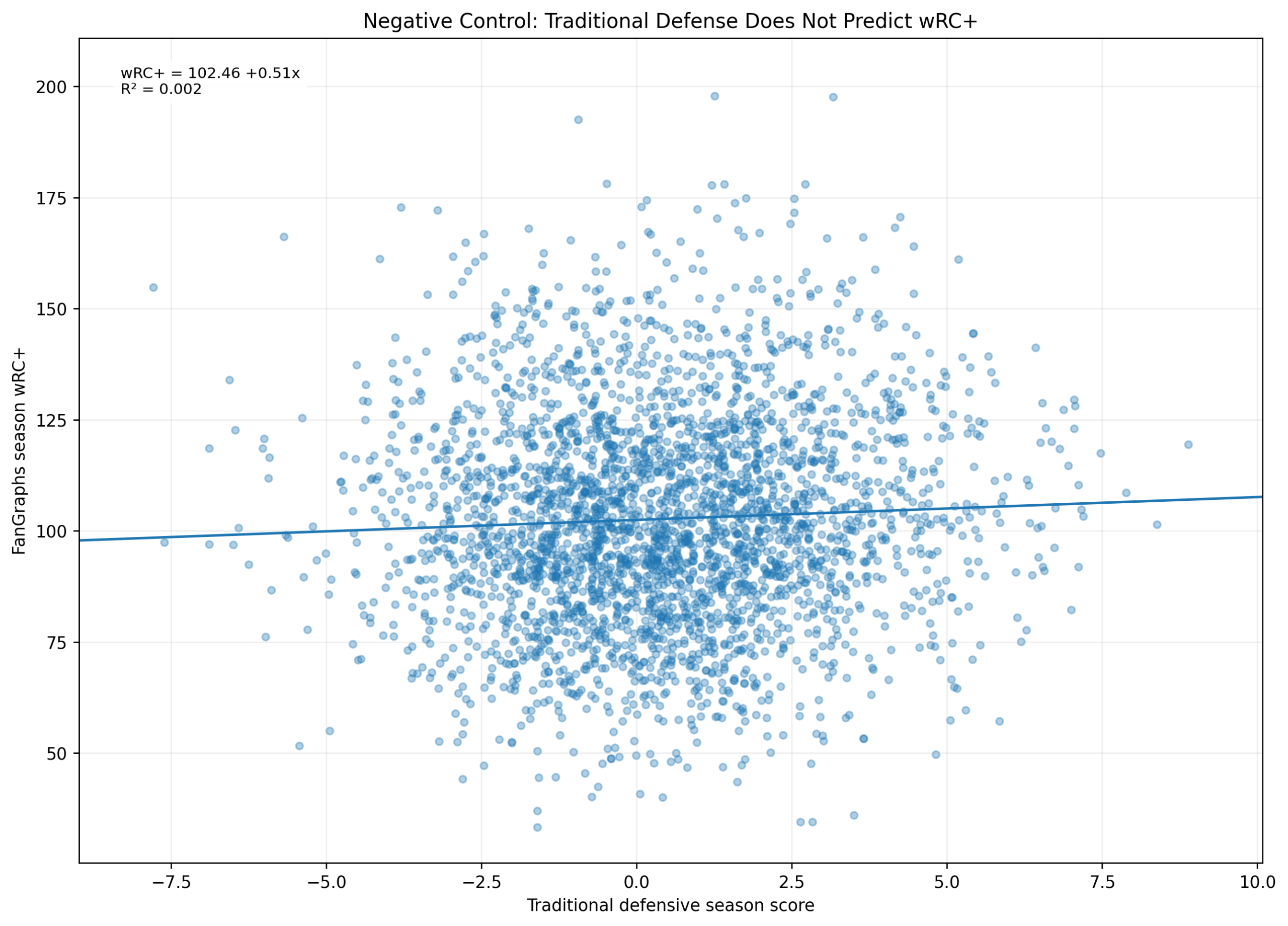
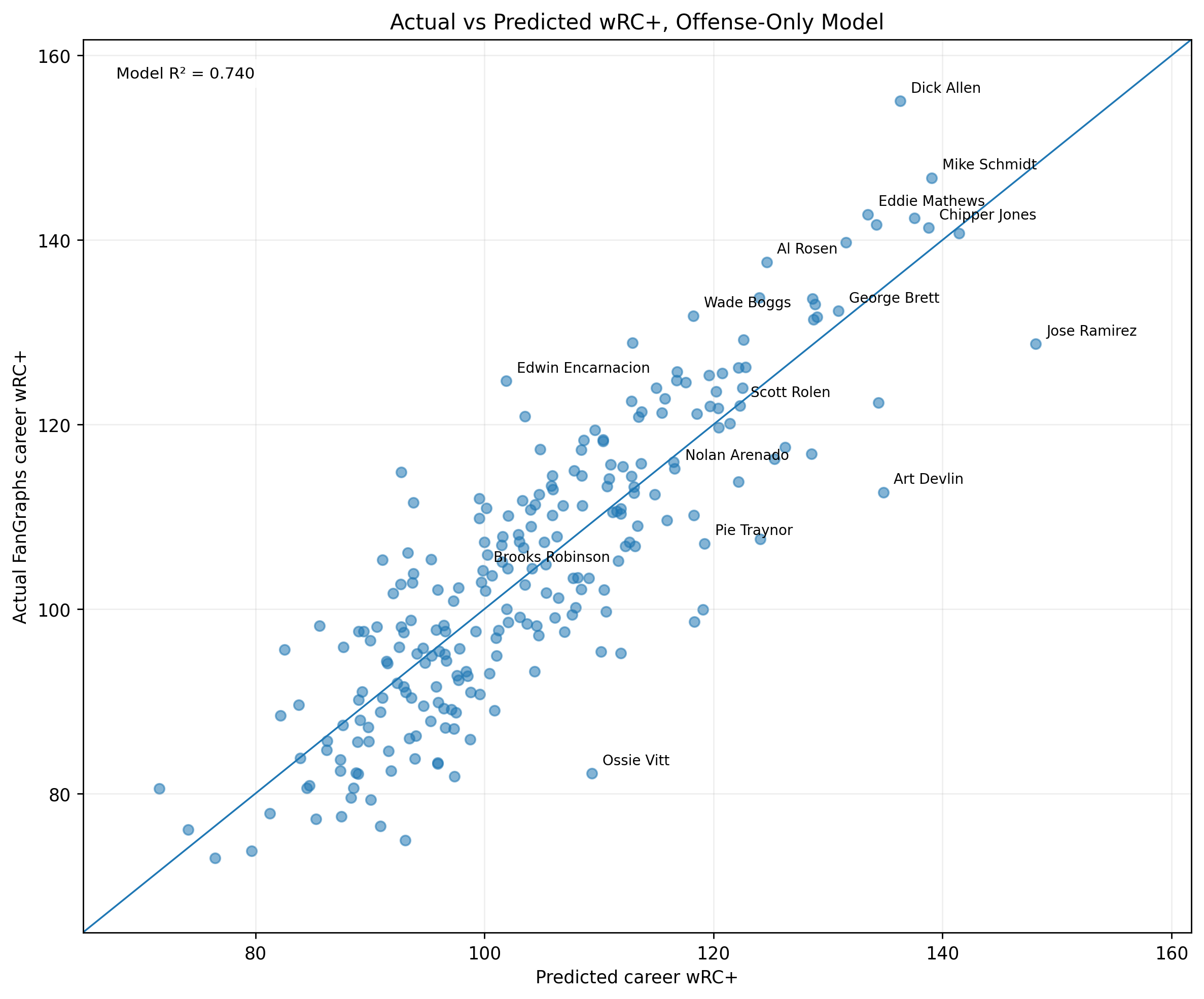
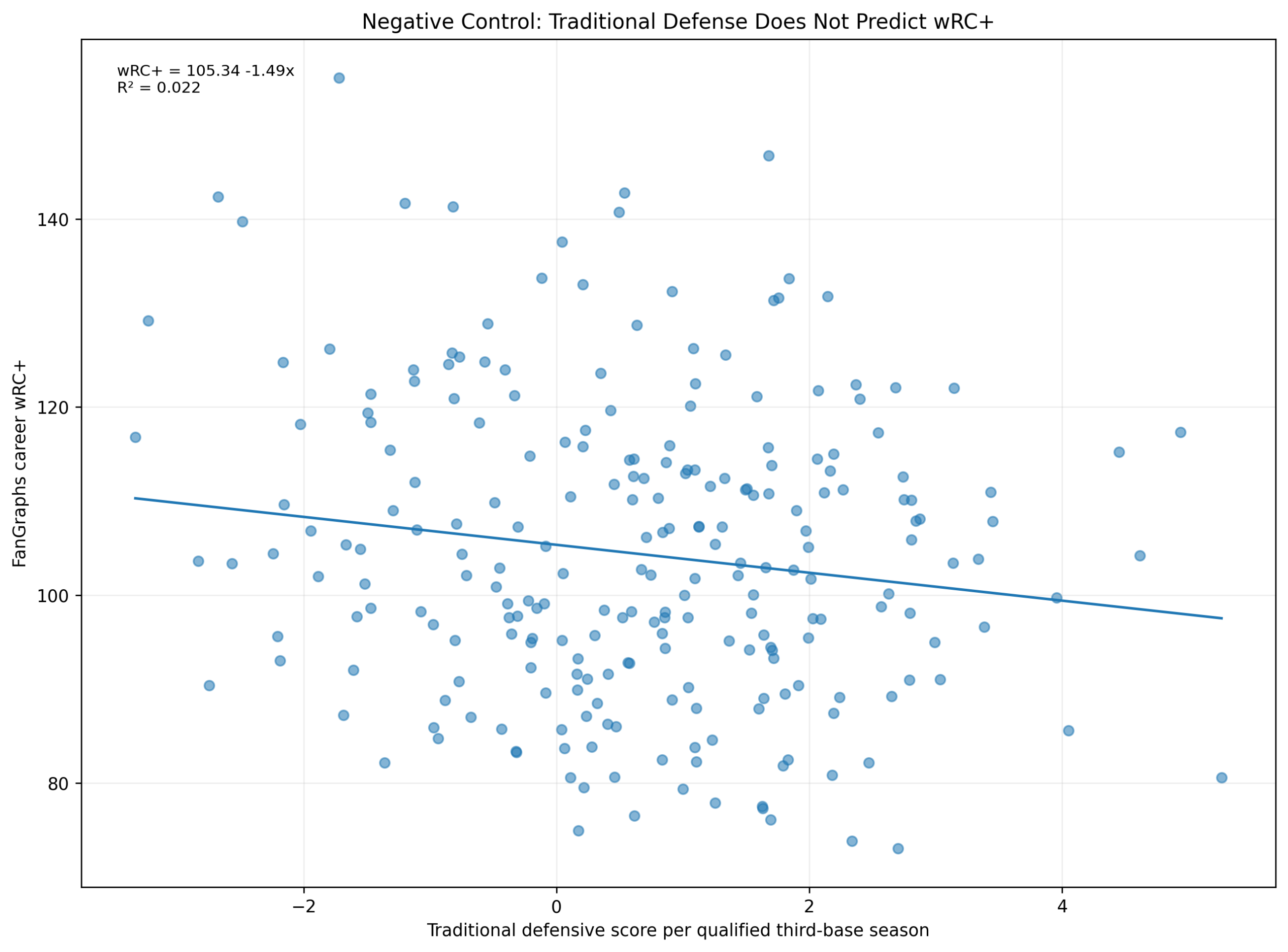
wRC^+ = 100.89 + 5.41(\mathrm{AverageOffensiveScore}) R^2 = 0.740The defensive negative control was also important. Traditional defensive score did not meaningfully predict wRC+. That is what we wanted to see.
The offensive model tracked offense.
The defensive model tracked defense.
The two-way model tracked overall value.
That separation gives the project credibility.
Figure 7: WAR Validation
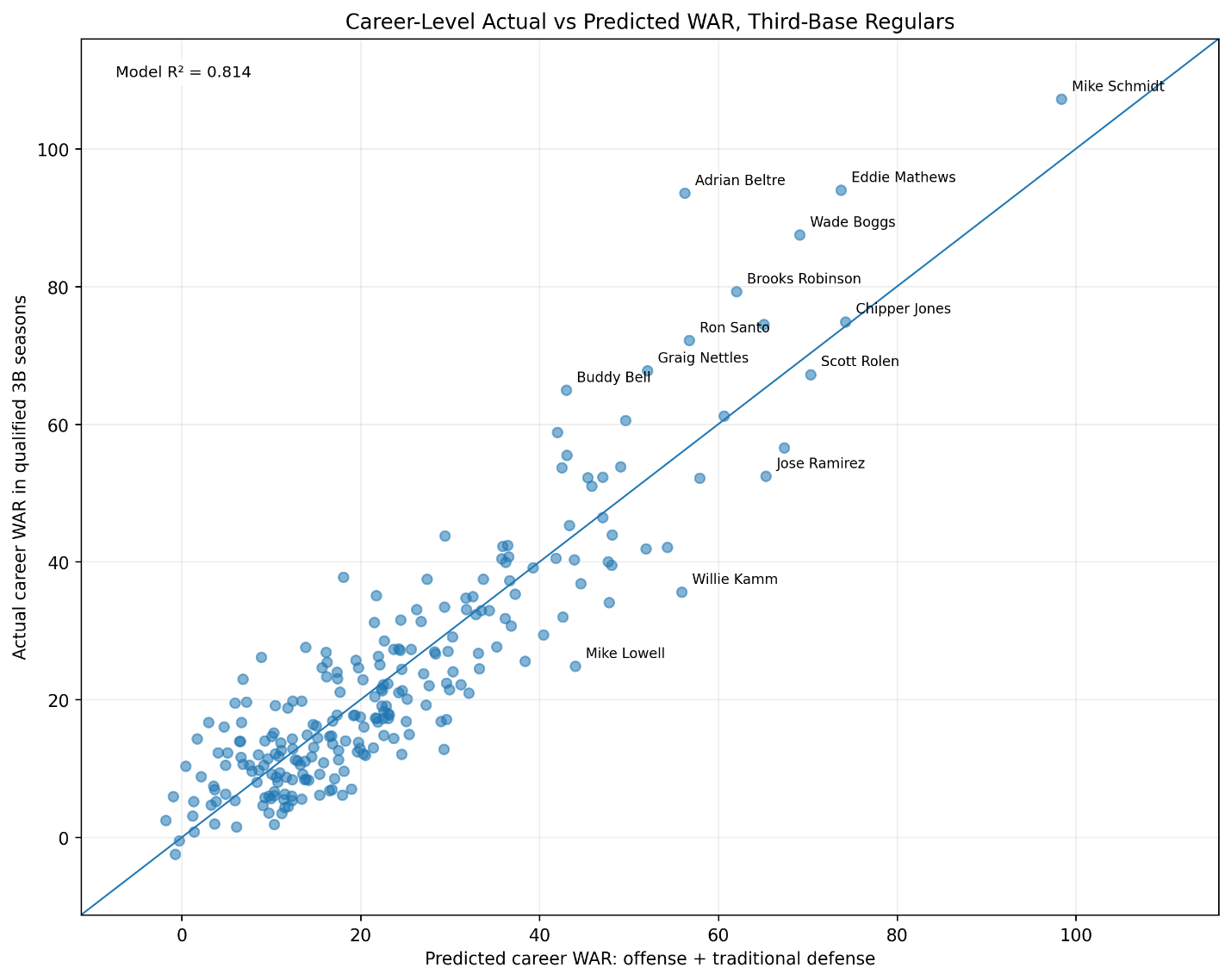
Figure 7. Career WAR, actual versus predicted from offensive and defensive scores.
The WAR validation figure belongs in the final chapter because it shows that the project is not only descriptive. It is also diagnostic.
The model found recognizable third-base greatness because its components corresponded to real baseball value.
Schmidt, Robinson, Beltre, Rolen, Boggs, Mathews, Brett, Chipper, Arenado, Santo, and others were not artifacts of the scoring system. They appeared because the scoring system captured meaningful dimensions of the position.
Figure 8: wRC+ Validation
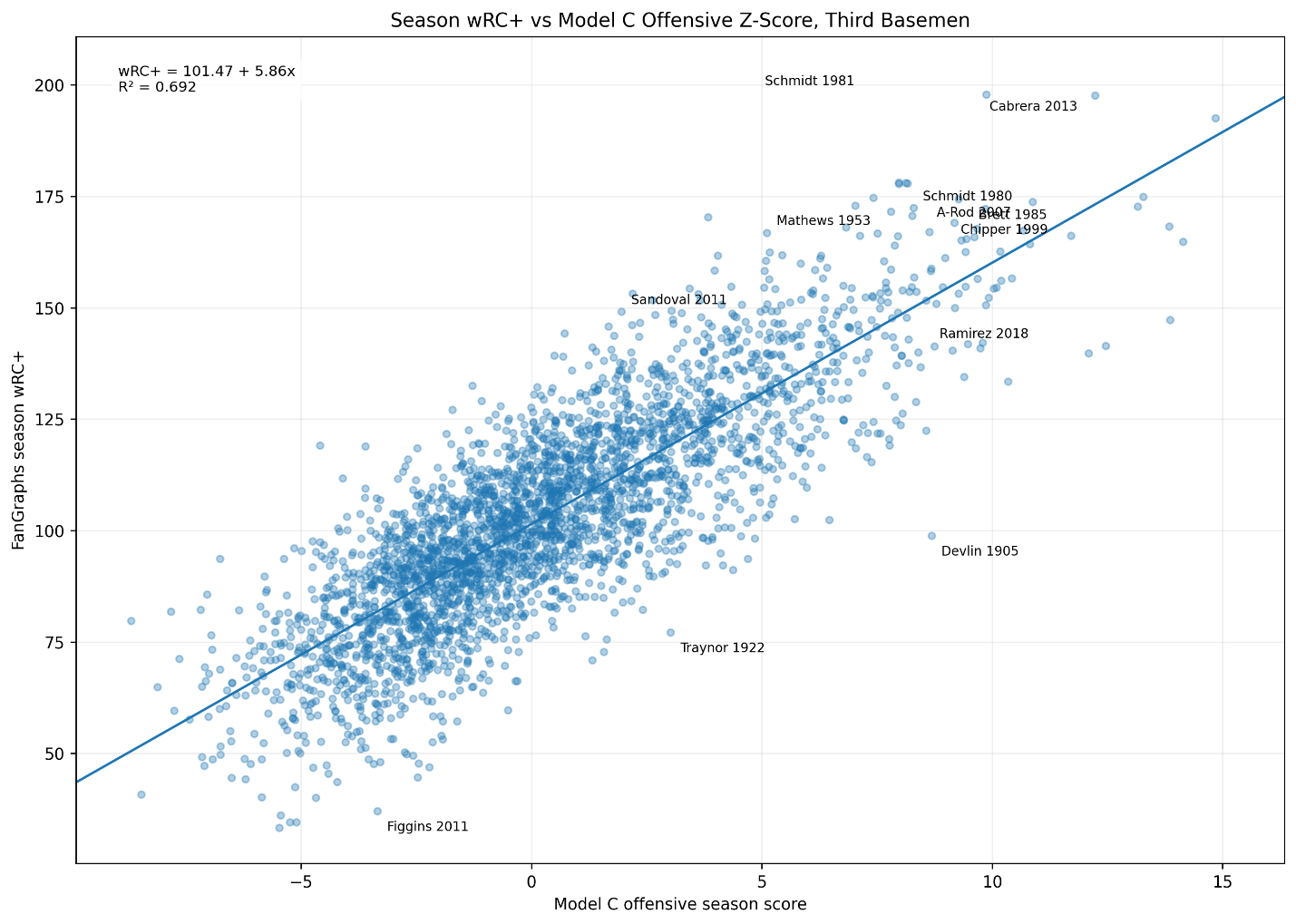
Figure 8. Model C offensive score versus wRC+ for third-base seasons.
The wRC+ validation figure should follow the WAR figure.
Together, these two validation figures show the difference between offensive value and total value.
wRC+ confirms the offensive model.
WAR confirms the broader two-way model.
That distinction is exactly what third base requires.
The Dendrogram: Types of Greatness
The dendrogram in Figure 4 adds one final interpretive layer.
Instead of asking who ranked first, it asked which great players were similar.
The distance formula was:
d(i,j) = \sqrt{ \left( z_{\mathrm{Offense},i} - z_{\mathrm{Offense},j} \right)^2 + \left( z_{\mathrm{Defense},i} - z_{\mathrm{Defense},j} \right)^2 }This produced recognizable clusters.
Schmidt, Chipper, Mathews, Brett, and Jose Ramirez formed an offense-heavy region.
Brooks Robinson stood apart as the defensive summit.
Rolen, Beltre, Arenado, Boggs, Nettles, Kamm, and similar players occupied the two-way or defense-strong region.
The dendrogram reinforces the project’s central point:
There is no single shape of third-base greatness.
There are families of greatness.
As Figure 4 shows, the dendrogram turns the ranking into a typology.
It lets the reader see why direct comparisons can be difficult.
Is Chipper Jones greater than Brooks Robinson?
It depends on what kind of greatness we are asking about.
Is Scott Rolen closer to Adrian Beltre than to Mike Schmidt?
In a two-dimensional offensive-defensive space, yes.
Is Mike Schmidt the most complete answer?
The evidence says yes.
Final Interpretation
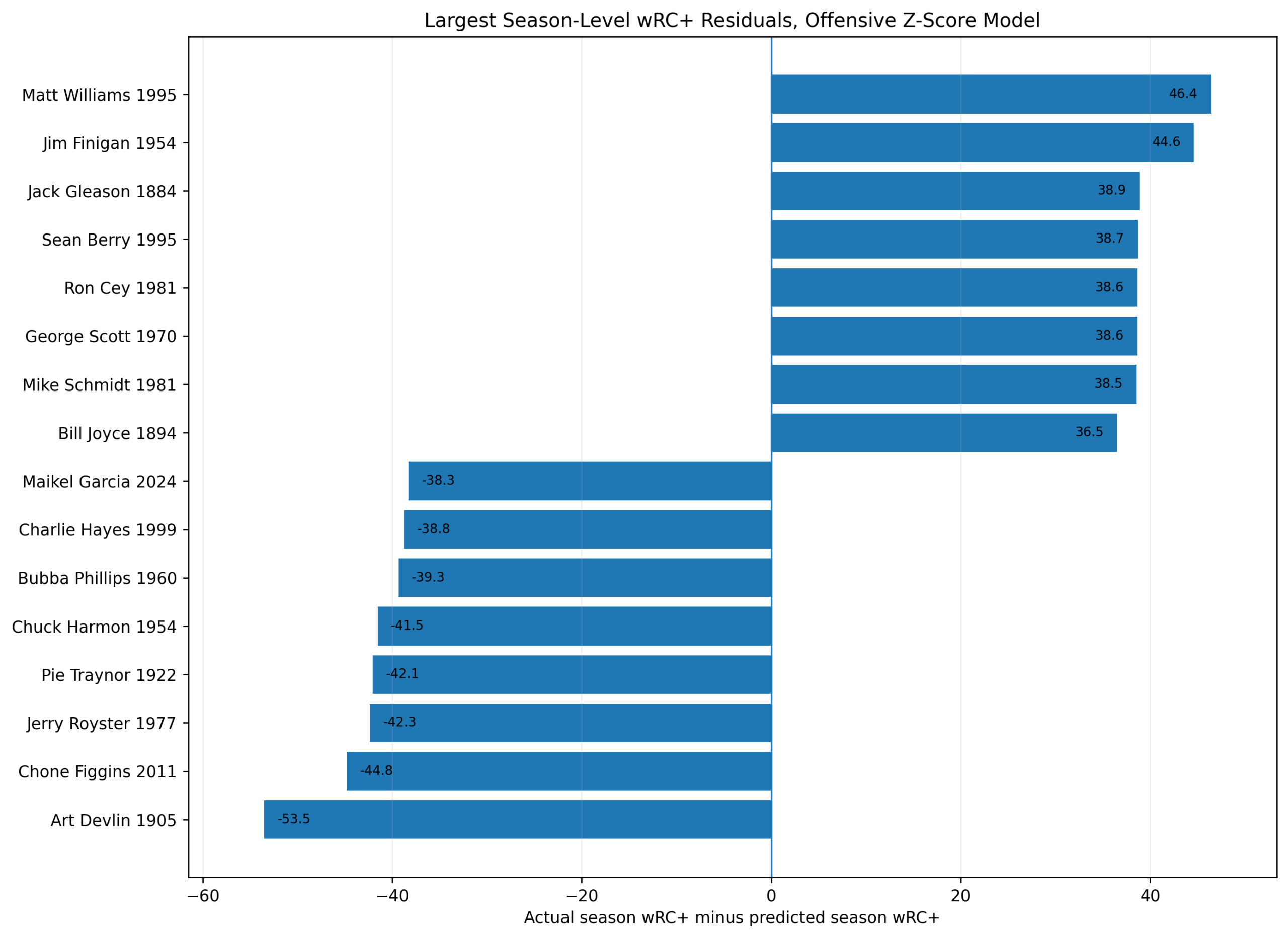
After all of the rankings, models, box plots, bar charts, validations, residuals, and dendrograms, the final interpretation is this:
Mike Schmidt is the best overall third baseman in this framework.
Brooks Robinson is the defensive summit.
Chipper Jones is one of the offensive summits.
Scott Rolen and Adrian Beltre are two-way ideals.
Nolan Arenado is the modern defensive-power bridge.
Wade Boggs and George Brett show that third-base offense is not only home runs.
But the broader conclusion is about the position itself.
Third base is a test of balance.
A great third baseman can win with the bat.
A great third baseman can win with the glove.
The greatest third basemen usually do both.
The home run study showed that third base belongs in the power conversation. The defensive study showed that the position still carries serious fielding responsibility. The WAR and wRC+ validations showed that the model behaves sensibly. The center and lower-tail studies showed that the full distribution matters, not only the top.
That brings the project back to the “full house” idea. Baseball greatness is not only about the record holder. It is about where that record, season, or career sits within the full distribution of the game.
This project used third base as the test case.
And third base rewarded the approach.
Conclusion
Third base is baseball’s hybrid position.
It is close enough to first base and the corner outfield to demand power.
It is close enough to shortstop and second base to demand defense.
It is far enough from both extremes to create unusual player types.
That is why the position has produced so many different kinds of great players.
Mike Schmidt towers because he solved the hybrid problem better than anyone else in this framework. He hit like a historic slugger while remaining a positive defensive player at a demanding position.
Brooks Robinson towers because his defense was so exceptional that it reshaped the positional landscape.
Rolen, Beltre, Arenado, Boggs, Brett, Chipper, Mathews, Santo, and others fill out the map because each represents a different solution to the same positional problem.
The final answer, then, is not only a ranking.
It is a definition.
Third base is where power and defense meet.
And that is why it was worth studying.