Pop Time: A Critical Metric for Catchers

In baseball, a catcher’s Pop Time can be the difference between catching a base-stealer and letting them slide in safely. Pop Time measures how quickly a catcher transfers the ball from their mitt to second base, factoring in the catcher’s footwork, exchange, and arm strength. This metric provides a more comprehensive assessment of a catcher’s defensive capabilities than arm strength alone, making it crucial in evaluating how effectively a catcher can control the running game.

This post explores the distribution of pop times among various MLB catchers, with visualizations such as a histogram, Kernel Density Estimate (KDE) plot, violin plot, and box plot. We’ll also examine some key summary statistics and update the analysis with the best pop times recorded during the 2023 season.


What is Pop Time?

Pop Time is the time it takes for a catcher to throw the ball to second base during a steal or pickoff attempt. It measures the time elapsed from when the pitch hits the catcher’s mitt to when the throw reaches the center of the base. MLB’s average pop time for a throw to second base is 2.01 seconds, but elite catchers are significantly faster.
Pop Time considers three main factors:

  • Footwork: The catcher’s ability to quickly get into a throwing position.
  • Exchange: How fast the catcher transfers the ball from the glove to the throwing hand.
  • Arm Strength: The velocity and speed of the throw.

Catchers with exceptional Pop Times obviously offer a much higher probability of recording an out.


Best Pop Times from 2023

Below are the best average Pop Times to second base on stolen-base attempts (minimum 15 SB attempts) from the 2023 MLB season:

  • J.T. Realmuto: 1.90 seconds
  • Yan Gomes: 1.93 seconds
  • Jorge Alfaro: 1.94 seconds
  • Austin Hedges: 1.94 seconds
  • Manny Piña: 1.94 seconds
  • Gary Sánchez: 1.94 seconds

These elite catchers consistently post Pop Times well below the league average, making them highly effective at throwing out would-be base stealers. J.T. Realmuto, whose reputation proceeds him, leads the pack with an impressive 1.90 seconds.


Pop Time Distribution: A Closer Look

To better understand how Pop Times vary among catchers, I visualized the distribution using a histogram:

The histogram shows that most catchers’ Pop Times cluster around 1.95–2.0 seconds, with very few recording times below 1.90 seconds. The majority of catchers are near the league average of 2.01 seconds, but the elite catchers separate themselves by consistently being faster than this threshold.


Kernel Density Estimate (KDE) Plot

A Kernel Density Estimate (KDE) plot smooths out the distribution to provide a clearer picture of the underlying trends:

The KDE plot highlights the peak of Pop Times around 1.95 seconds, confirming that most catchers perform near this time. The data skews slightly to the right, indicating that a few catchers have slower pop times exceeding 2.0 seconds, but most fall below this threshold.


Violin Plot: Visualizing Distribution and Density

I also created a violin plot, which combines the features of a KDE and a box plot to visualize both the distribution and the density of pop times:

The violin plot shows that most catchers fall within a narrow range of 1.90 to 2.00 seconds. The distribution is dense around 1.95 seconds, with fewer catchers having significantly faster or slower times. This plot also highlights that catchers like J.T. Realmuto are outliers, excelling well beyond the typical range.


Box Plot: Highlighting Key Statistics

The box plot below offers a simple yet informative view of the data, focusing on the central tendency and spread of Pop Times:

Key points from the box plot:

  • Median Pop Time: 1.97 seconds
  • Interquartile Range (IQR): Most pop times fall between 1.93 and 1.99 seconds.
  • Outliers: A few catchers have slower times above 2.0 seconds, but these are rare.

Summary Statistics

The summary statistics for Pop Times further illustrate how closely clustered most catchers are around the league average:

  • Mean Pop Time: 1.96 seconds
  • Standard Deviation: 0.051 seconds (indicating low variability)
  • Minimum Pop Time: 1.83 seconds
  • Maximum Pop Time: 2.09 seconds
  • 25th Percentile: 1.93 seconds
  • 50th Percentile (Median): 1.97 seconds
  • 75th Percentile: 1.99 seconds

These statistics show that most catchers perform within a narrow band, with the elite catchers falling below 1.90 seconds.


Conclusion

Pop Time is a critical metric for evaluating a catcher’s ability to control the running game. While arm strength is important, Pop Time provides a fuller picture by incorporating footwork and exchange speed. This type of analysis also lets us ignore the pitcher and focus exclusively on the catcher’s skills.

Our analysis of Pop Times using visual tools like histograms, KDE plots, violin plots, and box plots shows that most catchers fall within a narrow range of 1.95 to 2.0 seconds, with a few standout performers excelling beyond this. The data from the 2023 season illustrates how slight differences in Pop Time can significantly impact a catcher’s effectiveness at throwing out base stealers.

For catchers, a fast Pop Time can be the difference between a successful defensive play and allowing the opposing team to gain momentum on the bases. I hope you are enjoying this deep dive into the nuances of catching; I certainly am. It is fascinating, isn’t it?

Whiff Percentages in Baseball: A Little EDA Goes A Long Way

In baseball analytics, understanding a player’s whiff percentage—the rate at which they miss the ball when swinging—can offer key insights into their performance. A higher whiff percentage suggests a tendency to miss pitches, while a lower percentage indicates better contact with the ball.

In this post, I explore whiff percentages from both leagues across several years using three different visualization techniques: box plots, violin plots, and a line plot of medians. Each method offers a unique perspective on the data, and together, they help paint a comprehensive picture of trends in whiff percentages from 2015 to 2023. All players with approximately 200 plate appearances in that given year are included in the study.


1. Box Plot: Visualizing the Distribution by Year

A box plot is a simple yet powerful tool to summarize the distribution of whiff percentages each year. It shows the median (the line within each box), the interquartile range (the box itself), and any outliers (the dots outside the whiskers).
This box plot gives us several insights:

  • Consistency: In certain years, the boxes are tightly grouped, indicating less variation in whiff percentages (e.g., 2015).
  • Outliers: Some years have extreme values, shown as dots, which highlight players who either significantly outperformed or underperformed compared to the rest.
  • Year-to-Year Comparison: The height of the boxes gives a sense of how spread out the whiff percentages were for each year, helping to identify years with more variability in player performance.

Why use a box plot? Box plots are ideal when you want to compare distributions without being distracted by individual data points. It provides a clean, uncluttered view of how the overall performance fluctuated from year to year, and highlights outliers effectively.


2. Violin Plot: Adding Depth to Distribution Analysis

A violin plot enhances the box plot by providing additional information about the shape of the distribution. It combines aspects of a box plot with a kernel density estimate, which helps visualize the probability distribution of the data. I will mention once again that I invented these plots, much to the chagrin of my peers, many decades ago. See my “A Crush, A Data Viz, and a Book Long Postponed” post for that tragic tale.

This violin plot offers some extra depth:

  • Distribution Shape: You can see how the whiff percentages are spread out within each year. Some years have narrow violins, suggesting that most players had similar whiff percentages, while others are more spread out, indicating more variability.
  • Density: The wider sections of the violin show where most data points are concentrated, allowing us to see not just the range but also the density of players’ performances in each year.

Why use a violin plot? Violin plots are particularly useful when you want a more nuanced understanding of the data distribution. While box plots are excellent for a high-level summary, violin plots allow us to see the underlying density, which can reveal patterns not visible in box plots alone.


3. Line Plot of Medians: Tracking Trends Over Time

Finally, to understand the overall trend in whiff percentages, I created a line plot of the median whiff percentage for each year. The median is a robust measure of central tendency, making it ideal for highlighting general shifts without being overly influenced by outliers.

This plot shows us:

  • Overall Trend: The line plot helps reveal whether the median whiff percentage is increasing, decreasing, or remaining stable over time. If the line rises, it suggests that players are missing more swings as the years progress, while a falling line indicates better contact rates.
  • Key Years: Significant upward or downward trends in specific years are easily spotted. These could prompt further investigation into why such changes occurred, whether due to rule changes, player performance shifts, or other factors.

Why use a line plot? A line plot of medians is the best way to capture the long-term trend. It smooths out individual variations and provides a clear picture of how the “middle” of the data is changing over time.


Conclusion: Insights from Multiple Perspectives

By using these three visualizations—box plots, violin plots, and line plots—we gain a multi-dimensional understanding of whiff percentages in baseball:

  • The box plot provides a clean, high-level comparison of distributions across years, highlighting outliers and general performance variability.
  • The violin plot offers a deeper look at how player performances are distributed within each year, revealing the shape and density of the data.
  • The line plot of medians shows the overall trend, capturing how the middle of the distribution shifts over time.

Each plot tells a part of the story, and when combined, they provide a comprehensive view of player performance over the years. Whether you’re a data enthusiast, baseball analyst, or interested bystander, these tools can help unlock valuable insights into the game. And yes, I find the trend reversal after the 2020 season curious. The great thing about Exploratory Data Analysis (EDA) is that it can strongly suggest what questions must be asked in subsequent stages of analysis. That is certainly what happened here.


Frame This: MLB Catchers (2023)

I took a deeper dive into MLB Catchers for the year 2023. I found lots of interesting stuff. Let’s get to it.

In this post, I decided to focus on catcher framing. Some catchers are better than others in fooling umpires that a ball is a strike. That is what catcher framing is all about. This may surprise some of you, but all this data is now readily available. Every pitch is tracked with impressive accuracy, with terabytes of data generated for each game played.

I created this figure to illustrate the standardized zones used for pitches thrown to home plate. The following is taken from the perspective of the catcher and home plate umpire.

Take Zone 11, for example. The reams of data tell us the percentage of pitches in that area that are taken and called strikes. In 2023, 19.2% of all pitches thrown into that zone were called strikes. Austin Hedges, then a catcher for the world-champion Texas Rangers, managed to get 27.6% of those pitches called strikes by the sweaty man crouching behind him. Get the idea? Hedges’ strike rate for that zone led all of MLB.

Hedges’ work in Zone 13 was even more impressive. The league average for pitches thrown up and away to right-handed batters was 23.6%. Hedges managed to get strike calls on 42.2% of those pitches. Extraordinary.

I ran a Cluster Analysis of all the framing data across all the zones to recognize the top ten catchers in MLB in 2023. Hedges and Patrick Bailey of the San Francisco Giants stand apart based on their superior performance.

And, yes, what is a top ten list without a bottom ten list? There might be a name or two on there that will surprise you.

In a previous post, I had identified J.T. Realmuto as having an outstanding defensive season in 2023. Regarding pitch framing, he ranked a ridiculous 63rd. I admit, I found that unexpected.

Now, we can move on to something very cool. I have known what heatmaps are for a long time, but I have never needed to create one. It simply never came up. Guess what is next; go ahead.

I want to point out one aspect of this map: Hedges was well below the league average regarding framing pitches in Zone 14. I must admit, that is curious. I do not know why he would be so bad in that area and excel in all the other zones. I have no explanation for that anomalous chunk of data.

And, yes, I also generated a heatmap for the bottom ten catchers in 2023.

Another strange fact is that Martin Maldonado was very good at getting strike calls in Zone 11 but well below average in all the others. Does that have something to do with the pitchers on the Houston Astros in 2023? That line of reasoning might lead to a possible explanation.

I thought that was the end of this post, but I decided to test the new AI release that ChatGPT just dropped. I asked it for recommendations on how it would display this data. It offered up something very cool. Here are Radar Plots of the top 5 and bottom 5 catchers for pitch framing for the 2023 season.

Note that Hedges in Zone 13 and Miguel Amaya in Zone 17 stand out.

These plots are beautiful, but I haven’t decided on their utility. Are they diagnostic enough to merit their use? We will look more into that question in future posts.

At least for now, the takeaway is that determining the best defensive catcher in 2023 is much more subtle and nuanced than one might have imagined. Stay tuned; there is more to come.


The Unopened Letter (Flash Fiction)

The Unopened Letter


A soft thud echoed from the hallway. Marie looked up from her computer screen, her glasses slipping down the bridge of her nose. The mail had arrived. She sighed and went to the front door. Bills, advertisements, a postcard from some real estate agent—nothing unusual.

But there was one letter that caught her eye.

It was different. No return address, no postage stamp. Just her name scrawled in a familiar hand. Her hand. Marie’s breath hitched in her throat. She turned the envelope over, but it was sealed shut with an embossed wax stamp. Her intuition told her this wasn’t some prank. She had written the letter. But how? When?

She stepped back inside, the world outside the door suddenly too sharp, too loud. Sitting at her kitchen table, she stared at the envelope, her fingers tracing the edges of the paper. The handwriting was unmistakable. The way her “r” curled slightly, the way she looped her “e”—it was her own. But she hadn’t written a letter to herself, had she?

Marie’s heart quickened. The edges of the world seemed to blur, like reality had bent just slightly. The envelope weighed heavier in her hand than any ordinary letter should.

The air in the kitchen felt stifling. Her fingers twitched, wanting to tear it open and read the words. Yet, something held her back. Fear. What could it say? Was this some kind of cruel joke, was her intuition deceiving her, or was it… something more?

She shook her head. This was ridiculous. Letters didn’t just appear out of nowhere. There had to be a logical explanation. Maybe she’d written it and forgotten, right? But then how did it get delivered?

Her phone rang, her boss demanded a report be submitted by the end of the workday. Marie knew it was due, and she had already done much of the work, so she quickly hung up and went into her home office.

The end of the day was approaching when Marie got another call. The main office needed numerous items added to the report. She took a deep breath and worked late into the night.

The following morning, Marie was awakened by her phone. A text message from Greg:
Hey, are we still on for dinner tonight?
A normal text. Everyday life, pulling her back into routine. She swallowed, glancing between her phone and the letter on her nightstand.

Yeah, she typed back, 7 p.m. at Luca’s, right?
Right.

She felt relieved by the prospect of a night out. She picked up the envelope and brought it into the kitchen. She picked up a butterknife to use as a letter opener but quickly put it back. Her fingers hovered over the edge of the envelope once more before she tucked the letter into a drawer. Later. She would deal with it later. She wasn’t ready now. It can wait.

But Marie couldn’t forget the letter.

Back at work, she found herself distracted, staring at her computer screen but seeing only the envelope. During her lunch break, she examined her desk, half-expecting the letter to have magically appeared. She had to consciously stop herself from running into the kitchen, tearing it open, and confronting whatever lay inside.

The anxiety clawed at her all afternoon. What could the letter say? How did it end up at her door? The thought gnawed at her, and by the time she had finished the day’s tasks, it was all she could think about.

When she turned off her computer, the first thing she did was head to the kitchen drawer. She stood there, staring at it for a long time, her hand resting on the handle. Slowly, she opened the drawer and pulled out the envelope. Her heart hammered in her chest as she sat down with it again.

“Okay,” she whispered to herself. “Okay.”

Her thumb slid under the flap of the envelope, and—

A knock at the door startled her so badly that she dropped the letter.

Marie stared at the door, her pulse racing. She wasn’t expecting anyone, was she?

Another knock, this one more insistent. The letter lay on the floor, unopened.

She left it there and crossed the room cautiously. When she opened the door, Greg was standing on the porch, his hands stuffed in his jacket pockets. His smile wavered as he took in her frazzled expression.

“Hey, you okay? You didn’t respond to my last text. I thought I’d just come by and make sure we were still good for dinner.”

Marie blinked, her mind whirling. She had completely forgotten.

“Yeah, dinner. Right.” She glanced over her shoulder at the letter on the floor, still sealed. “I… uh… just lost track of time.”

Greg raised an eyebrow but didn’t push. “You sure you’re alright? You look like you’ve seen a ghost.”

“I’m fine,” she said quickly, rubbing her arms. “Just… distracted.”

His eyes followed hers to the envelope on the floor, but he didn’t comment. “Okay, well, if you need to reschedule…”

“No,” she interrupted, forcing a smile. “Dinner sounds great. Let me just grab my coat.”

Throughout dinner, Marie tried to push the letter from her mind, but it was impossible. Greg’s voice became background noise as she ran through every possible scenario. If she had sent herself a letter, it had to be important. Urgent. But what if opening it changed everything? What if reading the letter caused something terrible to happen?

“Marie?”

She blinked, suddenly aware that Greg had been talking to her. “Sorry, what?”

He frowned. “You haven’t heard a word I’ve said, have you?”

“I’m sorry, I just—” She paused, lowering her fork. “Something weird happened yesterday.”

Greg leaned forward. “Weird, how?”

“I got a letter. From me.”

His brow furrowed. “From you?”

“Yeah, like… it was in my handwriting. My name, no return address. It just showed up, and I have no idea how.”

Greg sat back, his face a mix of confusion and mild amusement. “Maybe it’s some kind of prank?”

“I thought of that, but… I don’t know. It felt too real.” She shook her head. “I haven’t opened it yet.”

“Why not?”

“Because… because what if it’s something I’m not ready to know? What if it’s a warning or…” Her voice trailed off, her chest tightening.

Greg was silent for a long moment. “Marie, if you wrote this letter to yourself, there’s a reason. Maybe it’s something you need to hear.”

She stared down at her plate, her appetite gone. “I’m scared.”

“I get that,” Greg said softly. “But maybe the fact that you’re scared means you need to read it.”

That night, Marie sat on her bed, the letter resting in her lap. The edges of the envelope were soft now from all the times she’d handled it, but it was still sealed. Still waiting.

She took a deep breath, trying to steady her nerves. Her hands trembled as she finally slid her finger under the flap and tore it open. A faint yellow glow surrounded her hands as she removed the sheet of paper.

The letter inside was short, only a few lines. Her heart pounded as she unfolded the paper and began to read.

In her own handwriting, the message was simple:
Don’t open the door tomorrow.

The words blurred before her eyes as the realization hit her like a punch to the gut.

Tomorrow.


In the Presence of Shadows (Flash Fiction)

In the Presence of Shadows


When Jacob first woke, the air in his bedroom felt thick, like a smothering weight pressing down on him. His eyes blinked open to the familiar shape of his bedside lamp, the faint glow of morning just barely filtering through the curtains. But there was something else.

Someone was standing at the foot of his bed.

His heart leaped into his throat. A tall, shadowy figure, darker than the rest of the room, seemed to loom over him. Jacob froze, his body paralyzed with a cold, creeping terror that crawled up his spine. He tried to blink it away, telling himself it couldn’t be real. His fingers clutched the sheets, the pulse in his ears deafening.

But the figure didn’t move.

A breath caught in his throat, sharp and painful. Then, in an instant, like a trick of the light, the shadow was gone. There was nothing there—just the familiar shapes of his dresser, the door slightly ajar, the room as it always had been. Jacob sat up, swallowing hard, his hands trembling as he dragged them through his sleep-tousled hair.

It was a hallucination, just a figment of his groggy, half-asleep mind. It had to be. He’d been stressed—work had been hell lately, and his sleep schedule was a mess. This kind of thing could happen to anyone, right?

He swung his legs over the edge of the bed and planted his feet on the cool hardwood floor. He rubbed his face, trying to shake off the lingering unease. He’d been on edge for days, running on caffeine and fumes. The vision had been a warning from his overworked brain, no more, no less.

Jacob stood, stretched, and padded toward the bathroom. The rest of the morning was supposed to be mundane—shower, shave, breakfast—but as he went down the hallway, he felt… off. His steps seemed too loud on the floor; his skin tingled like it didn’t fit quite right. The quiet of the house had a strange weight to it, like it was watching him.

Shaking his head, he tried to dismiss the thought, but the sensation persisted, an inexplicable tightness in his chest.

When he stood at the kitchen counter, pouring himself a cup of coffee, the unease had settled into something more tangible. Every so often, he’d catch a flicker of movement from the corner of his eye—a shadow darting across the wall, a figure slipping behind a corner. His head would snap toward it, only to find nothing there. Empty spaces. Ordinary silence.

Jacob clenched his jaw, forcing himself to focus. “Get it together, man,” he muttered, gripping the coffee mug too tightly, his knuckles going white.

The momentary distraction helped. He busied himself with making toast, methodically buttering the bread, the warmth of the kitchen offering some comfort. But as he reached for the silverware drawer, his hand brushed something cold.

Startled, Jacob looked down. His fingers had grazed the handle of a knife, but the metal felt icy, far colder than it should have been. He pulled his hand back, and in the reflection of the knife’s blade, he saw something move behind him.

He whirled around.

Nothing.

The kitchen was empty, just as it had been. His eyes scanned the space, his heart hammering in his chest. His mind was playing tricks on him, indeed. But the knife…

He stared down at the butter knife. It was just a regular utensil sitting innocently on the counter. Maybe the air conditioning had kicked on. Maybe—

A sharp pain shot through his right hand, causing him to drop the knife with a clatter. He gasped, clutching his hand, his pinky throbbing like he’d jammed it in a door. He flexed his fingers carefully, but something wasn’t right. The pinky seemed… off. It was bent at an unnatural angle, swollen and discolored.

“What the hell?”

His breath came faster now. He hadn’t hit it on anything. He hadn’t even touched anything hard enough to break a bone. Panic began to bubble up inside him, mixing with the strange, disorienting feelings that had been plaguing him since he woke. His skin felt too tight again, his thoughts scattered.

Something was wrong. Really wrong.

The coffee mug slipped from his grasp, shattering on the floor. The sound rang in his ears, louder than it should have been, like a gunshot. Jacob flinched, his pulse racing.

It was enough. He grabbed his phone, fumbled for his car keys, and within minutes he was out the door, driving with one hand while his broken pinky throbbed in time with his heartbeat.

The fluorescent lights buzzed overhead at the emergency room, casting a sterile glow over the rows of plastic chairs and the low hum of chatter. Jacob sat with his right hand cradled in his lap, his mind still spinning. He kept running his thumb over the curve of his pinky, feeling the break, the way the bone didn’t line up quite right anymore.

A nurse finally called his name, leading him into a small exam room. The doctor arrived soon after—a tall, wiry man with graying hair and a kind smile. He introduced himself as Dr. Fields, gave Jacob’s hand a cursory glance, and immediately ordered an X-ray.

That creeping sensation returned as Jacob sat on the examination table, waiting for the nurse to return with the X-ray machine. The room felt too cold, and shadows seemed to pool in the corners where the overhead light didn’t reach.

He glanced toward the open door and saw something. A figure, tall and thin, standing just out of sight in the hallway.

His chest tightened. He could barely breathe. His vision wavered, like heat rising off asphalt. He blinked, and the figure was gone, swallowed by the sterile white light of the hospital.

The nurse wheeled in the X-ray machine, oblivious to the tension thrumming through him. He forced himself to sit still, to focus on her instructions as she positioned his hand for the scan. But his heart wouldn’t slow down. His mind raced.

The hallucinations were getting worse.

The scan took only a few minutes, and soon, Dr. Fields returned with the results. He slid the black-and-white film onto the lightbox and flipped the switch, illuminating the delicate bones of Jacob’s hand.

“Well, Mr. Hale,” Dr. Fields said, his brow furrowed as he examined the X-ray. “It’s definitely broken, but… it’s odd.”

“What do you mean?” Jacob asked, his voice tight.

“This kind of fracture is more common in crush injuries or severe trauma. It’s clean, but with enough force applied directly to the bone to cause significant displacement.”

Jacob swallowed. “But I didn’t do anything to it. I mean, I didn’t hit it or crush it or anything.”

Dr. Fields looked at him thoughtfully, concern flickering in his eyes. “You don’t remember any impact at all? No recent accidents?”

Jacob shook his head. His hand throbbed again, the pain sharp and insistent.

“I’ll put a splint on it for now,” the doctor said, “but I’d recommend seeing an orthopedist in the next few days. This isn’t a typical break.”

Jacob nodded, barely hearing him. As the doctor left to retrieve the splinting supplies, Jacob’s gaze drifted back to the X-ray film. His bones seemed fine, normal, except for the fractured pinky. But behind the bright white lines of his skeleton, deep in the shadows of the film, something strange caught his eye.

There, nestled between the bones of his hand, was a faint, dark outline. It was almost imperceptible, but once Jacob saw it, he couldn’t unsee it.

A shape. Like a hand—thin and skeletal—resting over his.

A shiver ran down his spine. His breath caught in his throat.

He stared at it, unblinking, as the cold hospital room grew darker around him.


Baseball Has a Strange Math Issue

Baseball Has a Strange Math Issue

My last post was about the defensive capabilities of MLB catchers in 2023. I mentioned that there was more to come. As I was researching the follow-up post, I came across something bizarre. As soon as I stop violently shaking my head back and forth, I will show you what I found.

This post was supposed to be about framing pitches. Some catchers are very good at fooling umpires into calling strikes on pitches that are actually balls. There is lots of excellent data to quantify the ability of any catcher to do this. As you might guess, this is a precious skill that any team would want to have in their catcher.

As I reviewed the data and put together a strategy to analyze and visualize it for the post, I realized that I needed to draw pictures of home base, more commonly called home plate. Why home base, then? That is what it is called in the official baseball rule book. How did I end up on a web page showing those rules? That is an excellent question.

I searched for the dimensions of home plate; it wasn’t something I had committed to memory. Trust me, I know the numbers now, and I doubt I will ever forget. Here’s why…

The following paragraph is taken from Official Baseball Rules, 2024 edition, published by the Office of the Commissioner of Baseball.

2.02 Home Base. Home base shall be marked by a five-sided slab of whitened rubber. It shall be a 17-inch square with two of the corners removed so that one edge is 17 inches long, two adjacent sides are 8½ inches and the remaining two sides are 12 inches and set at an angle to make a point.

So, what’s the big deal? The rule book describes an impossible figure. The shape described does not, and cannot, exist. Unbelievable, isn’t it? Look at the drawing I conjured up.


Figure 1. Home plate as it should be and home plate as described in rule book.


I suppose a lawyer could litigate this. It seems that the intent was for the angle formed at the point to be 90 degrees, which it clearly is not when following the description from the rule book. It takes slightly more than 12 inches to meet the requirements of Pythagoras and his ubiquitous theorem. Is Major League Baseball concerned about this? Apparently not. Am I concerned that they have fudged a famous trigonometry theorem? I’ll crank up some Mozart and mull it over for a bit. My guess is I won’t lose much sleep.


Scales of Unusualness: 2023 MLB Catchers (Defense)

The hierarchical cluster tree, or dendrogram, visualizes the relationships among 2023 MLB catchers based on their defensive statistics. As always, players who are closer together on the x-axis have similar defensive profiles, meaning their statistics in categories like putouts, assists, errors, and caught stealing percentage are more alike. The height of the horizontal lines (distance) indicates how similar or dissimilar players are: the lower the line, the more similar the players are in their defensive performance.

The visualization highlights individual performance and helps teams or analysts compare players across a wide range of defensive metrics. For example, catchers clustered together likely share similar defensive styles or capabilities, making it easier to compare catchers in terms of their effectiveness behind the plate. Furthermore, the dendrogram’s structure shows which players stand out as outliers due to superior or weaker performance compared to their peers, giving teams valuable insights for recruitment, strategy, or training decisions.

Note that J.T. Realmuto is off by himself. Despite not receiving a Gold Glove Award, his defensive performance in 2023 was ostensibly exceptional. In a future post, I will drill down into the advanced metrics to see why he was overlooked. Don’t be surprised if the dendrogram I created in this post is deemed suspect in a few days or so.


Twilight Embrace (Flash Fiction)

Twilight Embrace

Roland stood on the edge of the pier, the salty sea breeze ruffling his thinning gray hair. The sunset cast a golden glow on the water, turning it into a shimmering mirror. He’d always loved this time of day, when the world seemed to slow down, the chaos of life pausing to catch its breath. But tonight, the sunset was more than just a daily spectacle; it was a backdrop to the thoughts that weighed heavily on his mind.

He heard her footsteps before he saw her, the soft patter of sandals on wood. He didn’t need to turn around to know it was Lila. She had a way of walking that was almost musical, each step a note in a melody that only he could hear. When she reached his side, she leaned on the railing, her youthful face glowing in the fading light.

“It’s beautiful, isn’t it?” she said, her voice as light and airy as the breeze.

Roland nodded, his eyes lingering on the horizon. “It is,” he agreed, though he wasn’t sure if he was still talking about the sunset.

He stole a glance at her, his heart tugging in that familiar, bittersweet way. Lila was young, vibrant, full of life—everything he no longer was. Her hair was a cascade of chestnut curls, her skin smooth and untouched by time. But it wasn’t just her youth that captivated him; it was the way she looked at the world, with wide-eyed wonder and an unshakable belief in endless possibilities.

He’d met her at the community center where he volunteered, teaching a creative writing class. She’d signed up on a whim, she’d said, looking for something to fill her summer days. But from the moment she walked in, Roland had been drawn to her. It wasn’t a sudden attraction, like a lightning strike. No, it had been gradual, a slow unfolding of admiration, respect, and something deeper that he hadn’t felt in years.

They’d spent hours talking after class, about books, music, and the dreams she had for her future. Lila was open, honest, her emotions unfiltered. Roland found himself sharing parts of himself that he’d kept hidden for decades. He felt alive in her presence, like a man much younger than his 63 years.

But as much as he cherished their connection, he couldn’t ignore the nagging voice in the back of his mind. He was old enough to be her father, perhaps even her grandfather. What could she possibly see in him? The thought haunted him, twisting his emotions into knots. Was it wrong to feel this way? Was it foolish?

Lila turned to him, her eyes catching the last rays of the sun. “Roland, you’re awfully quiet tonight.”

He forced a smile, hoping it didn’t look as strained as it felt. “Just lost in thought, I guess.”

She tilted her head, studying him in that way she had, as if she could see right through to the core of him. “You know, age is just a number,” she said softly, as if reading his mind.

His breath caught in his throat. “Lila, I—”

She reached out, placing a hand over his. It was warm, comforting, grounding him in the moment. “You make me happy, Roland. Isn’t that what matters?”

The simplicity of her words hit him like a wave. All the doubts, the fears, the self-recrimination—they seemed to dissipate in that instant, carried away on the breeze. He looked into her eyes, seeing only sincerity there, and something that might have been love.

He squeezed her hand gently. “Yes, Lila. That’s all that matters.”

And as the sun dipped below the horizon, casting the world into twilight, Roland felt something within him shift. He didn’t know what the future held for them, but for the first time in a long time, he was willing to embrace the unknown.


Steps Forward (Flash Fiction)

Steps Forward

Sergio stood at the edge of his driveway, phone in hand, staring down the quiet, leaf-strewn road that led to the harbor. The late September air was cool, tinged with the smell of damp earth and the first hints of winter. Lake Erie was only three miles away, a place he’d gone a thousand times before, but tonight was different. Tonight, he needed the walk. He needed the beer.

He scrolled through his contacts, hoping someone might answer, someone who could drive him down to the old pub by the harbor—Murphy’s Place. It was a spot he’d frequented in better days, back when life felt less like a cage. But now, it was just a distant reminder of the way things had changed.

The first call went to voicemail. “Hey, this is Dan. Leave a message.” Sergio didn’t bother. He tried a few more numbers—each one met with the same silence, or a polite but firm excuse. “Busy tonight, Sergio. Maybe another time.”

He let out a long sigh, shoving the phone into his jacket pocket. No one was coming. It seemed fitting, really. In the last year, most of his friends had drifted away, and those who hadn’t were more like acquaintances now—people with lives too busy for someone who’d become a shadow of his former self. It was easy to let that happen, Sergio thought, when you spent more time with a bottle than with people.

He started walking, his footsteps heavy on the pavement. The streetlights were spaced far apart, leaving long stretches of darkness between them. Sergio welcomed it. The shadows felt like a shroud, something to hide in, away from the prying eyes of a world that no longer made sense.

As he walked, the memories crept in. The accident. The year he’d spent trying to piece his life back together after losing his wife, Ellen. The guilt, the what-ifs that gnawed at him day and night. He’d been driving that night, too tired from work, too stubborn to admit he needed rest. And then the truck, the blinding lights, and the sound of metal tearing like paper.

They told him it wasn’t his fault, that it was a freak accident, but the words never reached him. They couldn’t undo the damage, couldn’t bring her back. So, he’d let the grief consume him, finding solace only in the numbness that came from a bottle.

The harbor came into view, its lights flickering in the distance like tiny beacons. Sergio felt a pull toward it, like it was calling him, offering some small comfort. He reached Murphy’s Place, its neon sign buzzing in the dark. Inside, the warmth and noise greeted him like an old friend. He ordered a beer, the bartender nodding as if he knew. Everyone knew, in a place like this.

But as Sergio lifted the glass to his lips, he paused. The walk had stirred something in him, something he hadn’t felt in a long time. A small, insistent voice that whispered: enough.

He set the beer down, untouched, and walked out of the bar. The night was cold, the air sharp in his lungs as he headed back the way he’d come. Each step felt lighter, the darkness less oppressive. He didn’t know what tomorrow would bring, didn’t have any grand plans to turn his life around. But as he walked back toward his empty home, Sergio knew one thing: he was done running.

The walk had changed something in him, something vital. It wasn’t about the beer, or the harbor, or the friends who no longer answered his calls. It was about the simple act of moving forward, one step at a time. And for the first time in a long time, Sergio felt like he could keep walking.


Pitching is (or was) more Important than Hitting? Who knew?


This analysis examines the relationship between a team’s On-base Plus Slugging (OPS) and their total wins in Major League Baseball (MLB) over a five-year period from 2004 to 2008. OPS is a key statistic in baseball that combines on-base percentage and slugging percentage, providing a comprehensive measure of a player’s (or team’s) ability to get on base and hit for power. The scatterplot visualizes this relationship, with each point representing a team’s OPS and corresponding number of wins for a particular season. The data points are colored by year, allowing us to observe any patterns or trends across the seasons. That factor proved not to be very useful.

A linear regression model was applied to determine if there is a significant correlation between OPS and team wins. The analysis revealed an R-squared value of 0.196. The R-squared value indicates that approximately 19.6% of the variance in team wins can be explained by their OPS, suggesting a moderate correlation. While OPS is a useful statistic, the relatively low R-squared value implies that other factors, such as pitching, defense, and managerial decisions, also play a significant role in determining a team’s success over a season.

The analysis covers data from five consecutive MLB seasons, providing a broad overview of the relationship between OPS and wins over multiple years. The consistency of the trend line and equation across the years indicates that the OPS-wins relationship is relatively stable during this time period.  However, given the moderate R-squared value, this analysis suggests that while OPS is an important metric for assessing team performance, it should be considered alongside other variables for a more comprehensive understanding of what drives a team’s success.

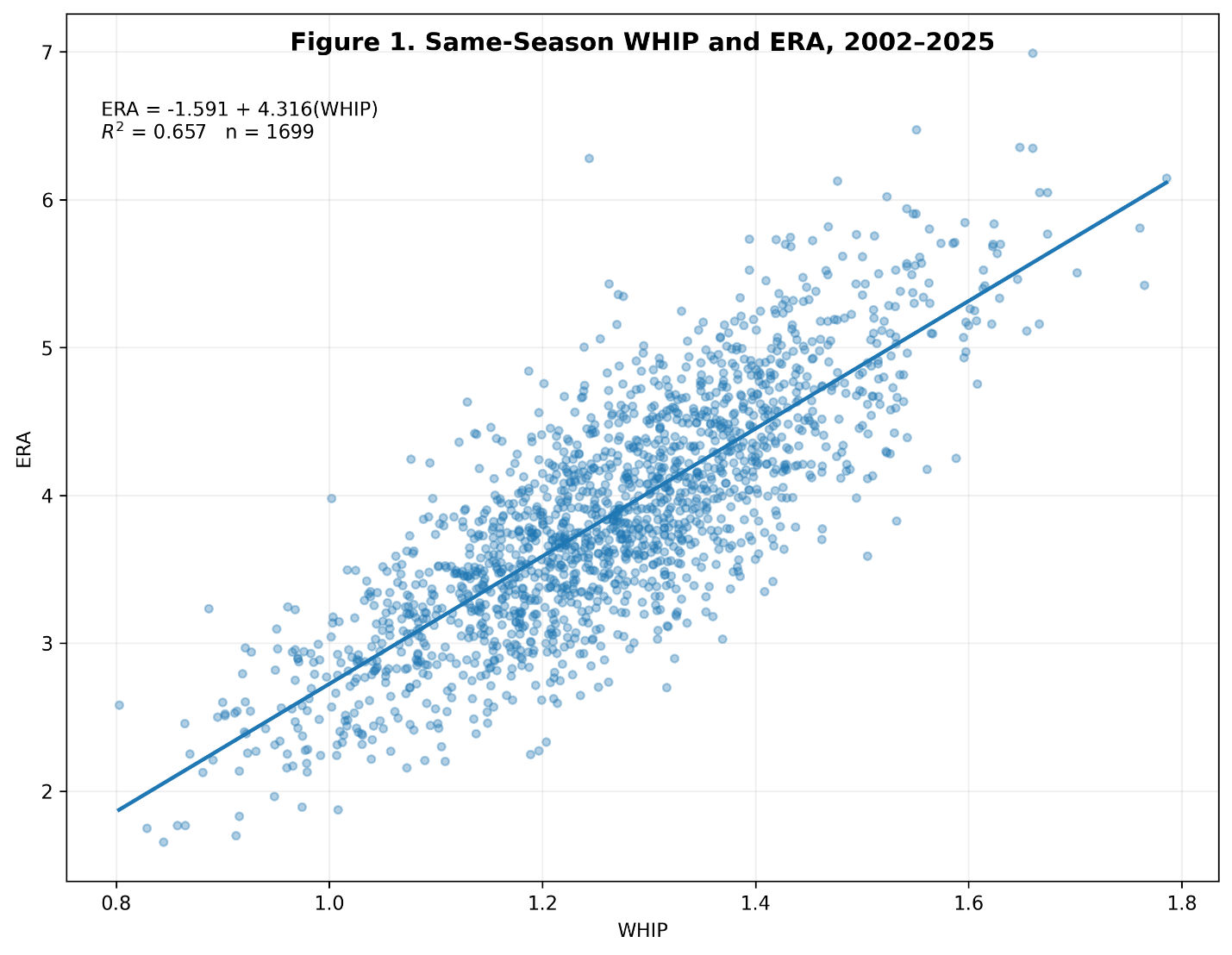
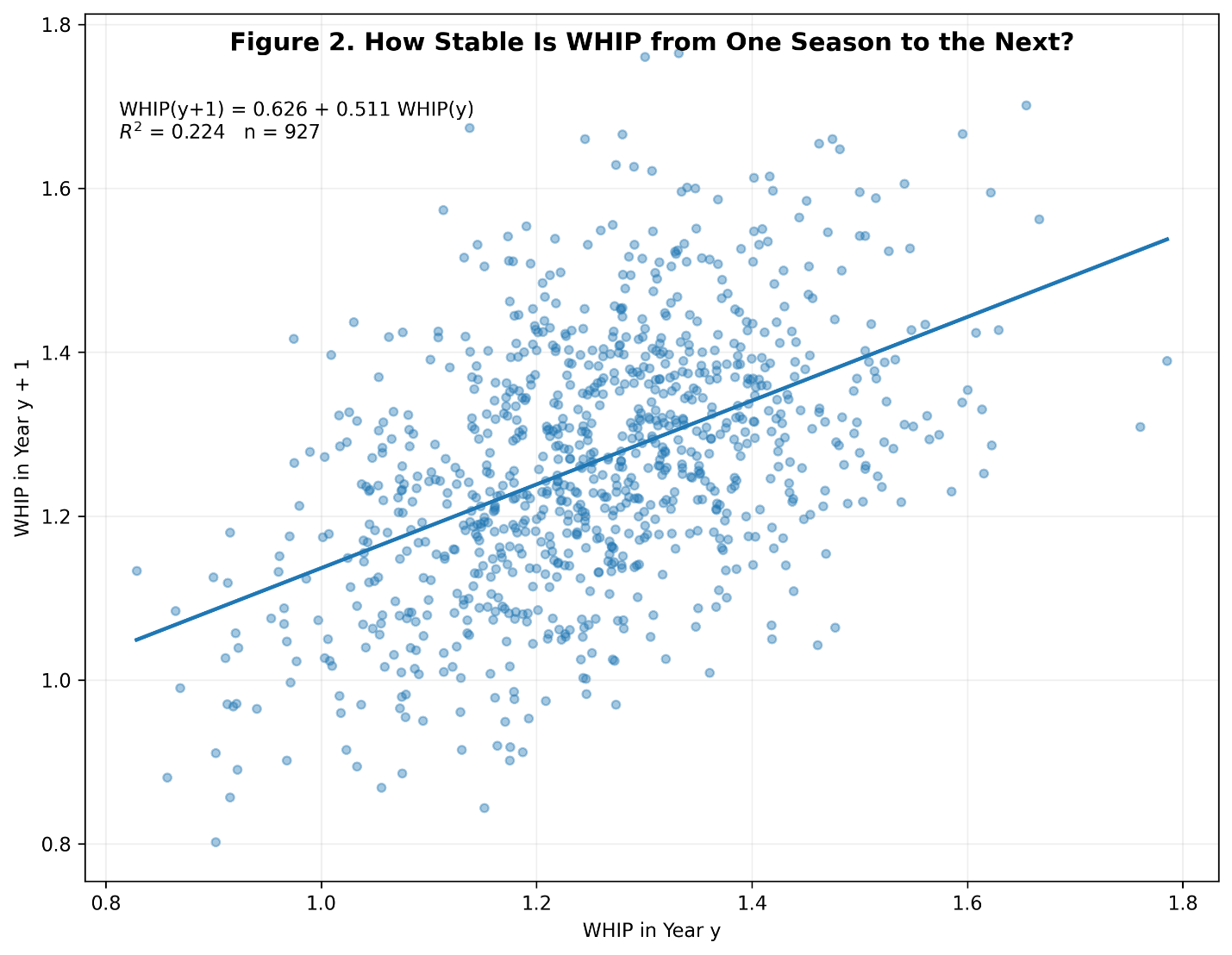
In a recent post, I demonstrated that WHIP is much more predictive of a team’s record than OPS, at least in the mid-2000s. I don’t think anyone will be surprised to learn that pitching is more important than hitting if you want to win baseball games. There will be more on that and related topics coming soon.