Scales of Unusualness: Offensive Production of AL Second Basemen in 2009

The title of this post is unusual (you see what I did). Why? Historically, I have chosen titles inspired by the band Arctic Monkeys. They had a propensity for overly long song titles that may or may not have anything to do with the actual song. For the longest time, they were my favorite band. The last two CDs, though, have given me pause. I listened to both of them hundreds of times, and I must admit that I just don’t get it. Maybe on some deep (nearly subconscious) level, I have given this post a most unlikely title as a mild form of protest. I am dubious of my potential impact.

This short essay is about the offensive production of American League second basemen in 2009. I will view each player’s statistics through an Explanatory Data Analysis lens, specifically by creating different Scales of Unusualness.

Here is a table of some of the data used for the study. Of course, the variables would be very different if we used players from last year. In 2009, no exit velocity or launch angle data were available. Even with this partial data set, many advanced metrics were eliminated from the table to make it more legible. Variations of these variables (and the others) were used to create the plot, which will appear shortly.

Table 1. AL Second Basemen, 2009

If we were just considering batting average (BA), it would be easy to rank the players. In fact, the players happen to be ranked in descending order based on that column, with Cano leading the way at .320. What happens if we want to consider all the variables together? Human brains aren’t very good at that task, but computers have no problem.

Next comes the scale that was referenced earlier. We can take each column and standardize the data by giving each value a z-score. A z-score measures the distance of a number in standard deviations from the mean of the data sample, in this case, all the columns with a “Z” prefix. Cano had the highest batting average, and you can see that his z-score for “Z_BA” is 1.68, which is more than double the next highest number in the column. That means his batting average for that year was highly unusual compared to other AL second basemen.

Table 2. AL Second Basemen Z-Scores, 2009

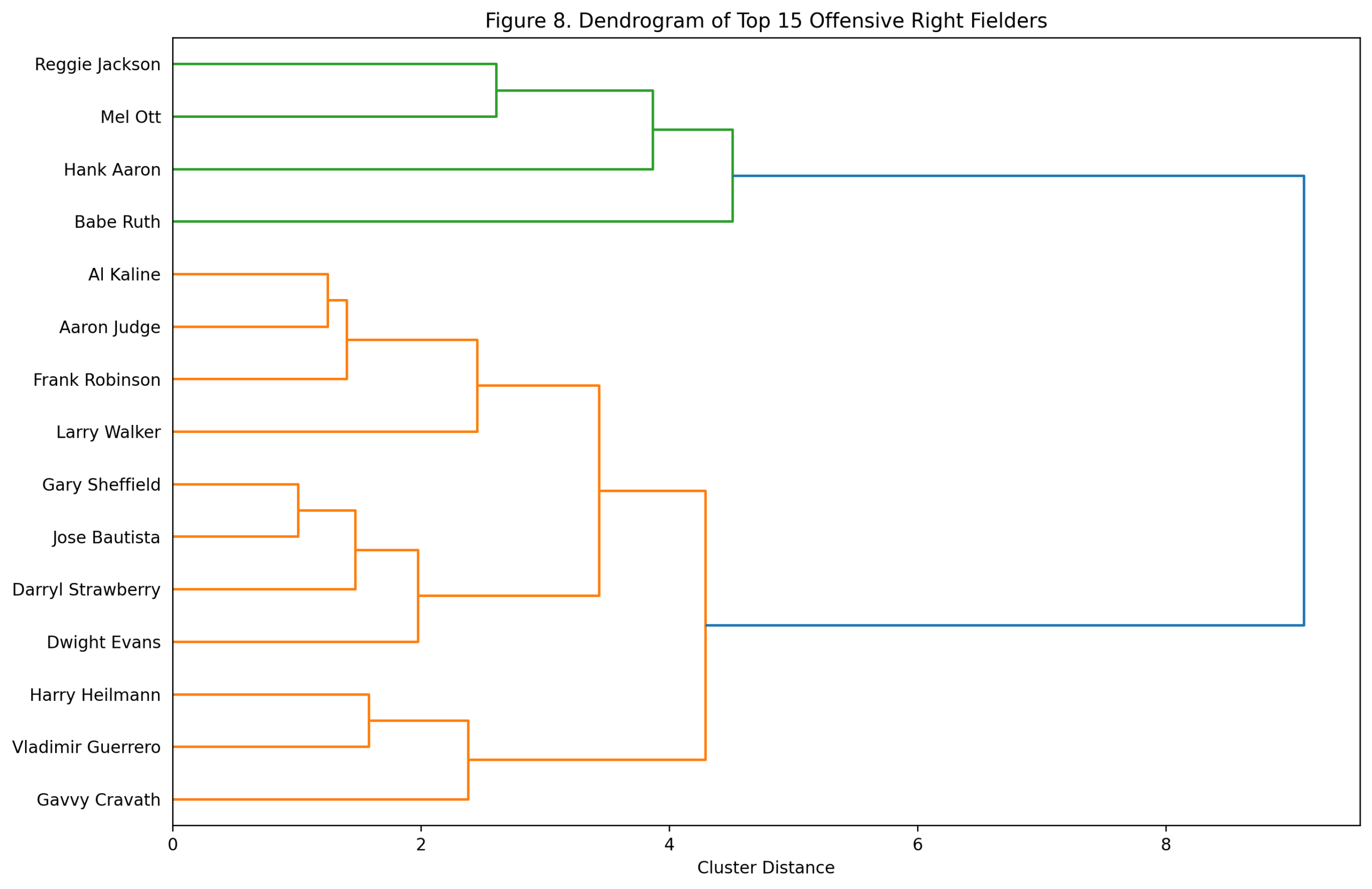
One interesting note. Look at the table and see if you can determine the two most unusual players when all the data is considered. I don’t think it can be done. There are eight variables, and that is six or seven too many. Fortunately, a technique called Cluster Analysis quickly solves the problem. Below is a Cluster Tree, or Dendrogram, of the computer’s analysis.


Figure 1. Dendrogram

The plot shows two large categories, those with high and those with relatively low offensive productivity. Among the top performers, the software identified Ben Zobrist as the most unusual. That means that Zobrist had the best offensive season of any AL second baseman that year. If you study the plot, you will see that Alberto Callaspo finishes a close second.

I would like to point out a couple more things. The plot shows that Maicer Izturis and Howie Kendrick had the most similar seasons. Their statistics were highly correlated in their unusualness with respect to the other players. Who knew?

So, as you might have guessed, there is a payoff to this post. A Scale of Unusualness doesn’t just identify the best or most productive offensive player; it works equally well on both ends of the scale. The most unusual offensive second baseman in the AL in 2009 wasn’t Zobrist; it was the unfortunate Nick Punto (with Chris Getz closing fast). Punto was much more unusually bad than Zobrist was unusually good. My guess is that when I include defensive metrics, Punto will more than redeem himself. You can’t play from 2001 – 2014 (and win a World Series) without being a big-time player. This one-year snapshot does not do him justice. Maybe I will post the defensive analysis next. Perhaps I will include offense and defense together in a more comprehensive study. Now that I think of it, I should take a break and give those Arctic Monkeys’ CDs another 300 listens.


19 Percent…huh?

19 Percent…huh?

I spent a lot of time putting together the lone figure in this post. My forthcoming baseball book will be filled with plots like the one that follows. I have known many people whose eyes glaze over when presented with figures or graphs (including professors who should know better). Pay a little attention to this one; you will be rewarded.

Between 2004 and 2008, there was a growing disparity in the payrolls of clubs in Major League Baseball. Lots was written about the unfairness of this. I agree with those who thought it outrageous that one team could spend 8 or 9 times what others could afford to pay their players. Consequently, every season began with plenty of fan bases lamenting the stone-cold truth that their teams had no chance to compete for a title or make the playoffs.

Growing up as a fan of the team then known as the Cleveland Indians, I knew that as soon as a young player started to excel, he was on his way out of town. It was a simple fact that other larger market clubs could easily outbid us for a young star’s services. Such was life in the big city.

Every year, big-money teams seemed to crush the less fortunate, and no one seemed to care. The fact that always got me going was that if a team (think Yankees), signed a player to a big contract and that guy floundered, all they did was treat the signing as a sunken cost and go about their business. Clubs like Cleveland, on the other hand, could be crippled by one bad signing. That is a statement of fact.

So, let’s see if we can gain some insight. One of the great things about a scientific mindset is that we can cut through the narratives and what people think is true, and get at the mathematical heart of the issue at hand. The following figure does just that.

I plotted payroll data from 2004 through 2008 against the winning percentage of all MLB teams. I colored the data points using a playoffs variable to simplify the plot. I think it makes it more interesting and easier to read.

Figure 1. 2004 – 2008 MLB Payroll versus Win Percentage Data.

The scatterplot is basically a blob (yes, the Yankees are in the upper right corner). That means a minimal relationship exists between a team’s payroll and that team’s record, at least for these 5 years. Note the equation in the lower right of the plot. That means a team’s payroll explains only 19 percent of all the MLB team’s record. In other words, there was very little explanatory value in predicting the number of games a team would win if you knew their payroll. The relationship between payroll and record is minimal.

Surprised? Well…if payroll is not a predictor of a team’s success, what is? If payroll accounts for about 19 percent of the outcome; what explains the other 81 percent? I will be looking into that in my book. Perhaps I will find that left-handed middle relievers are the key to success (I doubt it), or maybe if you are putting together a team, you need batters with high exit velocities, pitchers with exceptional strikeout rates, and outfielders who can run like the wind. I am going to try my best to find out.


A Crush, A Data Viz, and a Book Long Postponed

A Crush, a Data Viz, and a Book Long Postponed

I have a crush on a YouTuber. There, I said it. I hesitate because there is no chance I would ever approach her and “shoot my shot.”  She is probably half my age…maybe. She might be much younger. I am not delusional; even at my advanced age, I tend to still have my wits about me, so I will choose to keep my powder dry. So, why the crush, and, even more importantly, why would I choose to write about it? Let’s get into that.

Many months ago, I was doing my thing, surfing around the internet in an attempt to find a mathematical basis for the meaning of life (cough, cough), when I came upon an astonishing young woman. Indeed, I wasn’t looking for her, but that is how these things work, right? Most of the interesting things in my life have happened to me while I was standing in a corner, minding my own business, and breathing my own air.

This mysterious YouTuber is a brilliant Ph.D.  in theoretical physics who left academia because…well, that is one of the reasons why she is a content creator. She has many videos detailing why she left the academy to join the corporate world. I was instantly smitten. I was enchanted; I didn’t have a chance to surf away. The deed was done.

Was I instantly attracted to her obvious intelligence? Absolutely.  Was I impressed with her charm and personality? No doubt. And I must say, it didn’t hurt that I found her very attractive.

Immediately after I discovered her, I quit watching her videos. I didn’t need to be reminded of what I was missing while living here in Hillbilly Land. I say from experience and with all confidence that there is no woman like her anywhere near where I live. If such a bright light flickered near me, I imagine we would have crossed paths at some point. As it stands, I have no recollection of such a person. In fact, I just stepped outside and looked up and down my street…nothing. There was a chance she was driving through my town and got a flat tire in front of my house, right? Hold on, I’ll calculate the odds…ah, forget it.

As many of you know, it is much too early for me to reveal the lede (or thesis statement, if you like) as it has not yet been sufficiently buried. Trust me, the payoff is not a bad one. I felt this topic deserved its own essay mainly because I find the whole story unusual and fascinating.

Now, we can leave the present (where I sit overly impressed by a woman I will never meet) and travel back to the mid to late 1980s. The setting is Cambridge, Massachusetts, on the campus of Harvard University. I then was a dude learning graduate-level statistics. Believe it or not, Stem and Leaf Plots and Box and Whisker Plots were on the agenda. Now, kids learn about these things very early. I know a young man presented with these techniques in 6th grade. There are lots of reasons for this. John Tukey, the great statistician, published the seminal book Exploratory Data Analysis in January of 1977. Things take time to filter down to the mathematical masses. The lack of personal computers had something to do with the lag, as did the fact that high school teachers don’t spend much time looking through statistics textbooks. Also, who paid attention to mathematicians back then?   Who read their books? You get the idea. It was about as many people who pay attention to them now, at least on a percentage basis.

Of course, the bigger problem is how long it takes ideas, even great ones, to trickle down to society at large. An idea must go through levels of bureaucracy before it can be included in a public school textbook. No such stipulations apply to university settings. A professor can read a paper and talk about it in class the next day if they are inclined. I was known to do this a time of two. Not that it mattered; I don’t think my students even cared that they were learning something “hot off the press.”  They just yawned and asked if the material would be on the test.

Back then, and to this day, I spent a lot of time studying Tukey’s previously mentioned Exploratory Data Analysis (EDA). His book greatly impacted the study of statistics in general and proved to be a revelation in my little corner of the mathematical universe. I instantly understood the value of visualizing data in the way Tukey described. I wasn’t the only one, as Box Plots are as common today as bar graphs and pie charts.

Inspired by Tukey, I went on numerous statistical  “deep thinks” back in the day. I derived all the equations, both as an exercise and as a way to convince myself of the validity of the methods. It’s not that I didn’t trust the people who set the foundations of statistical thought; I simply thought it was required of me to do so. Many of my professors and I saw it as a way of paying my intellectual dues. Today, there are applied statistics programs that focus on the applications of the methods; they leave the mathematical nuts and bolts to those studying pure statistics. The applied statistics folks are experts at using the techniques; they don’t necessarily care what is under the mathematical hood. Nothing wrong with that. I think there might be an appropriate analogy with those who opt for English degrees instead of the more popular English Literature track.

A central focus of this post relates to an idea I had one day while studying Box Plots, known as Box and Whisker Plots across the pond, and Box and Dot Plots here. Mostly, they are simply called Box Plots, and that is fine. As I was studying a series of plots, not unlike those in the following figure, it started to bother me that the widths of the plots were not diagnostic; they appeared to be totally arbitrary.

Examine the plot illustrating baseball production by position. I created this in R using a dataset I  compiled long ago. The individual plots show the OPS (on-base percentage plus slugging percentage) for different positions in the American League during the 2009 season. The particulars are unnecessary; I just want you to notice the width of the boxes. You will see they all are the same, imparting no valuable information. In fact, the widths reveal no information at all. Shouldn’t the widths of the boxes change to reveal something about the data used to create the plot? Doesn’t that make sense?


Figure 1. Box Plots of 2009 AL MLB Hitters by Position.

I considered this issue and decided that the widths could and should reveal some information. I decided to develop a plot with the attributes of a Box Plot but changed widths depending on the number of observations in the data set at each point along the vertical axis of the box. I thought of them as supercharged Box Plots, or Box Plots on steroids, even though I never got to the point where I tried to name them. More on that in a bit.

My task was straightforward and didn’t require much insight to figure out what to do. I put my head down and made some plots, such as the following ones.

Figure 2. Box Plot of OPS for Second Basemen, AL 2009.

As usual, the nature of the data does not matter. This happens to be an OPS Plot of second basemen in the AL from 2009. I used the same data as in Figure 1. Next comes a histogram made from the same data set. Something interesting happened when I fused the two plots together. I say that with hesitation because I was in the extreme minority in my corner of the world.


Figure 3. Histogram of same data.

I rotated the histogram 90 degrees and then mirrored it. I then placed those plots on the box plot. It was a very simple process that required no mathematical insight or leap in intuition.


Figure 4. Rotated Histogram


Figure 5. Flipped (Mirrored) Histogram

I came up with the following. It is simply a box plot with varying widths. I wrote up a short paper and started circulating it among my cohorts, professors, passers-by, strangers, and anyone I thought might have an opinion. The results were disappointing.


Figure 6. Histogram and Box Plot.

The typical reaction I got was one of confusion. Huh? Why are you doing this? Why are you here? Why would anyone ever need this? This isn’t necessary (the implication being that I wasn’t necessary). I received no positive feedback. I received no neutral feedback. Everyone who saw my plots hated them. I think some people who viewed my plots felt embarrassed for me. It was a disaster.

I believe it goes without saying that I shelved my “box plots on steroids” project and went on with my life. If I had heard one word of encouragement, I would have developed the idea into a publishable paper.

I didn’t think of it again…until…a few weeks ago. I was using R, my computer language of choice, when I came across something curious. That is not unusual in and of itself; it happens constantly. What caught my attention was an image of something called a Violin Plot. I instantly recognized it. The output was very similar to my old project. Sure, the edges were smoothed, but the idea was the same.

I took a deep dive into Violin Plots. I realized that my idea from all those decades ago was now a common choice for those looking to create a statistical plot or data visualization, commonly known in data analysis parlance as a Data Viz.


Figure 7. Violin plot of Second Base Data.


Figure 8. Violin Plot overlayed on my original plot.


Figure 9. Violin Plot of Figure 1.

It is now time for the payoff to this essay. No, the point is not that I came up with an idea that was apparently way before its time. While interesting, I am sure that being attributed with the creation of Violin Plots wouldn’t have changed my life in any meaningful way. As mentioned, their existence requires no great insight or intuitive leap of significant consequence. No, the curious thing is what happened when I went on my deep dive of Violin Plots.

As I searched in an attempt to learn all I could about the newly revealed Violin Plots, I stumbled into a rabbit hole. I fell in face first, and as I dusted myself off and began my climb back to reality, I came across a scathing video by a young woman who HATES Violin Plots. She methodically went through her case. Many of her points were ones I had heard nearly 40 years ago, e.g., they aren’t necessary, it is easier to just use a histogram, box plots are fine, etc…

She also had one major criticism that had never occurred to me. In the last few weeks, I had spent a great deal of time looking at different Violin Plots, and I never thought they looked like anything other than violins. Seriously, I didn’t. The young woman’s main criticism of the plot is that immature males take their shape to resemble something other than a beautiful-sounding musical instrument. Unfortunately, she has a lot of anecdotal evidence to support her claim that these plots should never be used by anyone for any purpose.

I swear to you that what I will now tell you is accurate. If it wasn’t, I never would have written this essay. I almost feel stupid writing this because I am sure most of you have figured out that my YouTube crush and the young woman who hates Violin Plots are the same person. I would never have written such a scenario in a work of fiction because it sounds too contrived, yet here we are. I’ll slowly shake my head in disbelief as I crack open a beer.

What about the book, the one referenced in the title? I am guilty of more than a little foreshadowing. Yes, it is a book on baseball analytics. I started writing it in 2002. It got put off because I was compelled to write another book in its place. That entire book, The Athena Chapters, is posted on this site. My long overdue baseball book will be completed relatively soon, and much to the disappointment of my YouTuber, it will be full of Violin Plots because I find them diagnostic and beautiful. I know she disagrees, but I don’t see us arguing over their utility and functionality at some fancy dinner party. I’ll apologize in advance, place the plots where I want, and take my chances.


Gas Cards

I am broken…defeated. I fought the good fight, but I lost. Better people than me have experienced a worse fate.  The future I always had planned for myself is dead.  There is nothing I can do about it.

As some of you know, I spent my best years at Harvard University. I was there for about 6 years. Those are my ‘good old days.’  I still dream about the basement I lived in across from Tufts University.  For a time, I had a lab at Vanserg Hall.  It was miles away from my little apartment, but I used to walk. The entire area is charming.

I didn’t want to leave. I really didn’t want to leave. The Harvard community calls it “Exile from Eden” for a reason. They kick you in the butt, give you a mission, and tell you to go.  For the most part, you have to go.  The first time I graduated, I stayed and got another degree.  They really wanted me to leave after that, and so I did.

I like telling people about how remarkable that place is. I could easily sit down at a table with nine other people and know that there was an excellent chance that I was the tenth most interesting person there. Where I live now…not so much.

I have been thinking about Harvard because I am getting old. My brain has betrayed me. I don’t have trouble learning anything, but retention is a different story. Sometimes, I can not remember what I studied five minutes after getting up. That might be the main reason I study so much. Perhaps I am in a constant loop and have no clue. I do know I still love learning. And that brings me to Cliff Stoll.

I have written about the great Cliff Stoll, an astronomer who makes Klein bottles. He is a national treasure. Seek out his TED talk (The Call to Learn); he is a force of nature. He made one of the most profound statements I have ever heard during that 17 minutes. He said that if you do something once, you are a scientist; if you do it twice, you are an engineer; three times makes you a technician. I would add that the fourth effort makes you a trained monkey.

Stoll was talking about the mindset of a scientist, those true-born intellectual explorers. Once scientists have done something, they aren’t interested in ever doing it again. The appeal is to move on to the next problem. What else is unknown? Confirming someone else’s discovery is uninteresting.

One of the great tragedies is when a scientist, through circumstance or bad luck, is forced to do repetitive, soul-crushing monkey work for their entire working life. If you were not born with the spirit of a scientist, I imagine the monkey work is a little easier to take. For the scientists, even those doing the work of an engineer, it is heartbreaking.

Is there a point to this short post? Sure, as always, I like to bury the lede. I want to plant it deeper, but I am tired, worn out. As I said earlier, I am broken.

I fought the good fight; I really did. Some dreams die hard, and I am still shocked that mine passed away. I am shaking my head at the prospect of a dreamless future. I am disappointed. I need more time to reflect on this.  I will wake up tomorrow knowing that I need to win the lottery if I ever want to pursue my life’s work.  I do not anticipate winning the lottery.

At Harvard, people would often ask what equation would be on your tombstone or what the first line of your obituary would say. Yes, it really is that kind of place. As I have gotten older and my abilities have faded, I find myself thinking about that ‘contribution to humanity’ we were supposed to make. They were serious about it. We were all tasked with making the world a better place. It never occurred to me (until now) that I wouldn’t leave the world a better place than I found it.

I have yet to make that contribution; I haven’t done anything substantive, at least not in my eyes. That might be one of the reasons I have not set foot on that campus in over 30 years.

Some of you would disagree with my assessment, but I am the only true arbiter of success or failure. Just as you are with your life. No one else’s opinion is of any consequence.

I have been busy, I have written 16 novels and books under various pennames, but none are extraordinary. One was really good, but that contribution the Harvard people told me to make remains elusive.

I always knew I would spend my last years writing that great novel, the work representing my contribution. I worked hard to put together a plan that has been in place for decades. I was going to get a little place in Portugal or in South Africa, and I was going to drink some warm beer and write…a lot. I would leave behind a record of what it was like to be me.  Now, I am hurt.  If I believed in a soul, I would say mine is wounded.

Pushing my attempt down the road was not ideal, but I had little choice. I kept getting up every morning because I knew the day would come when I could sit by the beach with my computer or notepad. I would fight off inferior insights as The Muses battled for my ear.  That is not going to happen.

I have told friends I prepared for every eventuality except what has now befallen me. The universe broke me. Of course, I always knew it was indifferent to me, but it has been known to go way out of its way to make me feel its destructive power. The evolutionary biologists at Harvard used to constantly remind me that the universe is not cruel; it is simply indifferent.  They had to keep telling me because I had difficulty believing it.  I still don’t know what to think.

I won’t be going to Portugal or Africa. I will remain here in Hillbilly Land, a scientist stuck in the monkey clutches of an apathetic world. The hows and whys of my plight are uninteresting and don’t matter.  I must find a new reason to lift my head from the pillow.

The odds of me writing a great novel while stationed in Hillbilly Land are nil. I can’t fake inspiration; unfortunately, this is this continent’s most uninspired piece of land.   Hope does not spring here; this is where hope comes to die. This town is depressing, the people are (predominantly) uninteresting, and the weather is terrible.  I do not understand where I am supposed to draw the inspiration from.

I will let out a sigh as I contemplate my fate. I am sorry for all the people back in Cambridge who believed in me and expected something substantive. It is unlikely that is going to happen. The New York Times will certainly not notice my demise. As for that tombstone, burn me and throw me to the wind.

The Greatest Tweet

The Greatest Tweet

I am not a big social media guy.  I do have a Facebook page, but it is under a pen name.  I never visit it and don’t believe I have ever posted on it.  I don’t feel social media is necessary for me; if I have anything to say, I can speak up here.  Of course, this blog is also written under a pen name.  I guess the real version of me has very little to say at all.

So, how did I come across a tweet?  This one made national news, and I instantly realized why.  When the Twitter platform was conceived, the creators could never have imagined something so wonderful and insightful delivered through their code.  And yet, here we are.  I admit I am a novice and have no Twitter experience, but I can say with certain authority that what follows is the greatest tweet in history.  Let me slightly amend that; this is the most fabulous tweet possible.  People who tweet in the future can only hope for second place when the history of great tweets is written.  Behold…

This image was shared the other day.  The left-hand side shows 13 metrics that the team uses to evaluate players.  In the lower right, they tell us that the team assigns each player a score from 0 – 100 based on their analysis.  The revolutionary aspect of this visualization is the “analytics cylinder,” complete with the Bears’ logo.  I have been studying analytics and data visualization for decades, and honestly, this is the greatest thing I have ever seen.

Think about this, did the Bears risk giving away any proprietary information relating to their analytical process?  If anything, the Analytics Cylinder (yes, that deserves to be capitalized) creates more mystery.  What exactly are they doing?  Are they using Python, SQL, and R, or alien technology from Area 51 in concert with quantum computers to pick the most promising players for their team?  I don’t know, but I am interested.  Before I saw the tweet, I didn’t care one bit about how the Bears went about their data analytics.  Now, I assure you, I can’t get enough.  I might set up an account just so I can follow them.  Who knows, maybe a Database Rhombus is next.


Datasaurus!

Datasaurus!

Well…that is something.
Buford Lister (personal communication)

That is in the top seven of the coolest things I have ever seen.
Warren Andrew Slay (personal communication)

This post takes off where the last one (Anscombe’s Quartet) ended.  Anscombe had four data sets, whereas the mighty Datasaurus file has 13.  Yes, it is either a Baker’s Dozen or you can think of it as the dino plot along with 12 others (the Datasaurus Dozen) that illuminate its glory.  Either way, prepare to be dazzled.

As with Anscombe, the summary statistics for all these plots are virtually identical.  (x mean = 54.26, y mean = 47.83, x SD = 16.76, y SD = 26.93). Yeah, yeah, the 4th or 5th decimal place is different.  So what?  If you think that is important, I can’t help you.  Please just relax and behold the Datasaurus Dataset.  And yes, please be careful with your data when engaging in a project.  That just might be the point of the following plots.

I hope you are astonished.  I find it fascinating that all these plots share the summary statistics I mentioned earlier.  Considering those commonalities, I wouldn’t have thought it was possible to get this kind of variability.

If you want to learn more about these graphs, search for Alberto Cairo and the team of  Justin Matejka and George Fitzmaurice.  They have done good work.  They all want us to think carefully about our data.  I could not agree more.


Anscombe’s Quartet

Anscombe’s Quartet

Let’s be Frank; this data set is interesting.
Buford Lister (personal communication)


Yale statistician Frank Anscombe published a short paper in 1973.  As I recall, around that time, Tony Orlando hoped to see a yellow ribbon wrapped around an old oak tree while The Godfather dominated award season in the film industry.  As for me, I can’t recall, but I am sure I was wearing bell-bottom pants and a flimsy shirt to the local grade school.  Anscombe’s paper and The Godfather have fared much better than those bizarre jeans (the huge ones were called elephant pants, my flavor of choice).

In Anscombe’s paper, he introduced what has become known as Anscombe’s Quarter, one of the most famous data sets in the world.  Pay careful attention to the summary statistics at the bottom of the table.

Do you see it?  The summary statistics are virtually identical.  Back in the day, before computers were ubiquitous, many relied upon these summaries to get a general idea of their data.  After all, what else were they supposed to do?  Believe it or not, Box Plots and Stem and Leaf Plots were not commonplace.  Anscombe’s brother-in-law, the great John Tukey, introduced them and other exploratory data analysis techniques during this time.

I am sure many of you are ahead of the game.  You know the data set wouldn’t be famous, and I wouldn’t write about it unless there is something extraordinary about the data.  Take a look at the following graphs.

I only recently came upon this dataset.  I am currently learning Python and SQL.  I am also brushing up on R, a statistical package I have been fighting with for decades.  For those of you too young to remember the baby version of R, it consisted of a command prompt and numerous 1,400-page manuals.  Things are much better today.

This data set has appeared more than once in my recent studies.  It usually appears as a cautionary tale against making assumptions and refusing to think when you may be tired and want to go to bed.  Also, it serves as a stunning reminder to never forget to plot your data.  As you can see, the plots are essential to truly understand the data you are analyzing.

Even though I am done with this essay, I am just beginning with my “data” themed posts.  I have lots of information burning a hole in my hard drives.  I assure you, Anscombe’s Quartet, as brilliant and illuminating as it is, is just the beginning.

P.S.  Don’t forget to check out the regression equations.  Amazing.

A Few Thoughts from the Big City

A Few Thoughts from the Big City

Do any of us set out to live an uneventful, pedestrian life? My guess is that, yes, many of us want nothing more than a decent partner, a job that pays the bills, and kids that don’t end up as axe murderers. In the land of low expectations, you could do a lot worse.

I am back at the library, the intellectual and cultural center of this neck of Hillbilly Land. There is a man a table away from me struggling to get his phone charged. He is unhappy with the progress the USB port is giving him. He reached into his duffle bag and pulled out a couple of chargers. Those do not appear to be sufficient either. A mild inconvenience for me could prove disastrous for this man.

I could invent a back story for this homeless person. That is what writers often do. I have done it all my life. One guy is a secret agent, another a fledgling serial killer. See that guy over there?  He is about to steal a large sum of money from work so he can run off with his mistress.  I am not sure any of those random people would be given a backstory that matches their reality. A homeless man’s story is only interesting if they can somehow come out the other side with their wits intact. I am rooting for this guy, I haven’t seen him before, but the other homeless people know him. They are all saying hello or nodding in his direction.

When this man was a child, I doubt he envisioned that he would be an old guy without a home or a job. Perhaps he even had parents who had bright hopes for his future. No one wants to think that they will be the guy sitting by himself at the library, loudly cursing the phone charger that is letting him down. Indeed, no parent would wish that fate on their child.

Could it just be a bad cable? The dollar store sells them, and most of them are good. Still, the occasional defective actor slips through the quality control process. I bought many cables there and have had excellent luck with them.

Author’s Note:  I had a lot of trouble sleeping again last night. The past, a place I have a complicated relationship with, has been tugging at me. Thinking about the deaths of people who die far too soon can do that. Perhaps I am worried about living long enough to finish all my projects. That is probably it, right? Old Killy McGee has come after me twice in the last six or seven years. I have been lucky. I hope I won’t need to dip into that well again soon. It is a morass of stochastics and probability that allows only so many withdrawals before the bean counters take some initiative and do their thing.

A woman, another homeless person I have never seen before, just sat down with the man having phone charger issues. She is much younger than him. She is clearly agitated. I could take off my headphones to get a sense of the conversation, but I would rather listen to Mozart in my headphones rather than their conversation.

An interesting thing just happened. The people at the table are having animated conversations, not with the other person across from them, but with themselves. If I had a solution to this problem, I would present it. I would write it up, send it to anyone I thought would read it, and then work to implement a plan. I have nothing.

Mozart juxtaposed with hopelessness. And here I sit, the eyes through which a nonsensical story with no plot, direction, or purpose, is told. Mozart’s death was an unnecessary slap in the face to humanity.  He was taken from us way too soon in the most significant cosmic ripoff in history. The universe didn’t care that a genius was struck down before reaching his prime. I can’t help but think that the universe has the same attitude toward the two people at the table across from me. Genius, homeless, no matter.

The woman at the table is becoming increasingly animated as the man is loudly mumbling about a local church. I guess they will stop by there and get their lunch. They might be a couple, even though he appears much older. Love, right? Who can know how such things happen. Who understands the chemical, biological, or cosmic forces that work to bring two fragile and precarious people together. I have no thoughts on how such a thing might have happened to them (in particular) or others (in general).

Implied Author’s Note: I tried to publish the post I wrote about Dawn and her memoir yesterday. Things became odd, very odd. My website says that the post was published, and I can see it on my computers at home, but it does not appear on any other computers. I have no idea what is happening. In the past, with hundreds of other posts, I have never had this problem. I spent some time researching the problem, and I came up empty. It must be some kind of omen, right? Maybe not, probably not, most certainly not. I am sure it is some random nonsense that has a technical solution.

The couple just left together. He struggled to lift his backpack from the floor, his arthritis creating problems I am familiar with. She did much better. She had no problem jumping up, her backpack already around her shoulders. I wish them luck, but they will need more than I can offer, a lot more.

Author’s Note:  I do not make New Years’ Resolutions. If a person wants to change, they should simply do it. An arbitrary date on a calendar means nothing to me. That said, I have 8 books I want to get out the door and into the world this year. Some are 90% done, others closer than that. A couple volumes are going to require a lot of revision. Time and energy are in short supply in my general vicinity.

I usually sit and write at the library until I get up to use the bathroom. Old guys need to go a lot. For any young men who might be reading, when you reach my age, you will wake up in the middle of the night, probably multiple times. You are going to plan your travel so that a restroom is always close. The whole thing is an inconvenience and can quickly become a major problem. Hopefully, modern medicine will progress to the point where discussions such as these will be forgotten by the time you are my age. Good luck to all of you.

I have moved upstairs to the nonfiction section at the library. I am very hungry, but I am still on my “post-blood-clots-trying-to-kill-me-diet.” I am hungry all the time. I am hungry when I go to bed and hungry when I wake up. I am hungry all day and into the night. The powers that be tell me that is better than dropping dead. Most days, I tend to agree.

Implied Author’s Note: I recently discovered that nothing I have ever written has influenced a single person. How did I come to such a realization? That is a topic for a novel. If I can get those 8 other books out the door, I can work on that one.    With luck and a cheeseburger or two (something I haven’t had in years), things will be just fine.

Highly unlikely or even inconceivable events do happen on occasion. This might be one of those strange moments in time. Bizarre might be another word for it. I need to leave and go home. Against all odds, my laptop charger is malfunctioning. When I get home, I will try another cable. That’s probably all it is, right? I just need to swap out the cable. If that doesn’t work, I will have to think of other things I might be able to do to fix this mess. Without a charged laptop, there isn’t much for me to do at the library, and there is not much they can do for me. I don’t need any social services; I have a home and a job. I took a shower before I came in this morning. I think I’ll just head home and think about what I want to eat.


An Unwelcome Memoir

An Unwelcome Memoir

I guess it is simply a function of getting older, right?  No matter their age, these people I once knew are dying too young.  I am 60, but I am only 60.  I am not 85 or 90.  People I met when we were young should not be dying, yet here we are.

{If any hillbillies want to criticize me for writing this post, I recommend that they keep their thoughts to themselves.  I put the last ignorant hillbilly on a subtle form of literary blast.  I only developed a little sympathy for this person when one of my friends made a suggestion.  He said it was within the realm of possibility (or probability) that certain forms of branded hillbillies do not know what a metaphor is.  If such a person has read this far, I want you to stop.  Please just go away.  Seriously, go now.}

I am back at the library today.  My usual table was taken by a homeless man in Cleveland Browns’ gear.  He didn’t stay long, my table is now empty, but I don’t want to move.  I am unpacked and working.  I don’t feel the need to move ten feet just so I can keep doing the same thing over there that I am doing here.

I am pausing, hesitating, and procrastinating to write about this most recent death because I do not know what to say.  The story isn’t necessarily long or complicated; it is simply terrible.  I am debating whether to tell it.

The year is 1986.  Yes, present tense; see if you can take yourself back to that time if you were among the living.  I was in Hillbilly Land, not far from where I am seated now.  I bet I met Dawn no more than 100 feet from this spot.  Sure, the high school is gone, but the ground remains.  I do not like thinking back to that time; it is marked by a bunch of Hillbilly nonsense piled on top of more Hillbilly shenanigans.  Adjacent to that?  More Hillbilly stuff.  It was a cavalcade of Hillbillies.

I finished a summer at Harvard University and was back in Hillbilly Land.  I was preparing to go back to Cambridge for good.  I was teaching at a local university during the nights and substitute teaching at any school that needed me during the day.  You need a kindergarten gym teacher?  Sure, sign me up.  High school music teacher for a day?  No problem.  You get it.

I came in contact with many hillbillies (both upper and lower case), people with no ambition, direction, or hope for the future.  The individuals who didn’t have those inherent hillbilly qualities stood out.  A high school student named Dawn was one of those.  She attended my old alma mater, a school that I ended up subbing at a lot.

We know it is not uncommon for students to develop crushes on their teachers; it happens all the time.  Even though I was only a substitute teacher (not one to generally merit admiration or respect), it became clear that Dawn had a crush on me.  That one of her friends came up to me and told me multiple times only reinforced what I already knew.

I thought she was an extraordinary young lady.  If the universe had different plans for us, she would have been a college student what we met.  As it was, there was no way we could have any kind of relationship.  That was a simple fact.  There was nothing to be negotiated.

After the school year ended, I left for graduate work in Cambridge and never saw or heard from Dawn again.  Even so, I never forgot her.

The other day I was going through the obituaries in the local paper when I came across her.  Early 50s and widowed.  The obit said something about a rare liver disease.  I sat in stunned silence, numb from what I saw on my computer screen.

At the very bottom, her obituary mentioned the memoir she had just published a few months ago.  Reading that such a manuscript existed made me happy.  The fact that she had written a memoir implied that she had lived a life worth writing about, a life others would want to read about.  As I said, the fact that she wasn’t a hillbilly had jumped out at me all those years ago.

Author’s Note: I believe the workers at the library are viewing me with suspicion.  In high school, I was voted best dressed in my class.  Do you know how bad your fashion sense must be to be awarded such an honor?  They didn’t give me the title because I was a snappy dresser; it was an ironic award.  I have never, ever cared about clothes.  Today I am wearing a favorite pair of sweatpants.  They are over 20 years old, and they are falling apart.  The material is very thin, especially near the knees.  I know these will have to be thrown out soon, but I am wearing them because I love these sweatpants.  I feel a bizarre sense of loyalty to them.

I just finished Dawn’s memoir.  I couldn’t sleep again last night (why has that been happening so much lately?), so I knocked off the last couple of chapters.  Even though it was well written, it was hard to read.  She experienced lots of tragedy and didn’t spare the details.  It appears that those in charge of making people suffer for no apparent reason took a particular interest in her.  An indifferent universe remains unreasonably undefeated.

An observant reader might wonder why I need to include the part about the teenage Dawn and her feelings for a substitute teacher she never saw again.  Why did I mention that she had a crush on me?  Is that really necessary?  Well, yes, it is.  I am honored that such an extraordinary person thought I was worthy of her attention.  I suspected her life would turn out as bright and interesting as it did.  I just didn’t know it would be so damn short.

Author’s Note:  Some months ago, one of the homeless guys at the library thought I was another homeless person.  The details do not matter; it was apparent that he felt that only a person down on their luck would wear such sweatpants.  I was also wearing a 30-year-old Harvard sweatshirt that, like me, had seen better days.  That morning, I also carried the backpack I used back at Harvard decades ago.  I often utilize the old stuff because those items remind me of better days, my good old days.  The days when I woke up in a magical setting, surrounded by the most extraordinary people I have ever met.  The days when a remarkable woman might smile at me instead of looking through me.  The days that are long gone.

I am in my writing room.  It is raining much too hard for me to venture out.  The library can wait for another day or two.  I am sure I will not be missed.  As I look out the window, I see a few people walking along the sidewalk.  They are getting drenched.  No cars are moving out of the way of the large puddles.  The amount of water being thrown by the tires is significant.  Neither the drivers nor the pedestrians know that this neck of the universe is slightly less interesting today.  They are oblivious that an iridescent and significant light went out halfway around the world.  Unlike me, they have bigger worries.  After all, they are cold and wet, and I am warm and dry.

Postscript

Love, Loss and Lifelines: My Year of Grief on the Run is the memoir that Dawn Picken published shortly before she passed away.  Yeah, I think you should read it.

I have been thinking a lot about Dawn and the life she wrote about.  One of my friends said that Dawn was lucky to have met the love of her life even though he died so young.  “Lots of people don’t even get to do that.  They never meet the love of their life.” She looked at me sheepishly as she realized what she had just said to a 60-year-old dude who had never been married and would surely be dead for days before anyone might think something was wrong.  I don’t know what to think about my friend’s comment.  Maybe Dawn was lucky, maybe not.  Read the memoir, and you can decide for yourself.