The potato paradox is one of those little mathematical oddities that feels impossible the first time you hear it.
Suppose you have 100 pounds of potatoes. The potatoes are 99 percent water. After sitting out for a while, they dry slightly and reach 98 percent water content.
How much do they weigh now?
The instinctive answer is something close to 99 pounds. After all, the water percentage only dropped by one point. How much difference could that make?
The correct answer is 50 pounds.
That is the shock of the potato paradox. A change from 99 percent water to 98 percent water halves the total weight.
At first glance, this feels absurd. But there is no contradiction. The trick is not in the arithmetic. The trick is in the denominator.
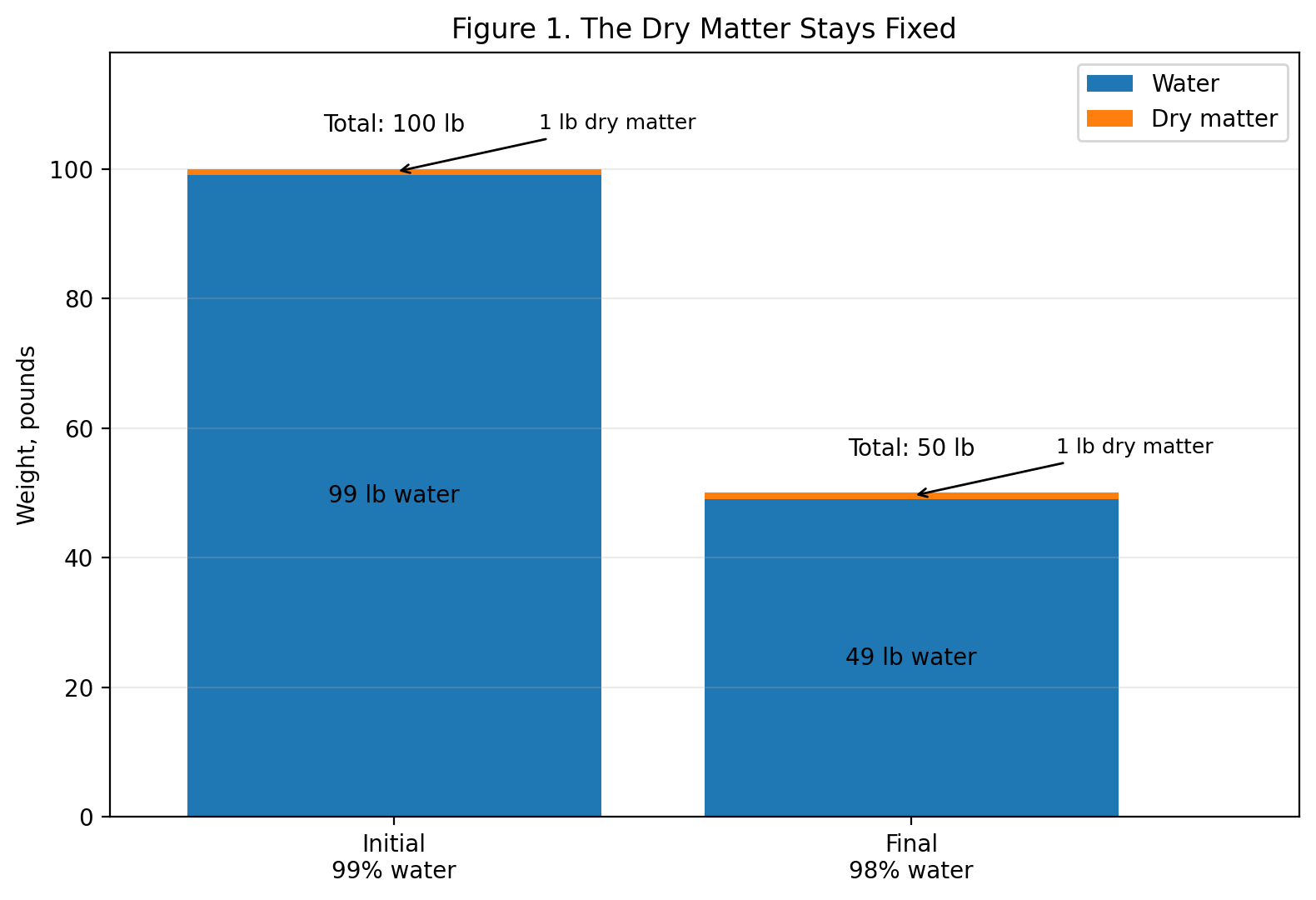
The key idea is that the amount of non-water material does not change. The potatoes lose water, but they do not lose dry potato matter.
Let the initial total weight be:

Let the initial water fraction be:

The dry matter is the part that is not water:

Substituting the values:

So the original 100 pounds of potatoes contains 99 pounds of water and 1 pound of dry matter.
That 1 pound is the anchor of the whole problem.
After drying, the potatoes are 98 percent water. That means they are 2 percent dry matter. But the dry matter is still 1 pound. So we need to find the new total weight W1 such that 1 pound is 2 percent of the total.
The equation is:

where:

So:

The potatoes now weigh 50 pounds.
That means the water weight has fallen from 99 pounds to 49 pounds:
99-49=50
So the potatoes lost 50 pounds of water.
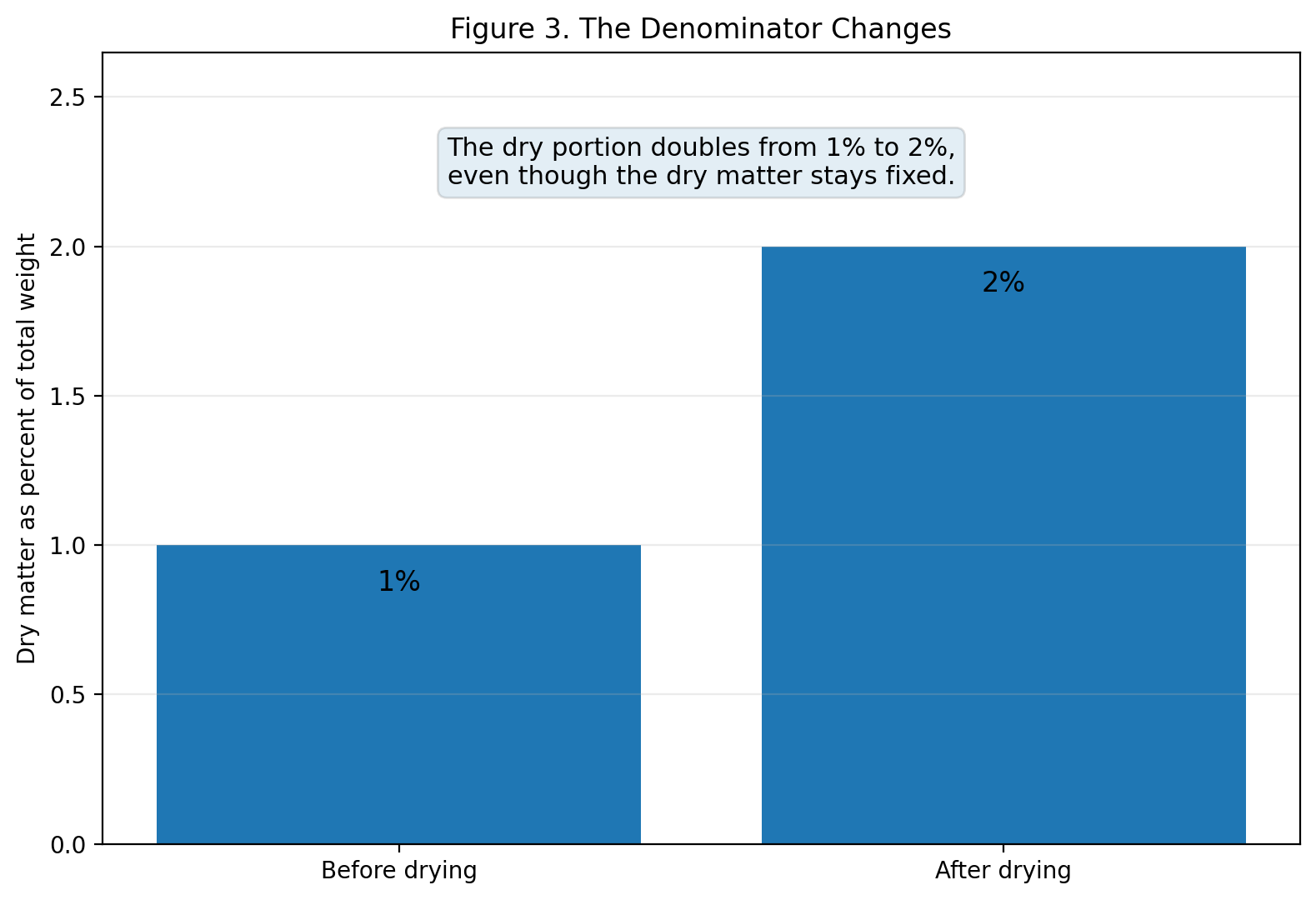
The paradoxical feeling comes from confusing a percentage point change with a small physical change. Going from 99 percent water to 98 percent water sounds tiny because the percentage dropped by only one point. But the dry matter share doubled.
Originally, the dry matter was 1 percent of the total:

After drying, the dry matter is 2 percent of the total:

The dry matter did not increase. The denominator decreased.
That is the entire puzzle.
The general formula clarifies the structure. If the initial weight is W0, the initial water fraction is p0, and the final water fraction is p1, then the dry matter is:

The final weight is:

Substituting the expression for (D):

So the general potato paradox equation is:

For the classic potato problem:

This is why the puzzle is so effective. The numbers look nearly identical:
99% & 98%
But the meaningful comparison is not between 99 and 98. It is between the dry percentages:
1% & 2%
That is a doubling.
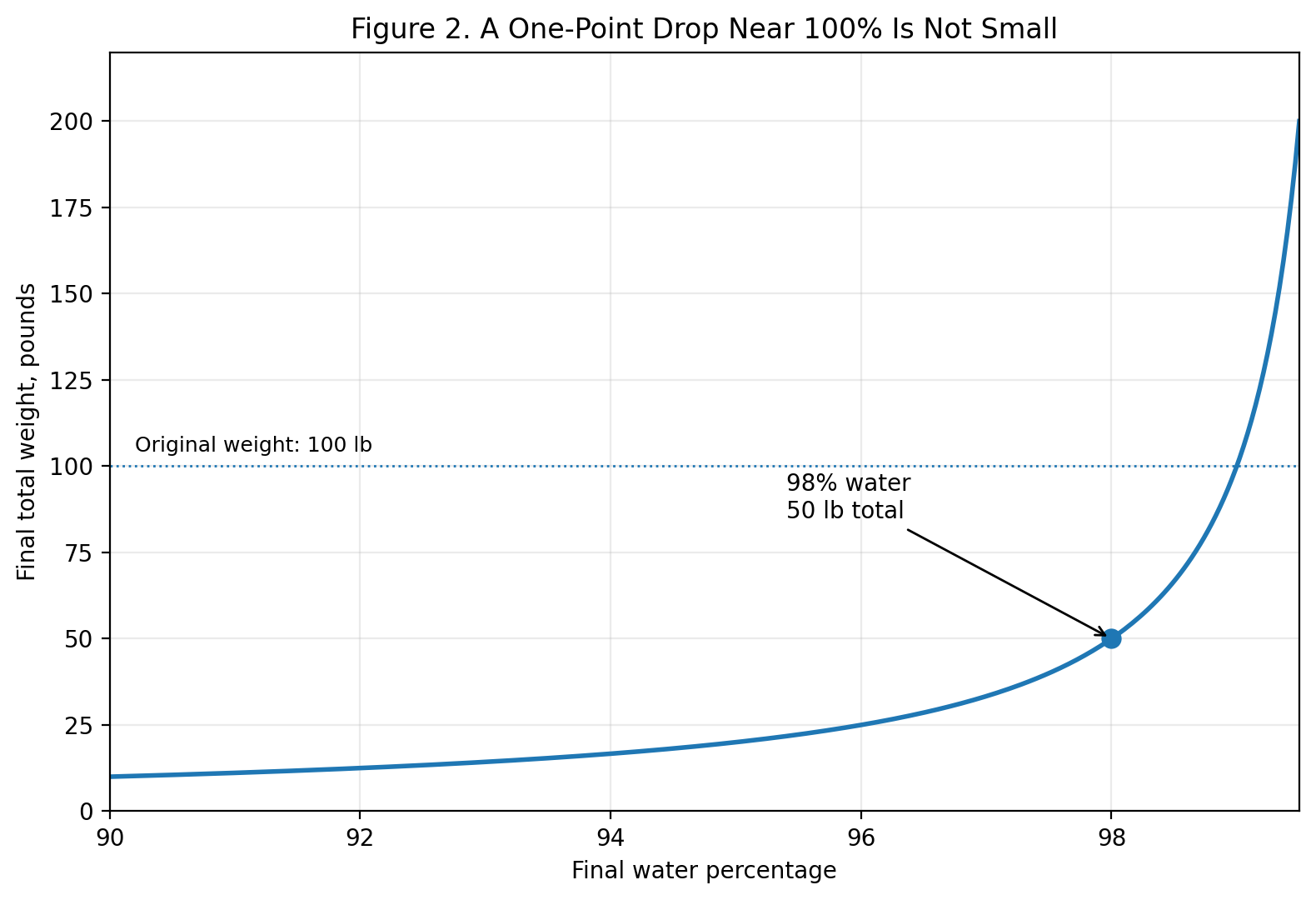
The closer a quantity is to 100 percent water, the more sensitive the total weight becomes to small changes in the water percentage. This can be seen by writing the total weight as a function of the water fraction:

Here D is fixed. The only thing changing is p, the water fraction. As p approaches 1, the denominator becomes very small. A small change in the denominator can produce a large change in the total.
The sensitivity is visible in the derivative:

As p approaches 1, the denominator becomes extremely small. That makes the total weight very sensitive to changes in p.
This is not just some kind of bizarre potato trick. It is a lesson about ratios, percentages, and hidden bases. Percentages are always percentages of something. When that “something” changes, intuition can fail.
The same kind of error appears in many places. A business may say its costs fell from 99 percent of revenue to 98 percent of revenue, which sounds modest. But if profit rises from 1 percent to 2 percent, profit has doubled. A baseball player’s out rate, a hospital’s survival rate, an investment’s expense ratio, or a website’s conversion rate can all create similar illusions. Near the extremes, small percentage-point changes can hide large relative changes.
So is the potato paradox really a paradox? Not in the strict sense.
The potato paradox is most properly classified as a veridical paradox: a result that appears impossible at first but is actually true. Its force comes from a denominator effect. The dry matter remains fixed while the total weight changes, so a one-percentage-point drop in water content produces a surprisingly large drop in total weight.
A true paradox usually involves a contradiction, or at least a deep tension between two apparently valid ideas. The potato paradox does not contain a contradiction. It contains a surprise. Once the dry matter is kept fixed, the result follows directly.
The puzzle feels paradoxical because our intuition focuses on the water percentage. The math focuses on the dry matter percentage. Those are complements, but psychologically they behave very differently.
The statement “the potatoes go from 99 percent water to 98 percent water” sounds like almost nothing changed.
The statement “the potatoes go from 1 percent dry matter to 2 percent dry matter” sounds much more dramatic.
Both statements describe the same situation. One hides the effect. The other reveals it.
That is why the potato paradox is useful. It reminds us that percentages are not self-explanatory. We have to ask what the denominator is, what remains fixed, and what is actually changing.
The potatoes did not violate logic. They exposed a weakness in ordinary intuition.
The paradox is not in the potatoes; it lies in how we perceive percentages.