The Athena Chapters: Chapter Seven


When I was an undergraduate, I started off as a general mathematics and science major.  The university I attended allowed you to take a certain number of these courses, along with all the other required stuff, to get an associate degree in math and science.  That was my first degree.  All you had to do was apply for it as you progressed toward your four-year degree, and they happily handed you an A.A. Degree.  I took everything from physics and astronomy to trig and calculus.  Oh yeah, all students (regardless of major) were required to take two writing classes offered through the English Department.  My story begins in one of those classes.

I wish I could remember this poor professor’s name, but I can’t.  Through the luck of the draw, I ended up in her writing class.  I had just turned 18, and I was ready to conquer the world.  The problem is I had no use at all for verbs, nouns, or proper sentence structure.

On the first day of class, she had us write out a paragraph or two on why we were in her class and what we hoped to learn.  I wrote that I was there because “the man” made me and that I sure hoped I wasn’t going to learn anything.  I went on to explain that mathematics was so much more beautiful and elegant than convoluted language, and that I was wasting everyone’s time by sitting in her stupid class when my time would be better spent learning more math.

Guess who she called out on the second day of class?  She walked into the room and immediately said: “Who is Ryan-Tyler N. Mason?”  Oh Crap.  I admitted that I was the culprit, and luckily another guy immediately started applauding as she read my short paper to all the students.  He was an older man (probably late 20’s), so I let him defend me.  He went on and on about what a waste of time this class was to an engineering major.

I was thinking about this today on my run as I was listening to a playlist that contains song after song of a certain group that is nowhere to be found on my list of favorite bands.  I was thinking of their singer and how much she has changed my life; I was thinking about all the turns I have taken on the road from “Who is Ryan-Tyler N. Mason?” to today;  I was thinking about my old professor, a woman who would not believe that I am reading a book of essays let alone writing one.  As I ran mile after mile, I was wondering if I will ever see Athena again; I was wondering if she really understands all she has done for me; I was wondering if she realizes that meeting her was the singular magical moment of my life.  Contrary to popular belief, I am not an idiot; I know that she simply doesn’t care.  Isn’t it funny how knowing that (something I suspected a long, long time ago) doesn’t turn down the knob on my inspiration meter?  Another mystery that I have no answer for; I find myself at a total loss to even form the proper question.

As I approach 50, it almost seems like I am just starting out on the path I was always meant for.  I have no idea if that is true or not, but it sure feels that way.  I know that the final draft of the novel I have been writing will be done soon.  I just need a little nudge, and then the work that I have in the can will become a finished product.

Sadly (and I do feel sad), this is the last essay in a volume of essays I have written about Athena.  I was sure that the first essay about her would be the last.  It is simply called the “Athena essay” in my special “Athena” folder on my desktop.  After I wrote a second essay about her, I decided that I could include an “Athena” section in another book I am writing.  After the third, fourth, and fifth were written, I realized I wasn’t going to slow down.  OK, I thought, I am writing a book of essays about Athena, the same Athena I met only once and might never see again.  Pfffttt, that really doesn’t surprise me at all.  In fact, if a masked cyclops with a machine gun busts through my front door demanding a strawberry pop tart, I am just going to calmly tell him that I am plum out.

So here it is, the last chapter in a book about the elusive Athena from Athens; destroyer of mp3 players and (apparently) breaker of hearts.  Actually, my heart is anything but broken; I smile way too much when I think about her to have a broken heart.  The thing is, I just can’t bring myself to change that sentence, I like it too much to mess with it.

Olive and I were sitting on my front porch, drinking a few beers the other day when I told him that I was relieved that I had finished a book about Athena.  I told him that my biggest worry, my only real concern since I met her, was that I didn’t want to be sitting on that same porch 20 years from now wishing I had done more to get her to go to lunch with me.  I feel satisfied that I have gone above and beyond what any normal human being would do.  I will sleep well tonight, knowing I will have no regrets when it comes to this extraordinary situation.

That brings me to the man, The Big Texas King Snake himself, the individual who somehow managed to get his incredible nickname into the title of an essay about Athena.  I think it is time to introduce everyone to Mike.

I met Mike back in the summer of 1986 at Harvard.  I was housed in one Leverett Tower while he was staying in the other one for the summer school session.  When I first heard his thick Texas accent, I wished I had one of those translators that the characters on Star Trek always seem to carry.  I mean, think about it, how many times did some dude meet a chick from a different species and found he wasn’t able to communicate with her?  Didn’t happen much, did it?

Mike and I became instant friends.  I remember the exact moment I knew we were going to be friends for the rest of our lives.  One day Mike came up to me and said: “You’ve got to hear this!”  We sat down as he reached for his notebook.  He was taking a music theory class, and the professor said something that day that befuddled Mike.  He turned to the proper page and then said, in that deep Texas drawl, “Listen to this crap!  This is what the professor said in class today:  Bach reached the pinnacle of contrapuntal achievement yet with an aesthetic eye toward simplicity.”  He was laughing so hard he hardly made it through the quote.  He then said, “Damn son, we don’t talk that way back in the Big D.  Isn’t that something?  That there is some real bull.”  I bring up that quote whenever I talk to him.  In fact, I have been known to send e-mails containing only that quote.  Does anything else really need to be said?  Unlike Descartes, I think not.

Mike is also the primary character in one of the funniest real-life scenes I have ever witnessed.  One day, a fine summer day in Cambridge, Mike and I stopped at a corner convenience store.  Mike picked up a coke and headed up to the register.  I was right behind him with my diet coke and a bag of chips.  Mike placed the coke on the counter and reached for his wallet.  As the cashier rang him up, he casually asked Mike if he “wanted his tonic in a sack.”  Mike said nothing; he was stunned beyond recognition.  He had a notion of what a sack was, he was pretty sure the guy meant a bag, but he had no idea at all what the heck tonic was.  It was one of the funniest damn things I have ever seen.  Mike didn’t know what to say.  He didn’t even say, “what the hell are you talking about? ” he just started shaking his head and repeating, “yep, yep, yep.”  When we left Mike’s coke was in a bag.  Once outside, I told him, “Welcome to New England.”  I also told him that the first time I went into that store, I also left with my tonic in a sack.

Mike is a very good guy, and my admiration for him has only grown over the years I have known him.  There are many reasons for this, but I want to tell everyone one thing in particular about Mike that inspires me every single day.  You see, Mike is an actor out in Hollywood.  He has been out there many, many years.  Casting call after audition after extra-role after limo job after…you get the idea.  Mike is pushing 60, and he is still at it, he hasn’t given up on his dream.  He knows that big break is right around the corner.

I have seen Mike on a bunch of TV programs, and that is always a thrill.  He had one long scene on The West Wing that was really cool.  The thing is, those roles might just pay the bills; they certainly don’t make anyone wealthy, or even comfortable.

Mike keeps saying that he is not ready to give up; he likes what he is doing too much.  He is one of those guys whose dreams are going to die with him.  His mother recently got sick, and Mike brought her out to Hollywood so he could take care of her while he keeps chipping away at that elusive role that will get him discovered.  I hope you all are beginning to admire Mike as much as I do.

He has some great stories.  If you ever meet him, ask him about the time Jennifer Aniston was going to leave Brad Pitt for him.  That is a tale worth listening to.  You might also want to ask him about the time he made Oliver Stone laugh by telling him, “I don’t know anything, I just drive the car.”  Now that I think about it, he has enough stories to write his own book.  All he has to do is ask, and he has himself a ghostwriter, no remuneration necessary.  Hearing all those stories is payment enough.

Besides being an actor, Mike is also a classically trained guitarist.  After you hear a couple acting stories, you can ask him about the time he saw Jimi Hendrix or what it was like to see one of the few shows that The Sex Pistols were able to put on before they inevitably imploded.  A few months ago, I called him, and we talked for nearly three hours about nothing but my favorite guitar, the Fender Telecaster.

I hope that one day 15 or 20 years from now Mike joins the boys and me on my front porch.  We are going to do nothing other than laugh and reminisce about all the good times.  One thing I can say for sure, neither Mike or I are going to talk about regrets.  I think we both have already done more than enough to ensure that is not going to happen.

In a last minute decision, I have decided to end this essay, and the book, with a last letter to Athena.  I guarantee it is the last one I am ever going to write her.  Here goes…

Athena,

I am writing one last letter for a couple of reasons.  I have omitted a few crucial details about our one and only meeting.  I have decided to go ahead and tell you exactly what happened when you introduced yourself.

Do you know that watches actually run slower near massive buildings?  They do, in increments much too small for mortals to detect.  My guess is that you do know that because I am still not entirely convinced that you are of, or from, this world.  Apparently, there are things other than dense mass that can warp the fabric of space-time.  Bright sparks and force of personality can also slow down the ebb of time; it can grind the flow to the point of stillness, to unexpected and inconceivable calm.  These things I know, I have experienced them.  Slow-motion became a meaningless concept when you said, “I’m Athena” and I was near to hear it; such a concept as “slowed down motion” is still much too fast for what I experienced.

I heard the word “I’m,” and then something happened, not something but “THE” thing.  You looked up from my shoes, and then everything froze, I mean everything.  I am sure that the earth stopped spinning even though I have no math to back up my claim.  Time became meaningless, so I have no idea what you saw, heard, and felt in the moment it took me to experience a lifetime.  Decades of waiting and wondering, years of honing the skill of patience; month after month of knowing that I was going to say “OK, what the hell was that all about?” as I found myself ready to die: all of it, every single instant collapsed as the vibe voice said “This is it…she is the one.  She is the one you have been waiting your whole life to meet.  Pay attention; she is the one.”  It took no time for the message to be received, time instantaneously became a foreign concept to me; it simply meant nothing.

Writer’s write, or at least they should write, because they are compelled to.  It is up to every single individual to determine how much of themselves they are willing to expose to the readers, mostly people who don’t know them and are likely to remain anonymous.  I have decided to give up a little more of myself.  All this is for you Athena; I hope you find just a little inspiration in it.

My brother Terry sent me a text the other day.  He said that Nuggets of “Wisoom” was one of my best essays and that I didn’t really want to see you again because things could only go downhill.  He said that you certainly served your purpose, that meeting you has changed me in unimaginable ways.  All the evidence is in the sentences and between the lines of the paragraphs that, mysteriously, sometimes seem to be written through me and not by me.

I want you to know that I understand completely what Terry was saying, I really do.  The thing is that I am one of those guys who believes that, at its core, life is a bunch of random bullshit that happens to us, and then we die, and we are dead for a long, long time.  I bet your purpose in my life is the same as mine in yours, one of coincidence and randomness, ultimately signifying nothing.

So Athena, was meeting you a “watch this” moment?  Of course not, such things are nothing more than wishful and hopeful nonsense.  There was no Supreme Fascist that looked over at his minions and said, “Hey guys watch this,” as I rushed over to meet you.  There is no cosmic gag reel that documents the slapstick pain and agony of humans as we all grind our way through our daily lives.  There is no one to get mad at if we find ourselves in extreme circumstances, and there is no appeal for redress.  Meeting you, while the biggest epiphany of my meaningless life, was nothing more than a brief stop on a tour bus for you.  As I glance over at my special bookshelf, the one your CDs will remain on for the rest of my life; as I look over at all the Vonnegut and Gould books; as I sit in stunned silence as I realize how hard it is going to be to give up and say goodbye; as I struggle to maintain my composure…the only thing that comes to mind is “So it goes…”

Postscript

Last November, I was supposed to go out to Hollywood to see Mike and get the lay of the land.  I have several scripts in my possession, all based on short stories or novels I have written.  We were going to pitch and then pitch some more.  I was talking to Mike at least five days a week about our plans.

One day I Skyped Mike, and he didn’t answer.  Same with the next day, and the next.  I tried calling him, and texting him.  No reply at all.  Mike ghosted me.  Why?  I haven’t the foggiest notion.

Is Mike all right?  I have no idea.  Is he lying in a ditch somewhere?  I hope not.  Did he somehow meet with foul play?  Did someone disappear him for unknown reasons?  Mike’s whereabouts, like many things in this volume, will remain a mystery.  I have no idea where he is, and I have no more leads.  He has no family I can contact.  He is simply gone, fate unknown.

Legos for Adults

Legos for Adults

I made it through high school and my undergraduate degrees without ever using a PC.  How is that?  They were rare, few people had them.  If I recall correctly, I didn’t even see a PC until I was at Harvard.

I arrived at Harvard in 1986, typing my papers on a typewriter.  I didn’t know how inconvenient that was because I had no frame of reference.  After all, a typewriter was a quantum leap from pen and paper.

A year or so after my arrival, I stumbled upon a word processor at Sears.  Word processing was all it did, there was no other functionality whatsoever.  It had a small mono screen and an attached dot matrix printer.  It was the greatest thing I had ever seen.  If there were typos, I could correct them on the screen before they were printed.  The device was a true quantum leap from the typewriter.  Having that thing on my desktop made my life a lot better.  For me, it was truly revolutionary.

Some years later, I was once again making my way through a Sears store when something caught my eye.  I noticed an IBM PS/1 computer marked down…way down.  I examined the specs, 9-inch mono screen, 256k of ram, and no hard drive.  I couldn’t buy it fast enough.  I took it home a few minutes later.

The computer had a modem so I was able to get on the World Wide Web.  There was no internet yet, so there were very few sites I could visit.  I was able to connect to the Harvard library system, and that turned out to be a big plus.

I ended up using that machine for years, swapping out floppy disk after floppy disk as they reached their capacity.  As good as the word processor was, this computer, a real computer, was infinitely better.  Even though I don’t use it, I still have it.  It is a great machine.

Shortly thereafter, I started to build my own systems.  It was truly the Wild West.  Manuals were bad, much worse than they are today.  It was a true guessing game to figure out where all the cables from the case were supposed to go on the motherboard.  Nothing was labeled, most connectors could go in two ways, one way would be correct, the other would fry a hard drive.  And heaven help the poor slob who wanted to insert a modem into a system.  Jumpers had to be accessed and disabled on the motherboard and Ouija Boards usually had to be consulted to ascertain their location.  Once again, labeling was considered optional by the manufacturers.

My first system was a snappy little number with no hard drive, one-quarter of one megabyte of ram, and a blistering 286 processor.  When Dos Shell arrived, I felt as if it was a gift from beyond the moon.  Suddenly, I didn’t have to memorize every command from every program that I used.  With all due respect to Socrates, the file manager aspects of that utility was a game-changer.  For the first time, I could actually see the files in each directory and click on the one I wanted.  Truly astonishing.

I guess I probably built around 100 machines for friends and family.  I think I stopped when the Pentium 4 processors were the top of the line.  I still have a working Pentium 4, 150mhz with 4 megs of ram, and a tape drive.  I am very proud of that machine, it has never crashed…not once.

I stopped building computers because it became cheaper to buy pre-built systems.  In many cases (pun intended) it was a lot cheaper.  The big problem was that the cost of hardware continued to go down but the cost of software went up and then up some more.  This was in the day before Linux, and its multitude of distros, got a strong foothold.

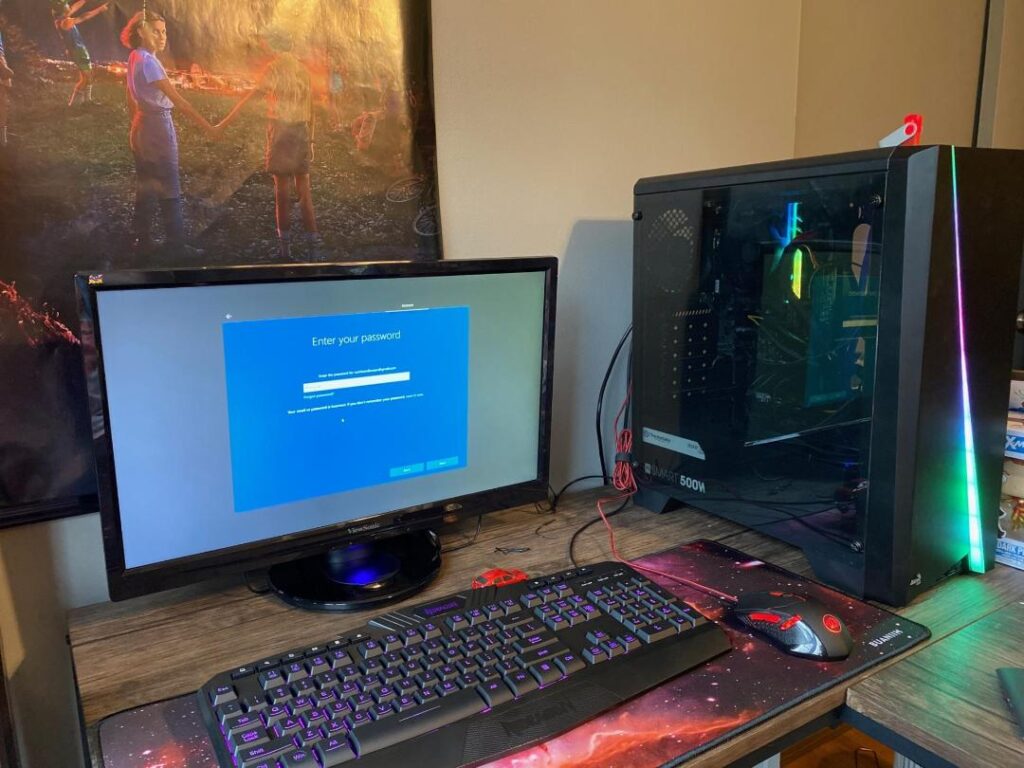
I recently started building computers again.  I quickly found that the landscape for home-built computers has changed dramatically.  In a sense, building a computer today is like building with Legos.  Pieces simply snap together with little fuss.  The parts are dependable, well-labeled, and much cheaper than they were 20 or 30 years ago.

This is the computer my nephews and I built.  We are all in isolation so we talked on the phone as Corndog and Z put this machine together.  It was their first build and things went smooth.  The only problem we had was when Corndog neglected to plug the monitor into the wall socket.  After we got that squared away, everything was fine.


I would highly encourage everyone to build their own PC rather than go to Best Buy or order one on Amazon.  The build process is simple and I guarantee you will feel a sense of satisfaction when you boot up your new machine for the first time.


Bonus Eruptus Redux! A Few Thoughts on COVID-19 Testing

Bonus Eruptus Redux! A Few Thoughts on COVID-19 Testing

SARS-CoV-2 is the virus that causes COVID-19.  For what it is worth, SARS-CoV-2 stands for severe acute respiratory syndrome coronavirus 2.  This post is not about the virus, it is about the mathematical and probabilistic problems the virus presents to those who wish to test for it.  Unfortunately, the news is not good.

The first thing that any researcher would want to know is the accuracy rates of the tests being given to the public at large.   What is the rate of false positives?  How about false negatives?  No test is 100% accurate, and some do not come close to approaching that figure.  So anyone taking a COVID-19 test is going to have some reasonable questions to ask the people administering it.

If I test positive, what’s the probability I have the virus?

If I test negative, what’s the probability that I have the virus in spite of the test results?

Two legitimate questions, don’t you think?  To answer those questions, scientists need one more piece of information to plug into the equations.  They need a really good estimate of the percentage of people taking the test who legitimately are infected.  Of those three questions, at this point in time, we don’t have a good answer for any of them.

The May 13, 2020 edition of The New York Times includes an article by Todd Haugh and Suneal Bedi,  business professors at Indiana University.  While they are not scientists, they have a strong interest in the economic aspects of getting the economy back up and running.  Here are the headlines of their article:

Just Because You Test Positive for Antibodies Doesn’t Mean You Have Them

In a population whose infection rate is 5 percent, a test that is 90 percent accurate will deliver a false positive nearly 70 percent of the time.

Yes, you read that correctly.  How good is a test if it gives us a false positive approximately 70% of the time?  Good question, isn’t it?

On 11/18/19, I wrote a short essay on the problems with mass medical testing.  Like the rest of us, I had no idea what was coming.  Replace the dreaded Bonus Eruptus with COVID-19, and you will get some insight into the problems we are all facing.  Mathematics and its close cousin Probability Theory are tyrannical in nature.  We can’t bend Mathematical Laws to our will no matter how much we would like to.  We will have to live with the inherent uncertainty of the tests being developed now and in the future.

Here is my original post.

Bonus Eruptus!

Let me begin by letting everyone know that I love The Simpsons.  The show is now in year 31, and I still look forward to each week’s episode.  I will admit that a few years in the middle of the run were pretty lean, but the show is experiencing a renaissance.  The Simpsons are back on solid footing.

Some of you may remember when Dr. Nick introduced us to Bonus Eruptus.  It was episode 21 of season 7.  The episode is entitled 22 Short Stories about Springfield, and that is exactly what transpires, 22 vignettes about the characters populating Homer’s hometown.  I think it is very clever and I have always wanted them to do more episodes like that one.  This particular episode, one of my favorites, first aired on 4/14/96.  Wow, the show has been around a long time, hasn’t it?  I will gladly take another 30 years.

During that stellar episode, Dr. Nick defined Bonus Eruptus as “a terrible condition where the skeleton tries to leap out of the mouth and escape the body.” Apparently, Grandpa Simpson had this condition, at least that was the diagnosis of the esteemed Dr. Nick Riviera.  I want to take a closer look at the mathematics behind this ostensibly severe condition.  Why?  I think that we might be able to learn a thing or two about probability theory and the inherent problems that come along with mass medical testing.

Please indulge me for a moment. Let’s all pretend that we live in Springfield USA and that Bonus Eruptus is a legitimate concern.  I know I wouldn’t want my skeleton to try to take its leave of me.

Imagine that Mayor Quimby, in a transparent attempt to get reelected, offers free, yet mandatory, testing to all the inhabitants of Springfield.  Since I have no idea how many people live there, let’s say that 10,000,000 people are living in the greater Springfield area.  I know that is more of a Capital City number but just play along, OK?  Of those, let’s say that 50,000 of them have the dreaded Bonus Eruptus.

Now let’s imagine that Bonus Eruptus is caused by a virus, one easily detectable by a simple test.  Like all tests, though, it is not perfect.  Some people who have the virus will test negative, and a certain percentage of the people who are negative will, in fact, test positive.  Imagine that the false-positive result rate is 2%.  Also, the poor people who have the virus will test positive only 95% of the time. So, the simple question is:  If someone actually tests positive, e.g., Bumblebee Man or Jeff Albertson (extra points if you know who that is), what is the probability that they actually have the terrible disease?  Think about that a while before you go on.  As you might already have guessed, the answer is not nearly as straightforward as you might think.  After all, why else would I be writing about it?

So, here we go.  Of the 50,000 people who have the virus, only 47,500 of them will actually test positive.

50,000 x .95 = 47,500

We know that 9,950,000 total people do not have it.

10,000,000 – 50,000 = 9,950,000

Of the people who do not have the virus, there will be 199,000 who will test positive anyway (the false positives).

9,950,000 x .02 = 199,000

So now, we can do some simple addition and see we come up with a total of 246,500 people who will test positive for Bonus Eruptus.

47,500 + 199,000 = 246,500

Of those, we know that only 47,500 will actually have it.  So if you test positive for the virus, there is only a 19.3% chance that you actually have Bonus Eruptus!. D’oh!

47,500 / 246,500 = 19.3%

Isn’t that interesting?  Without walking through the math, there is no way that a 19.3% chance could be seen as a reasonable possibility.

It is time for me to go.  I have to prepare for this week’s show.  I hear that Homer is going to do something stupid, and Marge is going to get upset.  I am about to burst with excitement.

The Athena Chapters: Chapter Six

Random Thoughts from a Nonlinear Mind: Volume 2: The Athena Chapters,
Chapter Six:
Nuggets of “Wisoom”

Don’t tell me he was a good writer; he had the worst penmanship I ever saw in my life.
Mel Brooks, as the 2000-year-old man, commenting on the writing ability of William Shakespeare

I have the collected works of Gary Larson sitting right on top of one of my bookshelves.  Vonnegut’s novels, Gould’s essays, and Athena’s CDs are to  be found on the shelf directly below the two massive volumes that contain Larson’s brilliant work.  The Far Side is, hands down, my favorite comic strip of all time.  Ask anyone with even a cursory interest in science what their favorite strip is, and you will get a similar answer.  I can practically guarantee that.

I, of course, loved reading The Far Side before Larson’s retirement because of the scientific themes that permeated the strip.  Many of my family and friends also loved The Far Side but for a much different reason.  Larson was fond of calling the dimwit rubes that populated his strips by a certain name, one that happens to be the same as one of my friends.  This particular name appeared in lots and lots of strips.  Sigh, he liked to name these poor slobs “Warren.”  I can’t tell you how many of those strips were cut out and sent to my friend by various smart-asses from across the country.  They knew damn well he already would have seen it, but they just couldn’t help themselves.  OK, I admit that I was the major perpetrator.

Once again, as I sit at my computer and look over at the CDs and the Larson books, I find myself reminiscing about my time at Harvard.  Maybe my incident in the swamp has something to do with it even though I have been thinking more and more about that special place the last few years.  Maybe as I approach 50, I am just getting old.  Who knows?  I think I need to get back there for a visit.  The problem is I am sure I will not want to leave.

Back when I was living in my small basement apartment outside of Cambridge, the Boston Herald and The Boston Globe both published The Far Side.  Larson took a sabbatical year in 1988, and I have just recently recovered from the cold turkey shock of no new strips of The Far Side that year.  It was always a highlight of the day to see what Larson came up with.  One day, though, disaster struck; I found myself in the middle of a very bad episode of The Twilight Zone.  I picked up the paper, looked at the strip, looked at it again, and then set the paper down.  I thought and thought and thought some more before I picked up my copy of The Boston Globe again.  I tossed the paperback down as my pulse raced, and my blood pressure spiked.  Guess what?  Horror of horrors, I had no idea what the hell the strip meant!  For the life of me, I was confused beyond all recognition.

I didn’t know what to do.  I couldn’t believe that Larson had outsmarted me.  How could that happen?  There had to be another explanation, and I had to find it.  Sure, his strips confused people all the time, but I had never had such a problem.  In fact, I was the go-to guy whenever someone else didn’t get a strip.  I can’t tell you how many times I found myself explaining what an ichthyologist or an ornithologist is to glass-eyed people who had no idea what Larson was talking about when they opened their daily paper.  It was clear to me that Larson, in this case, had obviously made some kind of grievous error.

I can’t remember exactly what happened next, but I am sure I stewed about my dilemma for weeks, maybe longer.  Search engines were a few years off, and my IBM PS/1 with its little black and white screen (and no hard drive) wasn’t going to help me at all.  I was stuck.

I eventually found out what the strip meant, and I will tell that story in a bit.  Right now, I am excited because I get to mention Umberto Eco.  He wrote The Name of the Rose, a book that was adapted into one of my favorite movies.  I mention Eco because he has a library at his house reputed to contain about 30,000 volumes.  As a master of the obvious, I can say that is one big private library.  Eco, as you might imagine, is constantly asked a certain question by his house guests, and I am sure you have guessed what it is.  The query is something along the lines of “Damn son, have you read all of those?”

In Nassim Nicholas Taleb’s The Black Swan, a book I highly recommend to everyone, Taleb talks about Eco’s unread books.  He refers to them as his antilibrary.  They are there for reference, you just never know when you might need one of them.  Taleb goes on to argue that everyone needs as big an antilibrary as they can afford.

Well, guess what?  I just went to my library/antilibrary and took down Volume 2 of The Complete Far Side.  Of course, I did this to find the strip that caused such a big ruckus all those years ago.  I made a guess as to what year the strip appeared, and I found it in ten or fifteen minutes.  I would have found it sooner, but I couldn’t help reading nearly every strip as I leafed through the big book.  I discovered that my nemesis strip appeared on 12/21/92.  Thank you for letting me know an antilibrary is a good idea Taleb, I must admit that it never occurred to me that I would one day need Larson’s strips for research purposes.  We can add that to the long and growing list of things that have never occurred to me.

The strip in question was not one with a scientific theme, that was the big reason why I didn’t get it.  The panel had four guys with pocket protectors, briefcases, and pencils doing all kinds of fancy horseback riding.  The caption simply read “Cossack accountants.”  I had no idea at all what the hell that was supposed to mean.  Do you have a clue?

I can now tell the story of how I was able to solve the riddle of this mysterious strip.  I remember one day sitting in the office of a Harvard research professor.  His name is Don, and he is a very good guy.  And luckily for me, he also has a Ph.D. in history.

I had asked many people what the strip was all about, and no one knew, I mean no one had a clue until I asked Don.  He immediately said that the Cossacks were known as excellent horsemen.  Of course, I remember him telling me, they could rape and pillage with the best of them, but they mainly went down in history for their mastery of horseback riding.  Huh, really?  I asked Don if there was any way I could have or should have known that.  He shrugged his shoulders, and I felt a sense of relief because I then knew that I was not the only poor soul who didn’t get that somewhat obscure reference.  I knew I could get some sleep that night.

So, Don had solved my problem, and I was grateful.  After his explanation, he handed me a copy of a paper he was writing.  He asked me to look it over and tell him what I thought.  I was more than happy to do that.  I’m sure you can all understand that when a Harvard faculty member asks for your opinion, that is a pretty big deal.  I leafed through the paper in his office as he told me what it was about.  It was a paper about Shakespeare; Don was trying to pin down his true identity.  The true identity of Shakespeare has been a question addressed by scholars for a long time.  To this day, there is quite a debate about who Shakespeare really was.  Many people think that there is no reasonable way that the historical Shakespeare was capable of having the inside knowledge necessary to produce all those great works.  Many scholars think that, of all people, the famous philosopher Francis Bacon is a very good candidate for being the true author.  Go ahead and google something about Shakespeare, Bacon, and true identity, and you will get a sense of the gravity of the problem.  It is quite interesting.  I don’t remember the conclusion to Don’s paper, but I do remember that he thought that there was no reasonable way that Bacon was actually Shakespeare.  Now that I give it more thought, I am pretty sure that Don argued that the historical Shakespeare was indeed the real Shakespeare.  Imagine that.

The epigraph of this essay is a line about Shakespeare from Mel Brooks’ and Carl Reiner’s 2000-year-old man sketch.  It is pretty damn funny.  I included it here simply because of the joke about Shakespeare having terrible penmanship, and that, by definition, makes him a terrible writer.  That strikes me as funny; that type of joke is right in my wheelhouse.  It is even funnier because the title of this essay should have been “Nuggets of Wisdom,” but my buddy Boss (like Shakespeare) is not a very good writer, at least by the standards of the 2000-year-old man.  In fact, his penmanship is nearly as bad as mine.  We can get to that story now.

For years I have been shaking my head and complaining to anyone who will listen about how bad our conversations are when I head out with the boys for a few beers.  All my friends are apparently, like me, masters of the obvious.  I often comment that their stellar observations should be documented to inform and educate future generations of deep thinkers.  I long ago decided that I needed to carry around a book so that I could record all their “nuggets of wisdom.”

Remarkably, one day Boss shows up at my house with a little spiral notebook labeled, in Shakespeare-like handwriting, “Nuggets of Wisoom.”  He swears up and down that is actually says “Nuggets of Wisdom,” but I see what I see.  If he gets really upset, he can type out his own damn essay.  Ha!

I just realized that I have once again reached a new low.  I am in the middle of an essay that, at least at some level, links Boss and Shakespeare.  I talked to my brother Terry the other day, and I told him that, believe it or not, I am finishing up an essay on Boss and Shakespeare.  He immediately said, “That was inevitable.  It was only a matter of time before that happened.  I know every time I look at Boss, I think of Shakespeare.”  That is really funny.  You might guess it is because both Boss and Shakespeare have both been known to wear pantaloons, but that is not the reason.  You see, Terry is one of those random smart-asses I write about now and then.  The only reasonable thing Boss and Shakespeare have in common is that they are both in this essay.  Trust me, you all would be very hard-pressed to find any other type of connection.

Now we can move along to the actual entries in my book of “wisoom.”  It will quickly become clear why I felt it was necessary to document and write about these friends of mine and their brilliant witticisms.  As you are about to see, these guys bring it strong.  Also, what follows gives rare insight into the quality of my social life here in lovely Iroquois County.  Of course, as many of you have already imagined, I have had to edit the material heavily.  I can’t even mention a large portion of it.  Those spicy entries are not included in this or any other chapter.

11 10 10 7:34 PM We were at BW3’s watching the Cavs play the Nets.  “Anthony Morrow (a player for the Nets) should have a nickname.  It should be Anthony “Bone” Morrow.” Boss.

11 10 10 7:46 PM “The other Cavs must step up in Lebron’s absence.”  Mobe.  I am totally speechless; I can’t think of a single thing to say about that.

11 10 10 8:56 PM “Twenty-year-old girls are hot.”  Mobe.

11 26 10 4:23 PM Once again at BW3’s.  This time we were watching Nebraska play Colorado in a football game.  “That guy has a big ass.”  Mobe.  Sigh and sigh again.

12 11 10 12:02 AM “Your pen name should be J. Owen Sheep.”  Boss.  I have no idea where that came from.

3 4 11 10:24PM  Ryan-Tyler is a @#$%&.  A great big ^%&*#@@ with a $#%%^&*&^% and a %^^&$#$#$ that &%%^**@@#$@.  Boss.  That comment speaks for itself.

3 4 11 10:25 PM My book says that I said that “Shawna is so pretty and amazingly perfect.”  Uh, it appears to be written in a young woman’s handwriting.  Those things happen when I forget to take my “Nuggets of Wisoom” book with me to the bathroom.  Interestingly enough, the previous comment by Boss is not in my handwriting either.

Those are the types of entries that populate my little spiral notebook.  I can feel the anticipation, can’t you?  We all know that the interesting stuff is coming up next, right?  It is time to take a look at all the advice I have received about Athena.  Most statements are not going to be attributed to a specific person.  The reasons for that might become apparent after you read the following little “nuggets of wisoom” spewed forth by various friends, acquaintances, and drunk strangers who wonder what the hell I am writing about in a dive bar at a table all by myself.  Prepare yourself for what follows even though I bet you all have a very good idea about what comes next.

“Uh, if she were interested, she would call you.”

“Give up; it is time to move on.”

“You are wasting a lot of time on a woman who isn’t even real.”  I really have no idea what that means.

“You are crazy.  You have lost your mind.”  I completely understand what that means.

“Give it up.”  I understand that, too.

“You should have given up yesterday, five months ago, a year ago.”  I was told that when I hadn’t even known Athena for a year.  I must admit that I am willing to listen to those who would argue that I don’t know Athena at all.  That sounds reasonable enough to me.

One woman, one of those random drunks that I mentioned earlier, looked at me for a long time without saying anything when I asked her what I should do.  Eventually, she gave up the following little gem:  “Has it ever occurred to you that there might be something wrong with you?”  Let me tell you how I met this person.  I was working on this essay at a local bar when a waiter walked over to my table with a check that wasn’t mine.  Two women from across the bar sent me their dinner bill.  Sigh and pffttt!  I went over to their table to ask them exactly why I should buy them their dinner.  Of course, they had no good answer.  I think they just wanted to know what I was doing all by myself with a pen and notebook.  Eventually, Phil (the same Phil from a previous essay) showed up, and we all sat together.  I told them that if they wanted me to buy their dinner, they had to eat it with me.  They were both done eating, so I got off easy.  I haven’t seen either of them since.

“It is time to give up.  She can be your muse.  Don’t dedicate your life to someone who is not reciprocating.”  My only reaction to this little nugget is a question, one posed rhetorically and hopefully answered for themselves by every single reader.1  Have you ever heard of anything more pitiful than a person who has a muse who refuses to even acknowledge them?  Feel free to let me know if you come up with something.  I am not going to hold my breath while I wait on the responses.

The most curious thing I heard was, “Your eyes are attached to your brain.”  I must admit that confuses the hell out of me.  I am at a total loss for any type of reasonable explanation.

The best response I received to my “So, is it time for me to give up?” question came from Sarah, a server at a local restaurant.  I asked her, and she said, “sure.”  Believe it or not, that response is probably close to perfect.  I learned long ago that most people are way too caught up in their own lives to worry about another person’s nonsense.  That is probably the way it should be.

It would appear that not a single person believes that I am doing myself any good by tapping out essay after essay about a person who doesn’t seem to want to even speak to me.  Their message is clear, but I bet you can all guess what my response is, can’t you?

I briefly mentioned in a previous essay that there are downsides to those powerful and inexplicable instant connections that some people are capable of experiencing.  For me, the upside is far greater than any downside I can imagine.  I am changed, I am inspired, I am in shape, and I am very tired.  Those are all good things, and they are all a direct result of me meeting Athena.  As for all the writing I have been doing, I am compelled to continue, I simply don’t have a choice.  For reasons I will never understand she continues to inspire me in a way that I never imagined possible.

Now for the bad news, and it is pretty bad.  Meeting Athena only reconfirms all the beliefs I have had about waiting for the right person.  I’m certainly not saying that Athena is the right person because it sure appears that she is not.  I would think that the right person for me would want to talk to me.  But exactly how am I supposed to settle for someone who does not inspire me or is not on the same wavelength as me when I know what the possibilities are?  I hate to say this, but deep down, everyone reading this essay will agree with me if they give it some thought.  We all know people who settled because they didn’t want to be alone.  I know lots of broke guys who don’t go out much anymore because their child support payments are so high.  How on earth did that happen?  Hell, I remember one conversation I had with a woman who admitted she had settled when she married her husband.  Incredibly, he was sitting right beside her when she said it.  I hear they are now divorced.  I am shocked to my core, how in the name of humanity did that marriage break up?

The sad bottom line is that once any person experienced what I did with Athena, it does not seem reasonable or even possible to just pick someone because they don’t smell too bad or because you are not looking forward to dying alone.  Being alone strikes me as the only reasonable alternative.  I am thinking that if everyone experienced exactly what I did when Athena introduced herself, they would all find nothing but inspiration in these essays.  Criticisms would fade to subtle admiration as they came to understand that giving up is an unimaginable, as well as a reprehensible, impossibility.  Also, if wishes were horses, beggars would ride.

Once again, we are back to that wavelength stuff.  I became convinced long ago that I was living in a very different world from the one everyone else was waking up in.  The thing is, I instantly knew Athena was occupying the same planet I was.  If she doesn’t realize that or just doesn’t care, then there isn’t any more I can do about it.  I am satisfied that I have made my position clear.  I would rest my case, but I have no idea if I am the prosecution or the defense.  Maybe I should just work toward a plea bargain while the jury is still out.

Postscript

I have been studying the mathematics behind coincidences for some time now.  There are some events that we, as human beings, think are rare occurrences that really are not.  These events are found to be quite commonplace when viewed through a mathematical lens.  Many of the essays that I write deal with this counter-intuitive nature of reality.  Look over Volume One of Random Thoughts from a Nonlinear Mind, and you will see what I mean.

Initially, I was going to end this essay without a postscript, but something just happened that we will all find curious.  I often work on these essays while listening to music or watching TV.  On this occasion, I happened to have my TV on.  An episode of the old Batman show starring Adam West was just shown.  They ended the show with a tease about the next guest villain.  I am so glad that I DVR these old episodes because the next show features a guest that I have never seen.  The next “bad guy” that tries to doom Batman and Robin is none other than Olga, Queen of the Cossacks.  They just showed a glimpse of her on her horse.  I am completely astonished.

I have never heard of this villain, but she certainly exists; at least she does in the fictional world of Batman’s Gotham City.  In the next episode of Batman, she will try to “do away” with the Caped Crusaders, but we all know she will fail miserably.  I will admit that it is quite a coincidence that this episode was previewed as I was finishing the final draft of this essay.  In my mind, though, it doesn’t come close to what happened when a certain dude met a particular chick at a punk rock show.  I am still trying to work out the mathematics of that deal.  I will be sure to let everyone know precisely when I come up with something, but I don’t think you all should be holding your breath while waiting.

Notes

Note 1.  The eighth episode of The Simpson’s seventh season is entitled  “Mother Simpson.”  I had to mention it because of the following scene between Homer, his mother, and Lisa.

Mother Simpson (singing Bob Dylan’s Blowin’ in the Wind): How many roads must a man walk down?  Before you can call him a man.
Homer: 7.
Lisa: No, dad, it’s a rhetorical question.
Homer: OK, 8.
Lisa: Dad, do you even know what “rhetorical” means?
Homer: Do I know what “rhetorical” means?

A Few Thoughts on Creating Lineups for NASCAR DFS

A Few Thoughts on Creating Lineups for NASCAR DFS

I play NASCAR DFS (daily fantasy sports) on FanDuel and DraftKings.  I don’t have a gambling jones, I started playing because I was attracted to the mathematics underlying the lineup selection process.  On DraftKings, you are tasked with picking 6 drivers per lineup; on FanDuel, it is 5.  This post is not about how to pick the right drivers to make lots of money.  I want to talk about how many possible lineups there are for an individual player to choose from.  For now, we will ignore the limitations imposed by salary caps on each site.

Back in the old days, The NASCAR Cup Series had a field of 43 cars.  There were usually more cars than that trying to qualify.  The slower entrants, not fast enough to make the field, got sent home with nary a handshake.  So, let’s say that we need a single lineup of 6 drivers for DraftKings.  Any guesses as to the number of unique lineups we have to choose from?  Go ahead…take your time.

Did you come up with 6,096,454?  Unbelievable, isn’t it?  There are over 6 million possible unique lineups to choose from.  This problem, and problems like it, are known as “n choose k” problems.  Of course, there is a handy and elegant formula for us to use.

\large \binom{n}{k}=\frac{n!}{k!\left ( n-k \right )!}

In this instance, n =  the total population to choose from and k = the number you are interested in selecting.  In our example n=43 and k=6.

Note: If you are not familiar with (!), that means factorial.  For example,

\large \! \! \! \! \! \! \! 6!=6x5x4x3x2x1\\9!=9x8x7x6x5x4x3x2x1

Get the idea?  For example, if you have 6 books (6!), there are 720 different ways to arrange them on a shelf.  What about 9 books? 9! = 362,880.  Astonishing, isn’t it?

Now we can talk about present-day NASCAR.  Recently, the fields have been at around 38 cars.  The high cost of participation and lack of sponsorship has led to the folding of many race teams.  Now our equation (38 choose 6) gives a still ridiculous answer of 2,760,681 possible lineups.  Good grief, that is still way beyond manageable.

Luckily, any competent DFS player can eliminate a bunch of drivers right at the start of their selection process.  There are cars referred to as backmarkers, these cars are too slow to compete.  It is very difficult for them to move forward through the field.  They tend to be the product of small, underfunded teams.  These cars ride around in the back of the pack, hoping to stay out of trouble as they cruise around the track in the hopes of a substantive paycheck.  For argument’s sake, let’s say there around 8 of those cars.

Now we are at n=30 and k=6.  30 choose 6 gives an answer of 593,775.  That is still a number way beyond what any human being could hope to tame.

What if you have a process whereby you can eliminate drivers based on any number of other factors?  Serious DFS players do this as a matter of course.  Imagine that you can whittle down your field of possibilities to 25 cars.  Now we have n=25 and k=6.  25 choose 6 = 177,100…still an outrageously large number.

There are more things to consider.  A person creating a DFS lineup just can’t pick any 5 or 6 drivers they want.  Each driver costs a certain amount, and there is a salary cap.  For our combinatorics problem, this creates some interesting issues, some easily solvable and others not.  As you will see, things get a lot more complicated when salary restraints are included in the equation.

On Draftkings, it is usually easy to split the cars into 3 different groups.  Let’s say that group 1 has 8 cars, of which you wish to choose 2 for each lineup you want to create.  8 choose 2 gives an answer of 28 different combinations.  Next would be a group of around 22 cars, of which 4 would be chosen.  22 choose 4 = 7315.  Now we have a total of 7343.  In practice, this number will be much larger due to the fact that it would be difficult to fit lineups under the salary cap using only those cars.  It is probable that some of the backmarkers would have to be included in the pool of eligible cars to create viable lineups.

On FanDuel, the salary cap restrictions are not nearly as severe.  If we go with all 38 cars in our pool, we get 38 choose 5, which equals 501,942.  If we use other methods to whittle the possible cars down to 30, we get 30 choose 5, which equals 142,506.

As of today, the most lineups one can enter in one contest is 150.  That is 150 out of possibilities ranging from the high thousands to the millions.  Obviously, the processes, mathematical and otherwise, that players employ to construct lineups are of utmost importance.  It is impossible to try to cover all bases, the math simply won’t allow it.


Give Me Some Space Redux!

Give Me Some Space Redux!

On 12/12/19, I posted an essay about spaces after sentences called Give Me Some Space! The other day I saw that there was a significant development in the story.  After reading about Microsoft’s decision to unilaterally “settle” the debate, I decided to update my original post.

If you use Microsoft Word, and nearly everyone does, you are about to be told how many spaces to put after a sentence.  If you only hit your spacebar once, you will happily move on to the next sentence.  If you have the gall (unmitigated or otherwise) to tap twice, Word will flag the extra space with that little red squiggle, letting you know that you have made a horrible mistake.

In recent years I have heard people talk about the power that Word has to tell its users what is and is not proper grammar.  You know what I am talking about.  Word constantly makes recommendations about grammar and spelling.  While the spelling suggestions are helpful and appreciated, what is to be said about how Word views grammar?  Every time Word tells a user that their grammar is lacking, the writer is given the “proper” way to fix it.  That is a lot of power put in the hands of programmers who may or may not be relying on sources with the best of bona fides.

Microsoft’s unilateral decision to make one space after a sentence the only correct way to proceed is a bit strange.  Why would they feel the need to chime in at all?  If they insist upon imposing their will when it comes to the use of a spacebar, you can imagine what they might be doing with their grammar algorithms.

My point is that Word is so widely used that the recommendations the program makes are bound to be accepted.  That is a lot of power for one subset of a single company to have.  Language will change based on what the people who code the program think.  Of course, I know they have advisors who are experts in language and grammar but should that group have this much power to mold the future of the written word?

As for me, I do not have an editor, so I use Grammarly.  I am glad I have it.  It points out things I might have missed, and it is always ready to tell me where commas or synonyms are needed.  It is a terrific program.  That said, I wish everyone would be mindful of what these programs are doing.  There is more than one way to write a sentence, and multiple iterations can be as acceptable as any other.

Below is my original post.  The issue of how many spaces to put after a sentence is an interesting one for old-timers who started typing long before computers were widely available.  If you didn’t read it in December, take a look at it now.  As for me, I have to dig into my Word settings, I know there must be a way to make the program leave me alone after I type my preferred two spaces.

*****

It is very difficult for old people to change their ways.
Buford Lister (personal communication)

A few years ago, I got an email from a friend of mine.  As I was reading it, I began to become irritated, then I became agitated, and then…well, I didn’t throw my computer monitor out the window, but I thought about it.  Why?  Was the content of the message that annoying and frustrating?  No, not at all.  I can’t even remember what the email was about.  What I do remember is that the author only put one space after each sentence, and I found that visual to be compact and quite disturbing.  Welcome to my world, a universe unto itself where the spacing between sentences is far more critical than the content of the text itself.

I am 57 years old, which means I grew up with typewriters; back in the day, personal computers were nothing more than a figment of somebody else’s imagination. I learned to type on an old mechanical device.  You had to push down hard on the keys to get them to strike with enough force to make an impression. Also, and this is the crucial point, everyone was taught to put two spaces between sentences.  That was how it was done, no questions asked.

Typewriters use monospaced fonts, which means that every character is given the same amount of space on the page.  An “I” and an “m” get the same area even though the “I” certainly doesn’t need or deserve it.  The use of monospacing led to a consensus that hitting the spacebar twice after a sentence was required to make it easier for the reader to see the end of one sentence and the beginning of the next.

We all know what happened, right?  Computers came along, and word processing programs started using proportional fonts, the type of fonts where an “I” gets less space on the screen, and the page, than an “m” or some other broader letter gets.  Before any of us knew what was happening, people were only hitting the spacebar once, dogs and cats were living together, and the ghost of Shakespeare was seen floating through English departments throughout college campuses worldwide.

The people who argue for one space after sentences hate, and I mean hate, to see two spaces being used anywhere.  They complain about rivers of white flowing through a passage of text.  It somehow offends them that there are still people walking the earth who prefer the two space method.   Sadly for them, I am a proud “Two-Spacer,” and I fully intend to die that way.  Hey, all you “One-Spacers,” do your worst, I am fully prepared for the onslaught.  Present the evidence in favor of your position, of which there is none.  Then sit back and behold the science supporting my position.

There was a study recently done; yes, you heard that right.  People take this stuff so seriously that someone is trying to further their academic career at a university somewhere by addressing this pressing issue.  The author of the study found that using two spaces after a sentence does increase reading speed as well as comprehension.  Take that!  Of course, the opponents say that the research must be flawed, how else could the wrong conclusion be reached.  So it goes…

I recently read a blog post somewhere about an older woman who was asking for advice about this issue.  She explained that she was too old to change, but she didn’t want her readers to think that her text was written by some sort of modern-day keyboard wielding buffoon.  So, what to do?  The reply was genius, shocking coming from a One-Spacer.  The One-Spacer said that the woman should type as she always does.  Keep right on tapping that spacebar twice, continue to do it out of habit, no worries.  When the document is complete, all she has to do is perform a search and replace.  Search for the two spaces and replace them with one space.  In one fell swoop, her document would then be acceptable for polite and sophisticated company the world over.  Not bad, right?

It is surprising (or maybe it isn’t) how worked up people get over this issue.  Lots of professional writers, as well as English professors and random commentators, take firm stances.  Their opinions are strong and unwavering.  While I much prefer two spaces, I am not going to take out a loan, purchase a tank, and go to war over it.  As for some of the others, I think they have already met with their credit unions.

Now for the big reveal, I have secretly left a trail of intrigue in this short essay.  I am conducting my own little, non-scientific study. I put two spaces after some of the sentences, and others got one space treatment.  Did you even notice?  Are you offended at this travesty?  My guess is no one noticed, but I bet you do in the future.  Once that genie escapes, they cannot be shoved back in the bottle.  Oh boy, I just used the word “they” to refer to a singular genie.  Not a bad segue to a future essay that I am finishing up now.  More on that soon enough.


Notes:  The article about spacing is entitled Are Two Spaces Better Than One? The Effect of Spacing Following Periods and Commas During Reading.  Rebecca Johnson, an associate professor at Skidmore College, led the team that conducted this outrageous and groundbreaking research.  Three cheers and a tiger for her and her colleagues, they are doing the world a service by putting those distrustful keyboard jockeys in their proper place.


Wouldn’t it be Wonderful?

Wouldn’t it be Wonderful?

In April 1989, some people thought we were on the cusp of a worldwide revolution.  Energy was about to become free for anyone who wanted it.  Third world countries were going to be able to build and power infrastructure at virtually no cost.  Pollution was going to disappear.  Even nuclear power plants were about to be shuttered.

During that time, I was at Harvard working on a graduate degree in Archaeology.  The local newspapers were busy covering the announcement from Stanley Pons and Martin Fleischmann that they had produced a nuclear reaction at room temperature.  If true, that meant that the world was about to radically change.  Imagine free energy with no resultant pollution.  Too good to be true, right?

The reason some serious people took pause is that Fleischmann was one of the world’s leading electrochemists.  He was an outstanding scientist, one to be taken seriously.  For most, though, the possibility of cold fusion was not in the realm of probability, or even possibility.

The story of how and why the experiments of Pons and Fleischmann became such big news is to be found in pure human greed.  Fleischmann wanted to publish the results from their experiments in an obscure journal.  The University of Utah, where Pons was employed as a chemistry professor, wanted to make sure all patents (and all the resultant money) found their way into the University of Utah’s coffers, where it obviously belonged.  Think of how they could upgrade their sports facilities if they got a cut every time a light bulb was clicked on or an HVAC unit was engaged.

The leaders at Utah got wind of what was happening with Pons’ research and jumped the gun by holding a press conference to announce that the world was about to change.  Energy was going to become free, the world was to be powered, and poverty was to end, due to the brilliance of the administrators at The University of Utah.  After all, they were the ones who had the foresight to hire Pons in the first place.

As I sat in my little basement apartment outside of Cambridge, I read, day after day, about cold fusion and the implications such a power source had for humanity.  Of course, most of the reports were highly dubious of Pons and Fleischmann’s claims.  That is until I started to hear whispers around campus that others had also created nuclear reactions at room temperature.

First, I heard that a group from Texas A&M had done it; they had created excess heat from a tabletop experiment.  The press release did not state the exact nature of the Pons & Fleischmann experiment, but scientists the world over were able to infer how they must have done it.  Shortly after the A&M results, a team from Georgia Tech had also replicated the results.  The Harvard campus was buzzing, especially among the nonscientists.  Everyone knew that if this were true, if nuclear reactions could be produced and sustained at room temperature, then everything about the daily lives of people throughout the world was about to radically change.

A few days later, I heard unsubstantiated claims that a group next door at MIT had also created a room temperature nuclear reaction.  Was this true?  I don’t know.  But it was an indication of the times.  People were talking about this, there was a lot of excitement in the air…until there wasn’t.

It didn’t take long for both A&M and Georgia Tech to retract their results.  Within weeks all the excitement dissipated, and hard reality took its rightful place.  Cold Fusion is, and always was, a pipe dream.

During this time, I was sitting in class when a student asked the professor what he thought about the cold fusion story.  The professor said that he was talking to lots of experts in the field, and they all reacted negatively.  They said it couldn’t be true.  He paused and then told the class that he spoke to one of his colleagues on campus, a Nobel Laureate, who told him that cold fusion was highly unlikely but if the laws of physics did allow for it: “Wouldn’t it be wonderful?”

Unlike belief in ghosts, wood nymphs, or angels, cold fusion requires immediate proof or people are going to jump off the bandwagon. Cold fusion is in bad shape, but it is not dead yet.  The Navy has a team working on it, and there are others scattered throughout the world who are still looking into it.  Why?  Those anomalous results that were popping up in 1989 are still being observed in experiments being conducted today.  The nature of those results remains a mystery.  Of course, if those results were consistently replicable, our world would be a much different place.  Unfortunately, the Laws of Physics don’t care about what we might want or need.  They are steadfast and unbreakable, just like belief in angels.


The Athena Chapters: Chapter Five

Random Thoughts from a Nonlinear Mind: Volume 2: The Athena Chapters,
Chapter Five:
Random Pulses of Bliss


Buford Lister lives in a one-dimensional world.  His universe is a straight line, a simple number line; everyone, by necessity, lives somewhere on the line.  There is nowhere else to go, nowhere else to be.  Consequently, all one needs to find someone else (or any location) on the line is a single piece of information.

He called Keira, a woman he had just met the previous evening, and invited her out to lunch.  “Sure, Buford Lister.  I would love to meet you for lunch.  Where do you want to meet?”  Buford Lister thought for a few seconds before saying, “Meet me at 7.6, I am leaving right now.”

*****

Are you keeping up with the results from the Large Hadron Collider (LHC)?  Do you even have any idea what it is?  Perhaps even more importantly, do you have any clue as to why I am starting yet another essay about Athena off with a discussion about a particle accelerator and the mini black holes that it just might create?  I didn’t think so.  Well, let’s get right to it and see if we can’t shed a little light on these dark mysteries.

The LHC is a massive particle accelerator located at CERN, a facility near Geneva, Switzerland.  About 100 countries are involved in this enormous project.  Because the facility employs about 10,000 scientists and engineers, it is the ultimate expression of big science writ large.  It probably won’t surprise you to learn that the LHC is the most complex piece of equipment human beings have ever created; yes, even more complicated than the Space Shuttle.

This machine takes beams of protons or lead ions and accelerates them to 99.9999991% the speed of light.  Why?  Simply so the beams can be smashed together to create particles that we mere mortals have never seen; particles that would have been present during the creation of the universe.  In effect, we (meaning humanity) are trying to replicate the conditions present right after the Big Bang.  That is so very cool. As you might imagine, there are all kinds of things we can learn by doing that.

You might have heard of the Higgs Boson (aka The Higgs), also unfortunately known as the God Particle.  Nobel Laureate Leon Lederman gave it that unfortunate nickname in a ploy to sell more copies of his fantastic book; a tome surprisingly called The God Particle.  Lederman has joked that he wanted to call the book The Goddamn Particle, but the publisher wouldn’t have it.  Anyway, the search for the Higgs Boson is a primary reason this machine was built.  The Higgs is the theoretical construct that gives rise to the field that gives particles their individual masses.  Think of a field the same way you think of temperature in a room; there is a value associated with any point you can pick.  As the particles pass through this proposed field, they encounter resistance.  Visualize the difference in how a marble passes through a glass of water as opposed to a glass of honey.  It is this proposed Higgs Field that theoretically gives the particles all their different masses; some pass through water, and others take the honey route.  The big problem is that we have no idea if this field exists.  And if it exists, we have no idea what it is.  As always, there is plenty of speculation.

Speaking of things that may or may not exist, let’s move on to Dark Matter and Dark Energy.  Would it surprise you to know that stuff comprised of atoms, including you and me, make up only about 5% of the universe?  We have no idea what the rest of the stuff is, but we call it Dark Matter and Dark Energy.  We know Dark Matter is there because of the gravitational fields it creates, but it does not interact with light, so we are having a hard time figuring out its true nature.  We know Dark Energy is there because the universe is still expanding from the Big Bang.  It really should have slowed down by now, but it hasn’t; in fact, the acceleration is increasing.  That strange situation is due to Dark Energy.  Hopefully, the LHC will give us a hand here, too.

*****

One day Buford Lister decided that being a point on a number line wasn’t very interesting.  He was having the type of existential crisis that only a point on a number line could have.  He gathered up many of the other points and said, “This is ridiculous, let’s take the ends of our number line and connect them to make what I call a circle!  Can you all even begin to imagine how that will change our lives?  Let your imaginations run wild and join me.  I say we do it.  Let the word ring out to all the points on the number line.  I swear we will form a circle!”

After lots of time and a tremendous amount of work, the points were able to take the ends of the number line and connect them.  They now had their circle.  Celebrations were planned even though the points felt a little ambivalent about the festivities.  Even Buford Lister admitted that he thought they would get something more out of all their work.  He was heard to tell Keira, “I surely thought I would feel different living on a circle instead of on a line, but I feel the same.”  Keira took a deep breath as she thought about the best way to break it to Buford Lister that a circle is also a one-dimensional object.  “Sweetheart,” she said, “a circle is the same as a straight number line.  You still need only one piece of information to determine the position of any point.  I’ll prove it to you, meet me at my place later tonight.  I now live at 36.84 degrees.”  The only thing that could be heard (and you had to listen really close) was a subtle “oh crap” coming out of the tiny mouth of the little point that was Buford Lister.

*****

There is one other intriguing area that the good people at the LHC are exploring, and that is the possible existence of extra dimensions.  Wow, how cool is that?  Go ahead and try to picture what a sixth or seventh spatial dimension might be.  All I can say is good luck.  Our puny three-dimensional brains have little chance of imagining what those extra dimensions might be like.

As a master of the obvious, I can confidently say that we live in a world with three spatial dimensions.  We can go up and down, back and forth, and side to side.  We can always call time the fourth dimension, which creates no problem for me.  The big issue is that contemporary theoretical physics (think Superstring Theory) suggests that there are many more dimensions other than the ones we can see.  I want you to think about where those extra dimensions might be.  Can you picture them?  The three I mentioned account for all of our freedom of movement, so where do we go from there?  I am open to suggestions, any and all.

There is a neat, short little book called Flatland: A Romance of Many Dimensions that can give us all some insight into our dimension dilemma.  It was written in 1884 by Edwin Abbott.  The characters in the book live in only two dimensions.  You can imagine what happens when a three-dimensional sphere visits.  Think about what the geometric shapes living in two dimensions would see.  Perhaps you have concluded that they would see a line as the sphere started to pass through their universe.  The line would get longer and longer until it started to shrink.  That might very well be what they would see.  I am mentioning this because it gives some sort of point of reference for us to begin a discussion of extra dimensions.  Surely, it is not going to help very much, but it is better than nothing.  At least it starts us thinking about dimensions in a bit of a different way.

I think about these dimensions a lot.  Historically, there are a couple of ways I rely on to try to amuse myself.  Actually, there are lots of ways, but I want to talk about two specific examples here.  One thing I do is I try to think about all the stuff that happened before I was born.  I have to admit that I have come up with nothing.  I have not been able to extract a single memory.  It has been 13.7 billion years from the Big Bang until now.  That is an awfully long time, and I am a bit disappointed I have no recollection of any of it.  The really bad news is that the universe seemed to do just fine without me.  If I were to give that some thought I might just get a little depressed.

The other thing I do is I try to imagine what all these other dimensions might be like.  I have made a little progress in this area, no really, I have.  I know what a four-dimensional cube looks like.  All kidding aside, I really do!  Head on over to Google and check out tesseracts.  You can also find them under hypercubes; they go by both names.  They might be the coolest thing I have ever seen.  There are strict mathematical rules that make the tesseract the proper analog to the cube just as the cube is related to the lesser dimensional square.  I have gone through the math, and it all makes perfect sense.

Crucifixion (Corpus Hypercubus), a 1954 painting by Salvador Dalí, shows the crucified Jesus hanging from an unfolded tesseract, technically called a net.  It is fascinating; it clearly takes us to a different place if we begin thinking about the possibilities presented by more than the three dimensions we are used to.  The best way I have found to think about it is that a tesseract is a four-dimensional representation in three-dimensional space just as a cube drawn on a sheet of paper is a three-dimensional object represented in two-dimensional space.

Why do physicists think that there might be more than the three dimensions of space and the one dimension of time that we are so familiar with?  One big reason is gravity.  Gravity is exceptionally weak, much weaker than all the other fundamental forces of nature.  Try this, take a small magnet, and see how easily you can lift a paper clip even though the gravitational force of the entire earth is working on keeping that tiny object on the tabletop.  That is truly extraordinary.  It is simply a contest of strength; the earth versus one small magnet, and it is no contest, the magnet wins every time.

It is the weakness of gravity that gives rise to the possibility of extra dimensions in our universe.  The string theorists claim we have 10 or 11 of them, not just the three we live in.  I am the first person to admit that is mind-bending, but the mathematics doesn’t mind those extra dimensions at all.  The equations just keep plugging away.

You know those mini black holes I mentioned earlier.  Well, guess what?  If we happen to create them, then that is going to suggest that these extra dimensions might actually exist.  Gravity is so very weak in our world, and one theory suggests this is so because it exists in all those other dimensions, and just a little bit leaks through to our normal three-dimensional world.  For mini black holes to be created, it would take some of that extra-dimensional gravity; there is simply not enough gravity in our three-dimensional world to allow that to happen.  The gravity from the extra dimensions could create mini black holes.  If we create them, then that is a clue that maybe those extra dimensions exist on something other than a physicist’s notepad.

So, who is rooting hardest for mini black holes to show up at the LHC?  Probably no one more than the famous physicist Stephen Hawking, the scientist that Homer Simpson refers to as “that wheelchair guy.”  Did you realize that Hawking has not been awarded a Nobel Prize?  His best chance at an elusive Nobel is the creation of mini black holes at the LHC.  It is that confirmation (for various technical reasons) that will get him the prize, that is, if he lives long enough for the committee to award it to him.

*****

Life was moving along nicely for the people of the circle.  Points were living full lives and,  for the most part, enjoying themselves.  That is until Buford Lister started creating another stink.  He was big enough to admit that he had erred by suggesting that the other points take the line and form it into a circle.  “I made a mistake; I should have thought more about my proposal.  If I would have listened to Keira, we wouldn’t be in this mess.  I sincerely apologize to everyone.  Now that I am older and wiser, I would like to suggest that we undo our circle and place a 90-degree bend in the middle of our line.  Keira and I have talked it over, and we are sure this will create another dimension for all of us to enjoy.  We both have no idea what it would look like or feel like, but I am convinced it is the right thing to do.  I know most of us are content living out our lives as we have, but I know there is so much more out there for us.”

There were lively public debates and serious private conferences.  You can only imagine what went on there.  Finally, the spirit of exploration won out, the circle was dismantled, and a ninety-degree bend was placed in the number line.   No one could have possibly imagined what was to happen next.  Yes, a plane was created, and every point got to live in two- dimensional space.   An X and a Y coordinate were now required to find another point.  For many years the points lived in ecstasy.  Buford Lister and Keira were hailed as heroes; schools were named after them, and Keira was asked to assume the Presidency of Plane Land.  She refused the honor; she enjoyed her life with Buford Lister too much to give it up and move into the arena of politics.  They settled into a wonderful life at X=5, Y=4, a location considered by many to be prime real estate.   She and Buford Lister were deliriously happy…for a time.

*****

I know a young man named Phil.  There are a couple of reasons why I include him in this essay.  He asked me an extremely interesting question not long ago, and my reaction conjured up all sorts of thoughts and emotions.  Also, his innocent query inspired me to tell him a story I have never told anyone before.  Now I will tell it to all of you.

Phil was on Christmas break from school when I ran into him at a local restaurant.  Now that he is away at college, he has a better appreciation for what getting an education is all about.  He knows how much time I spent in school, so he had lots to talk to me about.

He causally asked me “So, what are you still doing here?”  His question really was, “So, what the hell happened?  Weren’t you meant for something bigger and better than what you are doing?  Why are you here, in this depressing, dying town? ”  That is what he was really asking.  I took a long, deep breath before I answered him because he is one of the few people I have ever known who have the insight (and guts) necessary to ask me such a question.

He has been reading my essays, so I decided to answer his question in a way I knew he would understand.  I simply told him that I never met my “Athena” when I was younger.  I never met the woman I needed to meet.  I was never inspired; I was never introduced to the woman who would help me transcend the mundane day to day existence that we all struggle against.  I wanted to tell him that the single most difficult thing any person can do in this world is to live an inspired life when they have no inspiration.  I decided he didn’t need to hear that so I just told him that the most important thing for him was the only thing I couldn’t help him with.  I can easily help him refine his intuition and nudge and poke him toward a path that will make him examine his own life through a more critical lens, but I am at a total loss when it comes to helping him find his own “Athena,” his own source of inspiration.  It was then that I told him the story I am going to tell you.

When I was very young, a hell of a lot younger than I am now, I was having a conversation with one of my professors.  I can’t remember exactly how or why, but the conversation made its way around to Nobel Prizes.  He was talking about how an anthropologist could possibly win one, and he said it would have to be in the biological sub-discipline because that could potentially get a person one in medicine.  I mentioned that Jean-Paul Sartre was the only person to turn one down.  He didn’t know this, and he got extremely agitated.  He couldn’t understand why anyone would do that.  I defended Sartre (as if he needed my help) because I thought he had good reasons for doing what he did.  It was then that the professor sat me down and gave me a long talk on why I was never to do that, on why I was never to turn down such an honor.

My point here is that there were people who expected big things out of me.  I certainly include myself in that category.  So, what happened?  That is so easy.  Like I said before, I never found the wind beneath my wings.  I had forgotten entirely, but I now remember when I was about 20, another professor told me that what I needed more than anything was the love of a “good woman.”

Author’s Note:  When you get a degree from Harvard University, you are expected to go out into the “real world” and make a difference.  In my experience, almost everyone I met while I was there had plans to make a major contribution to humanity.  They felt it was a responsibility, a sort of cosmic obligation.  I also feel that way.  I write a lot under various pen names, and that is where my contribution is being made.  There is a novel that I am struggling to finish, that novel, if I am correct, will represent my significant gift to humanity.  My guess is everyone will have to wait until I am long gone to know the details.  I prefer to run silent and deep.

*****

One day, out of nowhere, a man showed up at Keira and Buford’s house.  He had with him a notebook full of equations and drawings.  “Hello, my name is Trey, may I come in?”  Greetings were made all around, and then it happened, Buford and Keira were introduced to an idea so radical that they remained speechless for quite some time.

In Trey’s notebook, a notebook consisting only of one long, flat page, they saw the theory, the convincing possibility that there might be more than two dimensions.  They looked at a cube, an actual cube drawn on the flat surface that was Trey’s notebook.  “You know, I am convinced that there is something more than a back and forth and a side to side,” said Trey.  “The math works; it makes perfect sense.  More than that, look at my drawing.  I call it a “square connected to a square.”  I know it is real; I just know that these things really do exist.”  Buford Lister, temporarily stunned, was finally, after some time, able to say something.  He looked at Keira and then said, “If it is true, how are we supposed to experience it?  I don’t see any way that we can go any other direction other than the X and Y that we move in now.  What exactly is this supposed to be?  Even if Trey is correct, I don’t see how it matters.  Keira, do you agree? “   Keira said nothing; she was in a deep think; a very, very deep think.

*****

I wrote in a previous essay that I was thinking of getting on with my study of Mozart.  Well, I have been doing just that.  I have ordered a bunch of video courses, bought a couple of books, and downloaded a cache of music.  The first video course I watched, Great Masters: Mozart – His Life and Music from The Teaching Company, is stellar.  Taught by Robert Greenberg, the course is very, very good.  It was the perfect place to start.

Mozart was clearly a genius, but like most everyone else, he had his unproductive periods.  This, coupled with the fact that he died so young, makes one yearn for all the unwritten music he left behind.  Greenberg mentioned an extraordinarily prolific period late in Mozart’s life that appeared to come out of the ether.  Nothing, nothing, nothing, and then (seemingly out of nowhere) an unexpected explosion.  What do you think the question was that Greenberg rhetorically posed to the class?  His dramatic pause was followed by something like this,  “So, who, besides his wife, was he running around with?”

The implication is clear; inspiration requires well, inspiration, and where is the best place to find it?  I think we all know the answer to that question.  If Mozart was suddenly creating the best work of his life, the inspiration had to come from somewhere, and the only logical place for that, for him at least, was from a woman.  I found myself laughing while I was watching that lecture.  So I guess it is not a big secret then.  People need inspiration, and there is one basic way to find it.

I offer up the following as an explanation for how and why these essays came to be.  Clearly, I have experienced an explosion of creativity since I met Athena.  The evidence is to be found on each of these pages, pages that surely never would have existed if I hadn’t decided to see that fateful rock show last summer.  That is truly astounding.  If I had met her years ago and if things were very different, I can only imagine what might have happened.  Hell, I imagine what might happen now if she would only talk to me.  It simply warps my mind.  I have only seen her once, and here I am, almost ten months later, still finding all the inspiration in the world from her.

*****

Keira finally spoke.  “He is right, Trey is right.”  She was excited.  “Buford, my dear, open your eyes.  Open them!  The third dimension is there; we just never looked for it.  It is all around us.  If I concentrate really hard, I get glimpses, tiny glimpses of it.  I can feel it; it is there!  I had spent so much time doing the math.  It never occurred to me to draw it, to see it.  I was approaching the problem the wrong way; I needed to be working visually, not mathematically.  After seeing what Trey did on paper, I am getting little pulses of “up.”  I can feel “up,” random, ethereal pulses of “up.”  It is the most incredible thing that has ever happened to me.”

As month after month went by Buford Lister became more and more worried, he knew that Keira was going to risk harm to herself by trying to find this extra dimension.  He had a bad feeling in his stomach as he gazed at her.  He knew it was already too late to try to convince her that she should just relax and think about all the bad things that might happen if she set out on an exploration of a mysterious dimension that might not even exist.  And, even worse, what if it did exist and she was able to find it?  There is no guarantee that it would be a warm, welcoming place.  It might be dangerous; it might not be a good place for a point, especially a point that Buford Lister loved so much.

One day Buford Lister, still stunned and nervous,  glanced at Keira’s notebook and saw lots and lots of math.  At the very bottom of the jumbled mess, he saw this:  a2 + b2 +c2 = d2.  He took a long pause.  His intuition, his higher self, told him, “She is a genius; you are the luckiest point alive.”  He looked at the equation for a long, long time.

“Buford Lister, my love, look up.  Up was always there; it’s just that no one ever bothered to look.  I know there is an “up,” I know it.”  Buford Lister tried his best to look “up,” but he couldn’t do it.  He strained and thought and concentrated like he never had before…and nothing.  Keira finally lit up, “I have an idea.”

*****

I am still running, I just got back from a 75-minute run, and I feel great.  My knees feel fine, and I am clearly back in shape.  I am even throwing around the possibility of another marathon in the not too distant future.

I had my yearly check-up with my doctor a couple of weeks ago.  He is also a runner, and he knows better than anyone that I really shouldn’t be able to run anymore.  He is one of the doctors who, in the past, looked at the MRI’s of my knees and then shook his head and whistled.  He asked me how the running was going, and I told him everything was fine, better than fine.  I told him I wasn’t having any problems at all.  He said that I need not question a miracle; I just need to keep running.  That is exactly what he said, and that is precisely what I heard.  I wanted to tell him my working theory on why my knees are bending again, but I just shut up and told him that I am not questioning my good fortune one bit.  If I would have told him that a chick said “I’m Athena” and that my knees immediately stopped hurting, he might have done a bit of a double-take and given me a referral, a very specific referral to a highly specialized type of doctor.

I have included this story because he used the word miracle to describe the situation with my knees.  I am not so sure I believe in miracles, but I do find it highly unusual that I was able to start running the day after I met Athena.  There are many things I find highly unusual about all this, and that is what I want to talk about next.

I have written about what I call my vibe voice.  I really have no idea what it is, but I know people who have definite opinions on the matter.  For reasons that are way too long and complicated to mention in this essay, I know many people who are very religious, highly spiritual, and even psychic.  They call the vibe voice Spirit; there is no question in their minds that the voice I hear is the same one that comes to them when they pray or meditate.  The psychics tell a very similar tale.  They talk about Spirit Guides and Angels and a whole host of other conduits that allow them to communicate with the spirit world.  I still haven’t quite figured out why such entities would want to bother with a guy like me, a totally agnostic dude trained in the sciences.  Besides, my little vibe voice is more than a bit of a smart-ass.  Remember the Avatar line from a previous essay?  I was telling the little voice to shut the hell up because I was trying to talk to Athena.  “I get it; I get it, Avatar, OK, sheesh!“  Who knows?  As usual, I am at a complete loss.

I mention my vibe voice because I heard from it again.  It was a month or so ago.  It is not like I walk around hearing a little voice all day long, I can count on one hand the number of times in my life that this has happened.  I am pausing a little because the story that follows is nearly one I did not live to tell.

 *****

Keira convinced Buford Lister that all they needed to do was bend the plane just as they had with the number line.  “If we bend the plane, we will create another dimension, we will make an “up,” and I bet you we will also make an “anti-up.”  We will have a third dimension.  All we need to do is tug and pull on the ends.  I am sure it will work.”

It did work!  By bending and pulling the points of Plane Land became the inhabitants of Square Connected to Square Land.  It was a golden era.  Now, to find any other point required three pieces of information; an X, Y, and a Z coordinate.  Simply astonishing.  Buford Lister looked at Keira and wondered what he had ever done to deserve such a brilliant partner.  He was blissful.  The only thing he could think to say was, “Keira, you amaze me.  You are the most beautiful…”  He stopped because he knew she wasn’t listening to him; she was distracted.  She was in another deep think.

*****

I have always felt that the really important days are the ones that start like any other.  They are not wedding or graduation days; they are just normal days that quickly turn abnormal.  You are about to hear about such a day.

It was very cold and snowy; the weather was not inviting at all.  It wasn’t snowing a lot, but it was snowing enough.  I was out in the woods trying to find an old fence line.  Any normal person would walk along the path of least resistance, especially in heavy woods, but I couldn’t do that.  I had to walk along the property line because I needed to find the buried fence.  I came to a swamp, and I stepped in.  I was wearing hip boots because I knew that the swamp was there from a previous visit.

I was carrying a heavy bag of equipment on my left shoulder, and I was carrying a costly GPS unit with my right.  The GPS was attached to a pole 6.5’ tall.  I was using the pole to probe ahead while I was walking.  I wanted to make sure that the swamp didn’t suddenly drop off to a depth that I might find inconvenient.  At least, that was the plan.

One second I was walking through the swamp, and the next thing I knew, I was underwater.  If I can take a moment to give some unsolicited advice, I would not recommend that one go swimming in a swamp while it is cold enough to snow.  The initial shock of the cold water took all my energy, but I had a bigger problem.  My bag got hooked on something, and I couldn’t get to the surface.  Talk about inconvenience; it was not one of my happier moments.  I somehow managed to claw myself free, and I was able to get to the surface.  That is when my problems started to mount.

I took the pole and pushed it down to try to steady myself.  I was in deep water, and I didn’t need to go under again.  I struggled for a bit until I was able to get one of my feet on to a sunken log.  I used the log as a foothold to get myself over to another log that was sticking out of the water.  I was hanging on to the second log while I was trying to figure out what I was going to do.  I noticed a beaver lodge, and I was able to get over to it.  I tried to climb on to the lodge, but I wasn’t able to.  My hip boots were full of water, I was totally drenched, and all my energy was sapped.  That is when things went from bad to worse.

I, of course, was freezing.  That is until I wasn’t.  I was rapidly losing feeling in my limbs, and the only thing I could think to do was to scream for help.  I was so tired that I had trouble making the words come out.  It didn’t matter because there was no one around to hear me.

I took the pole, and I started probing around me to see if I could figure out how to get out of the swamp, and on to the other side, it wasn’t that far, but it was far enough.  I moved around in every possible direction, and the pole never hit bottom.  I put the pole and my bag on the beaver lodge as I stood in chest-deep water and contemplated my dilemma.  I had no idea what I was going to do.

I knew I was in deep, deep trouble.  I could barely feel my limbs, and I wasn’t cold anymore.  I figured I could stay at the lodge and let hypothermia slowly kill me, I could jump in the water and risk a heart attack from the shock, or I could simply drown.  It really, really sucked.  I knew there was a chance I was going to die.

I had heard people say that their life flashed before them when they had a near-death experience.  That didn’t happen to me, but some damn interesting things did happen while I was leaning up against that lodge.  I began to think about all the stuff I have half-finished, all the books and essays that are incomplete.  I didn’t think about anything I had done. I thought about all the stuff I hadn’t done.  And yeah, guess what?

I thought about what I was going to do if I got out of there.  I thought about how damn stupid it was to be making a bucket list, no The Bucket List, when I had no idea if I was going to be around in a half-hour, or even in five minutes.  And yeah, guess what?

I thought about how long I was going to float in the swamp until my body was discovered.  I knew it was going to be a long time before someone thought it was unusual that I hadn’t called or checked in.  I knew it would be days and days and days before my dad would ask my brother, “Have you talked to Ryan-Tyler?”  It is not unusual at all for me not to go into the office; I usually work at home.  In any event, there would be no one waiting for me that night, and that meant my lifeless body was going to have plenty of time to bloat.  I wondered how much it would bloat.  I wondered if they would find me floating face up or face down.  And yeah, guess what?

We are getting close to the point in my story where I had to make a decision.  I knew I didn’t have much time left, so I did the dumbest thing I could have done.  I knew I had to leave the temporary safety of the lodge and swim if I wanted to get out of there.  So, I took a deep breath, grabbed the heavy bag of equipment and the pole, and jumped in.  You read that right; I did everything I possibly could to ensure that I would have the best chance of sinking.  I wasn’t thinking clearly at all, and there wasn’t a damn thing I could do about it.  And yeah, guess what?

I got a little angry as I about to jump in.  I was angry that there would be no one who would miss me that night; I was angry that my life might end in a smelly swamp, I had always imagined I would go out in a blaze of glory somehow involving numerous Dallas Cowboy cheerleaders; I was angry that I was angry.  And yeah, guess what?

I was really disappointed about a lot of things as well.  I was angry that I was thinking about a woman I had met only once.  I was disappointed that I was never going to get to know her.  I found it absurd that my thoughts were all about her.  That is when the little vibe voice decided to intervene.  It said if I wanted to get out of that swamp, I had to promise not to give up on her; I had to promise not to give up on Athena.  Then it told me something else; it offered up a brief message that I find extraordinary.  The funny thing is I knew immediately what the vibe voice meant.  It said, “You have to make her say no.”

[I am exhausted…I am losing feeling in my limbs…I can’t feel my left leg… I am in deep, deep trouble…I don’t want to die like this…not like this, not like this…so much to do…so much to finish…I don’t want to drown here and now…not today.]

I needed to use all my energy to keep myself afloat, I was in dire straits, and the best that my universal vibe voice could come up with is “You have to make her say no.”  With that in mind, I pushed myself away from the lodge.

[You can make it…you can make it…push the pole down as hard as you can…find the bottom…push, push, push…you can make it…you can make it…just a little further…you can make it…come on…you can make it…you can make it…fight, fight, fight…not today…not  today…you can make it….reach…lunge…deep breath…damn it all…don’t give up…real deep breath…you have to goddamn fight if you want to go home.]

“Make her say no.”  Divinely inspired words of encouragement, the words I need to paint on the walls of my office.  “Make her say no.”  The motivation for finding the strength to live another day.  “Make her say no.”  Hope and optimism spring and dance, just like cosmically inspired words on a typed page.  “Make her say no.”

I made it to the other side of the swamp and somehow found the energy to climb on to dry land.  That was not an easy thing to do.  I immediately started walking in the wrong direction, but luckily I caught myself and turned around.  I still wasn’t home, but the worst was over.  I was a half-mile or so from my Honda, and the terrain was very rough.  Also, I had to cross the stupid swamp again to get back.  I found an easy place to cross and made my way back.  I was really worried about frostbite, so I stripped naked and covered myself with a county road map.  Somehow I thought wearing a map was better than standing outside in wet clothes.  Eventually, it dawned on me that I might be warmer in the car.  I turned the ignition key, and I blasted the heat as I waited for my brother to bring me some dry clothes.

Ironically, all I had in my Honda was an extra pair of socks.  I remember bringing them with me just in case I got my feet wet.  I am, if nothing else, a man with a plan.

*****

Keira worked very hard to get her vision down on paper.  Equation after equation, dead-end after frustrating dead end.  She knew that there had to be more than the three dimensions her senses showed her.  So many problems, though, things simply were not working out.

In addition to everything else, Keira was having a difficult time adjusting to her new life.  She was excited, yet scared, by the new dimensions and all the attention it brought her.  She even, at very dark moments, wished she had never met Buford Lister.  Her life would have been so much simpler, so much better, she thought, if there were no extra dimensions.   All those damn things have done is complicate other things, she thought.

Buford Lister studied Keira’s mathematical arguments and also became convinced that there must be more dimensions than what they could see.  “Just because we can’t see something doesn’t mean it doesn’t exist” became the unofficial battle cry of the Square Connected to Square Science Institute.

*****

I called Boss and Olive, and we went out to eat, Mobe was bowling, so he missed out on a free dinner.  I told my tale, and we all had a few beers.  I was really happy to let them know what happened.  I was happy to be able to tell anyone anything.

I walked home from the restaurant, and things were as normal as can be, at least for a bit.  Then something remarkable started to happen to me, something that I have no explanation for, something that impacts my life every day.

Perhaps it is not such a surprise that I was thinking of Athena when I was in such a bad way.  She is the first human being I have ever met who I feel is on the same wavelength as me.  When I met her, I certainly wasn’t looking for someone like that; in fact, there is nothing that could have happened that would have surprised me more.  I guess, deep down, I knew it was possible to meet such a person, but I never thought it was possible for me.  Now that I give it some thought, I bet such meetings are the foundation of nearly every great story ever told.  Two people decide they are on the same wavelength, and then everyone else just stands back and watches them go.  So, what happens if only one person feels it?  Hmmm, I have no idea.

You know those warm fuzzy feelings that people get, especially when they meet someone new and they know something special is happening?  For reasons I can not comprehend, I am now getting something similar to those feelings on a constant basis.  The thing is, these warm feelings in the chest and butterflies in the stomach are not of an ordinary variety.  The warmth is of blast furnace quality, and the butterflies were, apparently, weaned on steroids.

I have felt these pulses on a consistent basis every single day since the swamp incident.  Yeah, there is some music that I listen to on my runs that intensifies the feelings, but they are there most of the time.  Also, that smile, the same one I have had for ten months, is growing larger.  It actually turns into a laugh now.

I am calling what is happening to me Random Pulses of Bliss.  Isn’t that the most remarkable thing you have ever heard?  I don’t understand it, and I don’t pretend to have any explanation.  I’ll just take my doctor’s advice and not question it.  Magically repaired knees and Random Pluses of Bliss; who knows, maybe they are an expression of the same phenomenon, maybe they originate from the same damn place. I have no idea; I will just go with it.  Even if I wanted things to change, I have no idea how I might go about doing that.

One guess is that these pulses are a little like gravity, weak in our universe but powerful in the dimensions that we can not see.  Maybe that is also where the vibe voice comes from.  Maybe dimension 7 or 8 is one of feeling, one of sensitivity and intuition.  I really don’t know, but I doubt there is an experiment that we can build, whatever the cost, that will give us any answers at all.  All I know is that my knees feel fine, and I have to come up with a playlist of my favorite music that will get me through 26.2 miles.  I can only begin to imagine how many of Athena’s songs will be on there.

As I sit here typing the pulses just keep coming.  It really is extraordinary.  I think the world might be a very different place if everyone would get these once in a while.  Perspectives and priorities might change, just a little, in the people hit with pulses like these.  It is nice to dream, isn’t it?

I just glanced out the window and noticed that the sun finally decided to make an appearance today.  I am going to try to stop laughing long enough to lace up my running shoes.

*****

One day Buford Lister looked over and said, “Keira, why must these extra dimensions be one of space?”  Keira gave this lots and lots of thought.  She tried and tried to get the mathematics to work using only the dimensions they could see, but she couldn’t do it.  Finally, in a last-ditch effort to try to understand what was going on, she let herself think of the extra dimensions as things like color, taste, and texture.  Conceptually, it worked just fine.   Mathematically, it was a very different story.

Keira decided to go for a run; she needed to clear her head.  As she got dressed, she thought back to her days in Plane Land and how no one could go for a run then.  Simply stated, there was no way to make the little rabbit hop around the great big tree.  Well, the bunny might be able to do that, but eventually, she needs to poke her head up, and no way was she ever doing that.   Consequently, there was no way to tie the laces of the running shoes; you can’t go up, over, and back under if those dimensions don’t exist.  The laces just dangled, and anyone who tried to run tripped continuously.

Keira started slowly on the beautiful running path that wove its way around the Science Institute.  She saw a figure in the distance.  Huh, she thought, another runner.  It was a bit unusual to see someone else on the path; it only happened occasionally.  Nearly everyone at the institute was into rock climbing.  They just couldn’t get enough of that newly discovered dimension known as “up.”

Keira ran up beside the other figure.  “Hi, I’m Keira,” she said.  It was nothing more than a simple snapshot of time, one that happened every day in Square Connected to Square Land.  Runners, rock climbers, artists, musicians, bakers, writers, and cowboys all lived out their lives the best they could.  Most days were like every other, but on rare occasions, the rules of physics, the equations of nature herself, were temporarily suspended for reasons unknown.  The theologians and the philosophers put a great deal of thought into why this happened, but their explanations satisfied no one.  As such, only the poets were consulted to explain what happened next.  The figure quickly glanced over and said: “Hi, I’m Ryan-Tyler.”

*****

I am at the close of another essay, and I find that I have to end this one as well with a letter.  Is this the last essay about Athena?  Who knows, maybe it is, and maybe there are fifty more to come.  Maybe I drop dead tomorrow, and maybe Athena and I are eating lunch together next week.  I have no idea.

Hi Athena,

I don’t have much to say, I really just wanted to say hi.  I do have a few more things I can add about my experience in the swamp, but those things are not for public consumption.  If you ever want to know, just ask me.

If you decide that we can go to lunch one day I do have a small request.  I know I am in no position to ask anything of you, but this is not that big a deal.  If, when we are eating, you see me reach into a pocket and pull out a small piece of paper, don’t bother to ask what it is.  If you see me take a pen and scratch off a line from the very top, you need not say a word.  Please, just smile back at me when I look up at you.

Ryan-Tyler


Why are you Looking at me that Way?

Why are you Looking at me that Way?

I have experienced some strange things during my nearly 58 years, and if I were to rank those experiences on some sort of Scale of the Bizarre, I would put Disjunctive Cognition near the top.  There is a very good chance you have also experienced this phenomenon even if you have never heard that specific phrase.

In 2001, a psychoanalyst named Mark Blechner published The Dream Frontier.  In this book, he documented case after case of people having two aspects of their cognition fail to match while they were dreaming.  This happens even though the dreamer knows that there is something wrong.  Try as they might, they can’t fix it.  What exactly is Blechner talking about?  I offer the following examples from my personal experience.

I have been posting chapters of the book I wrote about meeting Athena, the guitar player who made quite an impression on me.  I have already published six chapters about her and the fallout from meeting her.  I believe there are at least ten more to come.  This post is about a dream I had about her a couple of years after we met, this post is about my first encounter with Disjunctive Cognition.

In my dream, I was sitting in a large chair.  On my lap was an athletic African American woman with a fade haircut.  I instantly knew this woman was Athena, who, in real life, is an ultra-thin Caucasian woman with blonde hair.  Even though I knew it was Athena (I mean, I really knew it was her), I couldn’t change her appearance or get her to explain to me what was going on.  It was very, very strange.

Blechner states that my experience is commonplace among human beings in a dream state.  I certainly don’t remember ever experiencing anything like that before my dream about Athena.  For obvious reasons, I woke up very confused.  Since then, I have experienced Disjunctive Cognition in one other dream.

A few weeks ago, a young man appeared in one of my dreams.  He did not look like himself, he showed up in the guise of Justin Roiland, one of the creators of Rick and Morty, a TV show that I absolutely adore.  To complicate matters further, this young man took his own life in the recent past.  Why would I have a dream about him, especially when he was “disguised” as another person?  I have no idea.  I am left with speculation and a sense of unease.

Disjunctive Cognition is something I could probably do without.  Its strangeness is surpassed only by the disquiet I feel when experiencing it.  I don’t know what to make of it, I will simply add it to the long list of odd things I have experienced and move on.  As usual, the universe feels it is under no obligation to explain itself.


Medusa

Medusa by The WRB Project

This post is slightly different than those that have come before, this one is in multimedia form.  I wrote, directed, shot, edited, and produced the following music video.  We did everything in one take with a budget of zero.

I am making a short film called Modern Day Medusas.  The music video has clips from the film.  In a future post, I will tell the story of how I became involved in The WRB Project, what it is that we are doing, and what we hope to accomplish.  I hope that you enjoy the video.  The music is all original, written and performed by The WRB Project.  I think you will like it, give it a listen.